


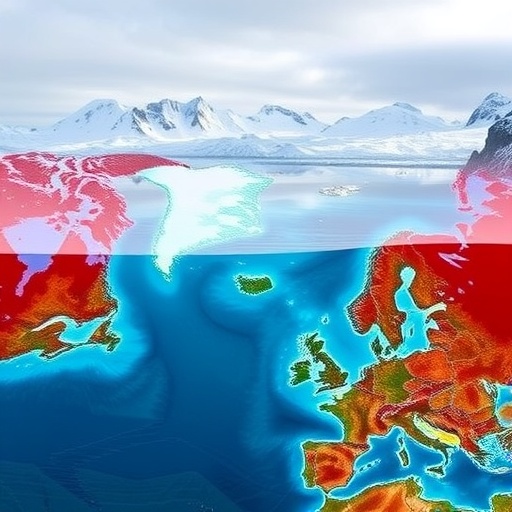
Satellite observations and climate models are converging on a surprising twist in how the Arctic “feeds” the North Atlantic. A new study reports that sea level rising and falling in the region north of Greenland can flip the routes and timing of freshwater export—reshaping the water that ultimately influences ocean circulation. Instead of a steady conveyor belt, the Arctic appears to reroute its meltwater when the balance of sea level and regional forcing changes.
Researchers focused on the North Atlantic pathway by tracking how freshwater is delivered from the Arctic to the subpolar seas. The work shows that events of sea level rise and subsequent fall north of Greenland reorganize the export, altering not only how much freshwater leaves the Arctic, but also where it enters the larger circulation system. That matters because freshwater strongly modulates the salinity and density contrasts that help drive thermohaline circulation.
Freshwater input affects the stratification of the ocean, influencing how efficiently heat is mixed downward. When salinity drops, surface waters can become lighter and form a more stable layer, which can slow deep convection. In the North Atlantic, that mechanism is tightly linked to the stability of large-scale circulation patterns that transport heat toward Europe and beyond.
The team interprets the reorganized export as a response to dynamic changes in sea level and linked hydrological processes. These shifts propagate through boundary currents and shelf-to-basin pathways, effectively changing the “plumbing” of Arctic outflow. The result is a freshwater signal that can arrive in the North Atlantic in a different configuration than it would under more uniform conditions.
A key implication is that extreme or alternating regional sea level phases may produce nonlinear impacts on climate-relevant ocean behavior. Rather than treating Greenland-adjacent conditions as background variability, the study suggests they can act as switches that reorganize freshwater delivery during pivotal periods.
By connecting regional sea level variability with Arctic-to-Atlantic freshwater transport, the findings sharpen expectations for how continued Arctic change could translate into ocean circulation shifts. In a warming world where meltwater production is increasing, the location and structure of freshwater export may be just as important as the overall volume.
The research, published in Nature Communications, therefore raises the stakes for monitoring and forecasting sea level dynamics north of Greenland. If these switches intensify, they could alter the timing and strength of stratification changes across the North Atlantic—potentially cascading into broader climate impacts.
Cite Scienmag News
Violet Maxwell. (July 15, 2026). Sea level shifts north of Greenland reroute Arctic freshwater to North Atlantic. Scienmag. https://scienmag.com/sea-level-shifts-north-of-greenland-reroute-arctic-freshwater-to-north-atlantic/
Violet Maxwell. "Sea level shifts north of Greenland reroute Arctic freshwater to North Atlantic." Scienmag, 15 July 2026, https://scienmag.com/sea-level-shifts-north-of-greenland-reroute-arctic-freshwater-to-north-atlantic/. Accessed 3 September 2026.
Violet Maxwell. "Sea level shifts north of Greenland reroute Arctic freshwater to North Atlantic." Scienmag. July 15, 2026. https://scienmag.com/sea-level-shifts-north-of-greenland-reroute-arctic-freshwater-to-north-atlantic/


