

Wednesday, July 15, 2026
Science
No Result
View All Result
  • Login
  • HOME
  • SCIENCE NEWS
  • CONTACT US
  • HOME
  • SCIENCE NEWS
  • CONTACT US
No Result
View All Result
Scienmag
No Result
View All Result
Home Science News Cancer

Mussel Protein Forms Protective Vessel Barrier, Then Disappears in Pancreatic Tumors

July 15, 2026
in Cancer
Reading Time: 2 mins read
0
Mussel Protein Forms Protective Vessel Barrier, Then Disappears in Pancreatic Tumors

Mussel Protein Forms Protective Vessel Barrier, Then Disappears in Pancreatic Tumors

65
SHARES
587
VIEWS
Share on FacebookShare on Twitter
ADVERTISEMENT

Pancreatic cancer remains among the deadliest malignancies, largely because it is detected late and is shielded by a dense tissue environment that makes efficient drug delivery difficult. Even when chemotherapy is administered intravenously, many drugs fail to reach tumors at therapeutic levels. A new study from POSTECH proposes a strategy to solve both problems at once: hiding the carrier in the bloodstream until it arrives at cancer tissue.

The platform centers on “smart” bioadhesive protein nanoparticles loaded with gemcitabine, a standard chemotherapy agent for pancreatic cancer. In conventional formulations, gemcitabine can degrade rapidly and distributes broadly, contributing to systemic side effects. Here, the researchers designed nanoparticles that remain stealthy in normal tissues while enabling targeted retention and sustained release at the tumor site.

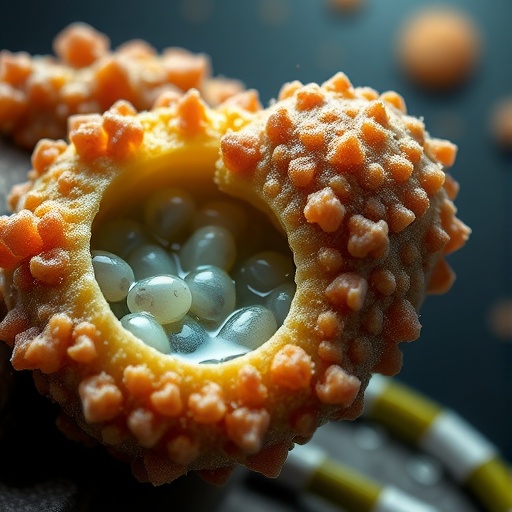
To achieve invisibility, the team mass-produced a mussel-inspired adhesive protein and converted it into nanoparticles. They then encapsulated gemcitabine within the particle core and applied a biocompatible polyethylene glycol (PEG) coating. PEG suppresses the adhesive functionality and helps the particles evade immune recognition, allowing stable circulation through the body.

The decisive component is a spatially controlled stimulus–response mechanism. The PEG layer is not removed everywhere; it is engineered to be cleaved by MMP2, an enzyme secreted at high levels in pancreatic tumor microenvironments. This creates a lock-and-key behavior: stealth persists during systemic transit, but the protective layer is shed upon encountering tumor tissue.

Once the PEG is removed, the underlying mussel-like bioadhesive protein becomes active again. The nanoparticles then bind strongly to the tumor microenvironment, improving local accumulation. That adhesion supports deeper penetration toward cancer cells and enables continuous drug release directly where it is needed most.

In an animal model of pancreatic cancer, intravenously administered stealth nanoparticles significantly outperformed conventional free drug and standard nanoparticle controls. Tumor accumulation and retention increased by more than 60%, without detectable systemic toxicity.

Importantly, treatment efficacy improved dramatically: tumor volume and weight were reduced by more than half compared with animals receiving conventional chemotherapy alone. Histological examination further confirmed widespread cancer cell death, consistent with sustained and localized dosing.

The researchers also emphasize the broader potential of this approach for other difficult solid tumors that share the relevant enzyme-rich microenvironments. With further development, the platform could become a next-generation targeted delivery system that improves benefit-to-risk ratios in systemic cancer therapy.

Subject of Research: Drug delivery nanoparticles for pancreatic cancer chemotherapy
Article Title: Stealthy systemic circulation of spatially controlled tumor microenvironment-activated bioadhesive proteinic nanoparticles for pancreatic cancer chemotherapy
News Publication Date: 18-Jun-2026
Web References: http://dx.doi.org/10.1016/j.biomaterials.2026.124384
References: 10.1016/j.biomaterials.2026.124384
Image Credits: POSTECH

Keywords: pancreatic cancer; gemcitabine; stealth nanoparticles; PEG; MMP2; tumor microenvironment; bioadhesive protein; controlled drug release; targeted chemotherapy; nanomedicine

Tags: bioadhesive mussel-inspired protein nanoparticlesdense stromal tissue in pancreatic tumorsenabling targeted drug releaseenzyme-triggered nanoparticle disassemblygemcitabine-loaded nanocarriersnanoparticle-based chemotherapy enhancementovercoming drug delivery barriers in pancreatic cancerpancreatic cancer tissuepolyethylene glycol (PEG) coating for immune evasionstealth drug delivery systemstargeted therapy for pancreatic malignanciestumor-specific stimulus response
Share26Tweet16
Previous Post

Insilico Medicine, Bora Pharmaceuticals partner on AI drug discovery and development

Next Post

KAUST Researchers Create Wearable Tech to Monitor Medicines in Real Time

Related Posts

Ulinastatin Shows Therapeutic Effects in Liver Diseases
Cancer

Ulinastatin Shows Therapeutic Effects in Liver Diseases

July 15, 2026
Discovery Paves Way for Drug Therapies for Hypopigmentation Conditions
Cancer

Discovery Paves Way for Drug Therapies for Hypopigmentation Conditions

July 15, 2026
Fred Hutch Announces 2026 Evergreen Fund Awardees
Cancer

Fred Hutch Announces 2026 Evergreen Fund Awardees

July 15, 2026
Genetic findings from tumor-prone reptile reveal clues for cancer research
Cancer

Genetic findings from tumor-prone reptile reveal clues for cancer research

July 15, 2026
Immune Ecotypes Could Account for Multiple Myeloma Outcomes Beyond Staging
Cancer

Immune Ecotypes Could Account for Multiple Myeloma Outcomes Beyond Staging

July 14, 2026
Nebraska Study Links Gut Microbe to Cancer-Fighting Immune Response
Cancer

Nebraska Study Links Gut Microbe to Cancer-Fighting Immune Response

July 14, 2026
Next Post
KAUST Researchers Create Wearable Tech to Monitor Medicines in Real Time

KAUST Researchers Create Wearable Tech to Monitor Medicines in Real Time

  • Mothers who receive childcare support from maternal grandparents show more

    Mothers who receive childcare support from maternal grandparents show more parental warmth, finds NTU Singapore study

    27656 shares
    Share 11059 Tweet 6912
  • University of Seville Breaks 120-Year-Old Mystery, Revises a Key Einstein Concept

    1061 shares
    Share 424 Tweet 265
  • Bee body mass, pathogens and local climate influence heat tolerance

    682 shares
    Share 273 Tweet 171
  • Researchers record first-ever images and data of a shark experiencing a boat strike

    546 shares
    Share 218 Tweet 137
  • Groundbreaking Clinical Trial Reveals Lubiprostone Enhances Kidney Function

    531 shares
    Share 212 Tweet 133
Science

Embark on a thrilling journey of discovery with Scienmag.com—your ultimate source for cutting-edge breakthroughs. Immerse yourself in a world where curiosity knows no limits and tomorrow’s possibilities become today’s reality!

RECENT NEWS

  • Study finds slight increased risk of sudden vision loss with GLP-1 drugs
  • One-Third of Community Health Centers Still Lack Prenatal Care Services
  • Glutathione redox imbalance linked to cognitive impairment in untreated first-episode schizophrenia
  • Megathrust tear faults trigger Omori-like earthquake doublets in subduction zones

Categories

  • Agriculture
  • Anthropology
  • Archaeology
  • Athmospheric
  • Biology
  • Biotechnology
  • Blog
  • Bussines
  • Cancer
  • Chemistry
  • Climate
  • Earth Science
  • Editorial Policy
  • Marine
  • Mathematics
  • Medicine
  • Pediatry
  • Policy
  • Psychology & Psychiatry
  • Science Education
  • Social Science
  • Space
  • Technology and Engineering

Subscribe to Blog via Email

Enter your email address to subscribe to this blog and receive notifications of new posts by email.

Join 5,146 other subscribers

© 2025 Scienmag - Science Magazine

Welcome Back!

Login to your account below

Forgotten Password?

Retrieve your password

Please enter your username or email address to reset your password.

Log In
No Result
View All Result
  • HOME
  • SCIENCE NEWS
  • CONTACT US

© 2025 Scienmag - Science Magazine

Discover more from Science

Subscribe now to keep reading and get access to the full archive.

Continue reading
