


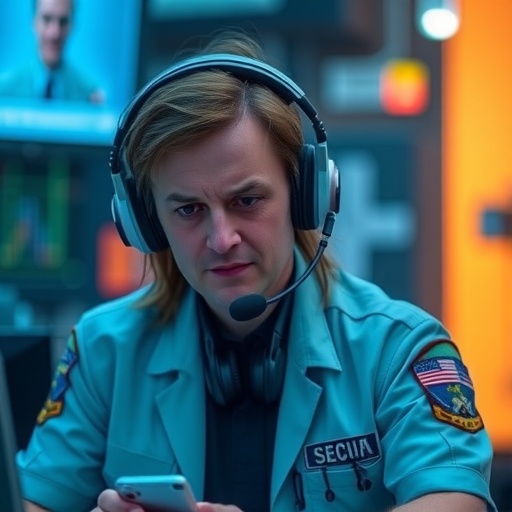
Emergency call takers and dispatchers form the invisible frontline of public safety, managing some of the most intense and life-threatening scenarios without ever witnessing their outcomes firsthand. A groundbreaking study from the University of Texas at San Antonio sheds new light on the psychological toll this critical yet often overlooked workforce endures. Using advanced natural language processing (NLP) techniques, researchers discovered that the language these workers use to recount their most harrowing calls offers early indicators of anxiety and depression.
Published in the peer-reviewed journal PLOS One, the study leverages NLP — a sophisticated branch of artificial intelligence — to analyze the emotional content embedded in the written narratives of 106 emergency communication professionals. Led by Drs. Vivian Ta-Johnson and Sandra B. Morissette, the research partner with the San Antonio Police Department and Bexar Metro 911 integrates psychology with computational linguistics to provide objective measures of mental health risk among telecommunicators.
Unlike traditional first responders, dispatchers face a unique psychological burden characterized by “indirect continuous trauma,” compounded by their lack of official first-responder status and insufficient access to wellness resources. Their stress often stems from enduring uncertainty — the inability to find closure about the fate of callers amid a relentless stream of emergencies. This phenomenon complicates their mental health landscape and calls for innovative approaches to support.
To quantify emotional reactivity, the team employed NLP tools anchored in a validated lexical database encompassing approximately 14,000 English words rated across dimensions such as valence (emotional positivity or negativity) and arousal (emotional intensity). The results revealed a striking correlation: dispatchers who used a higher proportion of negatively valenced words—terms like “blood,” “danger,” and “shoot”—experienced significantly elevated symptoms of anxiety and depression.
Interestingly, the intensity of language, or arousal, was not predictive of mental health outcomes. This highlights that while emergency call narratives are naturally charged with emotional intensity, the qualitative tone of language provides deeper insight into psychological well-being. The researchers emphasize that negative and positive word usage function independently, meaning fewer positive words do not necessarily indicate distress in this high-stress environment.
Far from diagnosing mental illness, these AI-driven linguistic markers could transform workplace wellness initiatives. Periodic, voluntary written reflections analyzed by NLP software could serve as unobtrusive early warning systems, flagging personnel who might benefit from mental health resources. Such an approach respects the stigma and operational barriers that often prevent first responders from seeking help.
Looking forward, the UTSA team is investigating whether encouraging dispatchers to frame their trauma narratives positively or in past tense can modulate emotional impact over time. They are also expanding collaborations with other police and telecommunication departments to validate and scale this technology-driven mental health support strategy.
This pioneering fusion of psychological science and artificial intelligence offers promising avenues to bolster the unseen heroes behind emergency response systems—ensuring their emotional well-being receives the attention and care it deserves.
Cite Scienmag News
Glenn Wilkins. (July 14, 2026). Word Choice Linked to Depression and Anxiety in 911 Dispatchers, Study Finds. Scienmag. https://scienmag.com/word-choice-linked-to-depression-and-anxiety-in-911-dispatchers-study-finds/
Glenn Wilkins. "Word Choice Linked to Depression and Anxiety in 911 Dispatchers, Study Finds." Scienmag, 14 July 2026, https://scienmag.com/word-choice-linked-to-depression-and-anxiety-in-911-dispatchers-study-finds/. Accessed 3 September 2026.
Glenn Wilkins. "Word Choice Linked to Depression and Anxiety in 911 Dispatchers, Study Finds." Scienmag. July 14, 2026. https://scienmag.com/word-choice-linked-to-depression-and-anxiety-in-911-dispatchers-study-finds/


