


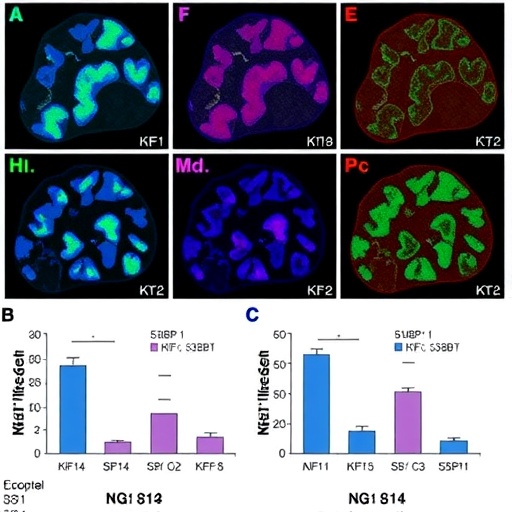
A groundbreaking study has unveiled a novel molecular mechanism that could revolutionize treatment strategies for one of the most challenging subtypes of medulloblastoma, a common pediatric brain tumor. Researchers have identified that silencing the gene KIF14 not only halts tumor cell proliferation but also significantly enhances the cancer cells’ sensitivity to chemotherapy. This pivotal discovery hinges on the regulation of 53BP1, a crucial DNA damage response protein, through its spatial dynamics within the cell.
Medulloblastoma is a heterogeneous disease classically divided into molecular subgroups, with the non-WNT/non-SHH subgroup representing a particularly aggressive form that lacks targeted therapies. The new research delves into the intricate interplay between KIF14, a kinesin motor protein traditionally associated with mitotic processes, and 53BP1, a pivotal mediator in the DNA repair pathway. By modulating the nucleocytoplasmic shuttling of 53BP1, KIF14 effectively controls the DNA damage response and by extension, the survival capacity of cancer cells under chemotherapeutic assault.
The study demonstrates that KIF14 silencing leads to an increased accumulation of 53BP1 in the nucleus, which intensifies the DNA damage signaling cascade. Enhanced nuclear retention of 53BP1 activates a potent checkpoint that impedes the proliferation of medulloblastoma cells by orchestrating an effective repair mechanism or triggering apoptosis upon overwhelming DNA damage. Importantly, this nuclear accumulation makes tumor cells more vulnerable to chemotherapeutic agents, suggesting a synergistic potential for KIF14-targeted therapies combined with conventional treatment.
This discovery was facilitated through a series of in vitro experiments using patient-derived medulloblastoma cell lines, alongside advanced imaging techniques tracking the intracellular localization of 53BP1. The authors employed RNA interference to specifically silence KIF14 expression, observing a concomitant shift of 53BP1 from the cytoplasm into the nucleus. This shift was correlated with a significant decrease in cell proliferation rates and an enhanced response to DNA-damaging chemotherapy drugs.
What sets this study apart is its illumination of nucleocytoplasmic trafficking as a regulatory layer in tumor biology, a relatively underexplored dimension in cancer therapy. The manipulation of protein localization dynamics offers a fresh avenue for therapeutic intervention, one that could circumvent some of the limitations posed by genetic and epigenetic heterogeneity in tumors.
While KIF14 has been previously implicated in various cancers, its precise functional relevance in medulloblastoma and its role in modulating 53BP1 localization introduces a novel biomolecular axis for clinical investigation. Future research could explore the development of small molecule inhibitors or RNA-based therapeutics targeting KIF14 to potentiate chemotherapy efficacy and improve patient outcomes.
The implications of this work extend beyond medulloblastoma, as the nucleocytoplasmic shuttling of DNA repair proteins is a fundamental process in cancer cells’ survival strategies. Targeting such mechanisms may herald a paradigm shift in oncology, focusing on subcellular protein dynamics rather than solely genetic mutations.
This discovery paves the way toward personalized medicine approaches tailored for non-WNT/non-SHH medulloblastoma patients, providing hope for improved prognosis in this notoriously difficult-to-treat cancer subtype.
Fang, H., Xu, T., Wen, W. et al. KIF14 silencing suppresses cell proliferation and enhances chemosensitivity by modulating 53BP1 nucleocytoplasmic shuttling in non-WNT/non-SHH medulloblastoma. Cell Death Discov. (2026). https://doi.org/10.1038/s41420-026-03252-2
Cite Scienmag News
Nathaniel Bowman. (July 14, 2026). KIF14 silencing boosts chemosensitivity by altering 53BP1 in medulloblastoma. Scienmag. https://scienmag.com/kif14-silencing-boosts-chemosensitivity-by-altering-53bp1-in-medulloblastoma/
Nathaniel Bowman. "KIF14 silencing boosts chemosensitivity by altering 53BP1 in medulloblastoma." Scienmag, 14 July 2026, https://scienmag.com/kif14-silencing-boosts-chemosensitivity-by-altering-53bp1-in-medulloblastoma/. Accessed 4 September 2026.
Nathaniel Bowman. "KIF14 silencing boosts chemosensitivity by altering 53BP1 in medulloblastoma." Scienmag. July 14, 2026. https://scienmag.com/kif14-silencing-boosts-chemosensitivity-by-altering-53bp1-in-medulloblastoma/


