

Tuesday, July 14, 2026
Science
No Result
View All Result
  • Login
  • HOME
  • SCIENCE NEWS
  • CONTACT US
  • HOME
  • SCIENCE NEWS
  • CONTACT US
No Result
View All Result
Scienmag
No Result
View All Result
Home Science News Chemistry

New Tick-Borne Viruses Evade Human Immune System Defense Mechanisms

July 14, 2026
in Chemistry
Reading Time: 2 mins read
0
New Tick-Borne Viruses Evade Human Immune System Defense Mechanisms

New Tick-Borne Viruses Evade Human Immune System Defense Mechanisms

65
SHARES
587
VIEWS
Share on FacebookShare on Twitter
ADVERTISEMENT

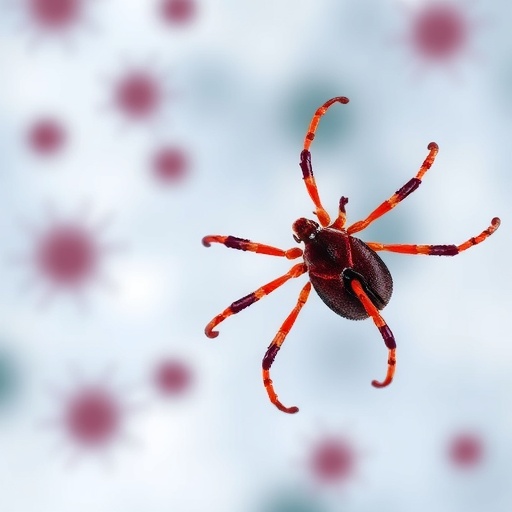
Warmer climates are contributing to the increased activity of ticks, notorious vectors for diseases like Lyme disease and Rocky Mountain spotted fever. However, a less well-known but emerging threat lies in a distinct group of tick-borne pathogens known as nairoviruses. These viruses can provoke severe fever and compromised organ function following tick bites. Recent research published in ACS Infectious Diseases sheds light on the sophisticated mechanisms nairoviruses employ to evade the human immune system, with significant implications for surveillance and public health preparedness.

In this study, Scott Pegan, along with his colleagues, explores how nairoviruses circumvent the host’s innate defenses. A notable example of this family is the Crimean-Congo hemorrhagic fever virus (CCHFV), a pathogen with a high fatality rate posing a global threat, particularly to civilians and military personnel in endemic areas across Africa, the Middle East, and Asia. Understanding the immune evasion strategies of such viruses is critical for developing effective countermeasures and improving biosurveillance capabilities.

Nairoviruses produce a specialized enzyme—an ovarian tumor domain-containing protease—that selectively cleaves ubiquitin and ISG15 molecules attached to human proteins. Ubiquitin and ISG15 modifications typically function as alarm signals to the immune system, marking infected cells for destruction. By removing these small protein tags, nairoviruses render themselves invisible to host defenses, enabling uninterrupted replication and pathogenesis.

The investigators analyzed enzymatic activity from four different nairovirus species: three recently identified orthonairoviruses isolated from patients in Asia and an additional virus known as Pacific Coast tick nairovirus (PCTNV) found in ticks but not yet confirmed in human infections. Their assays revealed that the PCTNV enzyme exhibited the highest efficiency in cleaving ubiquitin and ISG15 from human proteins, suggesting a superior ability to suppress immune detection compared to its counterparts.

Given that PCTNV is transmitted by a tick species known to bite humans and capable of carrying other diseases such as Rocky Mountain spotted fever, these findings raise concerns about potential human exposure risks, especially along the U.S. West Coast. This highlights the urgent need for vigilance, not only regarding tick bites themselves but also concerning the species of ticks involved, as they may harbor previously unrecognized pathogens.

Expanding on this work, Pegan’s team collated ubiquitin cleavage data from 13 nairovirus species to train computational models aimed at distinguishing pathogenic viruses from less harmful ones. This represents a promising avenue toward automated biosurveillance systems capable of real-time detection and risk assessment of emerging tick-borne viruses.

Overall, this study emphasizes the complex interplay between nairoviruses and human immune defenses and underscores the importance of integrated molecular and computational approaches to tackle the growing threat of these stealthy viral pathogens.


Subject of Research: Immune evasion mechanisms of nairoviruses, a class of tick-borne viruses
Article Title: How an emerging class of tick-borne viruses escape human immune defenses
News Publication Date: 13-Jul-2026
Web References: http://dx.doi.org/10.1021/acsinfecdis.6c00320

Keywords

Viruses, Nairoviruses, Tick-borne pathogens, Immune evasion, Ubiquitin, ISG15, Protease, Biosurveillance

Tags: climate change and tick activityCrimean-Congo hemorrhagic fever virusemerging tick-borne pathogensnairovirus enzyme functionsnairoviruses immune evasion mechanismspublic health implications of tick-borne virusestick-borne disease surveillancetick-borne virus pathogenicitytick-borne virusesubiquitin and ISG15 modificationviral immune system evasion strategieszoonotic virus transmission
Share26Tweet16
Previous Post

China’s water quality improvements impact agricultural productivity negatively

Next Post

Space launch costs may drop over 90% by 2040, revolutionizing space market

Related Posts

Programmable Arene Ring Opening Enables Diverse Phenol Synthesis
Chemistry

Programmable Arene Ring Opening Enables Diverse Phenol Synthesis

July 14, 2026
Sensitive SWCNT Pyroelectric Phototransistors for Broadband Infrared Detection at Room Temperature
Chemistry

Sensitive SWCNT Pyroelectric Phototransistors for Broadband Infrared Detection at Room Temperature

July 14, 2026
3D-Printed Contact Lenses Made in Just 20 Minutes
Chemistry

3D-Printed Contact Lenses Made in Just 20 Minutes

July 14, 2026
Acidic Cross-Linking Boosts One-Bath Dyeing of Polyester-Cotton Blends
Chemistry

Acidic Cross-Linking Boosts One-Bath Dyeing of Polyester-Cotton Blends

July 14, 2026
New Catalytic Method Converts Polystyrene Waste into Pure Toluene
Chemistry

New Catalytic Method Converts Polystyrene Waste into Pure Toluene

July 14, 2026
New Catalytic Method Converts Polystyrene Waste into Pure Toluene Efficiently
Chemistry

New Catalytic Method Converts Polystyrene Waste into Pure Toluene Efficiently

July 14, 2026
Next Post
Space launch costs may drop over 90% by 2040, revolutionizing space market

Space launch costs may drop over 90% by 2040, revolutionizing space market

  • Mothers who receive childcare support from maternal grandparents show more

    Mothers who receive childcare support from maternal grandparents show more parental warmth, finds NTU Singapore study

    27656 shares
    Share 11059 Tweet 6912
  • University of Seville Breaks 120-Year-Old Mystery, Revises a Key Einstein Concept

    1061 shares
    Share 424 Tweet 265
  • Bee body mass, pathogens and local climate influence heat tolerance

    682 shares
    Share 273 Tweet 171
  • Researchers record first-ever images and data of a shark experiencing a boat strike

    546 shares
    Share 218 Tweet 137
  • Groundbreaking Clinical Trial Reveals Lubiprostone Enhances Kidney Function

    531 shares
    Share 212 Tweet 133
Science

Embark on a thrilling journey of discovery with Scienmag.com—your ultimate source for cutting-edge breakthroughs. Immerse yourself in a world where curiosity knows no limits and tomorrow’s possibilities become today’s reality!

RECENT NEWS

  • Iron’s Crucial Role in Shaping Major Upper Ocean Mesoplankton Size
  • Sensory Nerves Shape Neonatal Mouse Mouth for Suckling and Vocalization
  • Palliative Care Consultation Influences Neonatal End-of-Life Care Use
  • Word Choice Linked to Depression and Anxiety in 911 Dispatchers, Study Finds

Categories

  • Agriculture
  • Anthropology
  • Archaeology
  • Athmospheric
  • Biology
  • Biotechnology
  • Blog
  • Bussines
  • Cancer
  • Chemistry
  • Climate
  • Earth Science
  • Editorial Policy
  • Marine
  • Mathematics
  • Medicine
  • Pediatry
  • Policy
  • Psychology & Psychiatry
  • Science Education
  • Social Science
  • Space
  • Technology and Engineering

Subscribe to Blog via Email

Enter your email address to subscribe to this blog and receive notifications of new posts by email.

Join 5,146 other subscribers

© 2025 Scienmag - Science Magazine

Welcome Back!

Login to your account below

Forgotten Password?

Retrieve your password

Please enter your username or email address to reset your password.

Log In
No Result
View All Result
  • HOME
  • SCIENCE NEWS
  • CONTACT US

© 2025 Scienmag - Science Magazine

Discover more from Science

Subscribe now to keep reading and get access to the full archive.

Continue reading
