


A groundbreaking study reveals a transformative approach to fabricating polyamide (PA) desalination membranes by harnessing the often-overlooked realm of interfacial rheology. Fluid interfaces featuring dynamic compositions and complex microstructures have long been known to exhibit intricate rheological behaviors, which directly influence numerous chemical and biological phenomena. Researchers have now demonstrated how tuning the mechanical properties at the water–oil interface dramatically governs the polymerization process that underpins PA membrane formation.
Traditionally, interfacial polymerization results in membranes with heterogeneous morphologies, limiting their efficiency in water purification applications. This latest research circumvents these limitations by employing photoreactive amphiphiles to precisely modulate the rheological properties—especially viscosity—at the two-dimensional interface where polymerization occurs. By controlling these parameters, they effectively steer the development of patterned fluid instabilities, which ultimately define the membrane’s surface architecture.
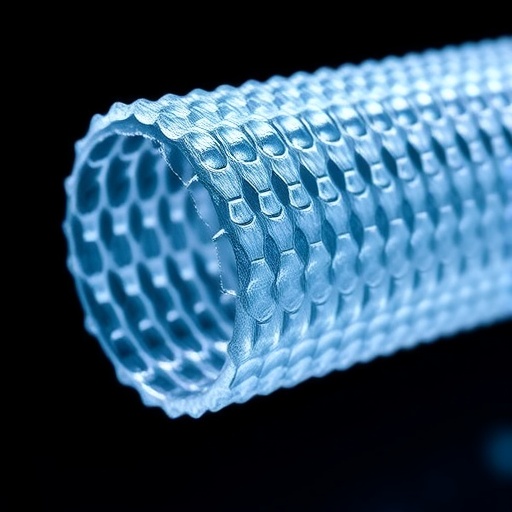
Through methodical experimentation, the team revealed a robust correlation between the effective interfacial viscosity and the resultant length scales of membrane features. Specifically, altering the interfacial viscosity allowed for the creation of macroscopically uniform hollow-ridged structures on the membrane surface. This morphology not only enhances the membrane’s structural integrity but also optimizes its filtration capabilities, offering a compelling example of physics-informed materials engineering.
The advanced PA membranes fabricated through this approach exhibit exceptional nanofiltration performance. Strikingly, they achieve up to 99.8% rejection of sodium sulfate (Na₂SO₄), a challenging salt to filter, while delivering a high water permeance rate of 44.15 liters per square meter per hour per bar. These performance metrics approach or exceed benchmarks set by current state-of-the-art membranes, highlighting the practical utility of manipulating interfacial dynamics.
Furthermore, the researchers demonstrated the scalability of this technique by successfully producing membranes at the module scale without any loss of performance. This scalability is critical for transitioning from laboratory prototypes to real-world industrial fabrication, where consistent membrane morphology and function are imperative.
Beyond desalination, this physics-based strategy unlocks new possibilities for controlled membrane manufacturing in a variety of applications, ranging from wastewater treatment to selective molecular separations. By leveraging interfacial rheology—a property often overlooked in conventional membrane science—this work opens a frontier for fine-tuning membrane microstructures with unprecedented precision.
As global demands for sustainable and efficient water purification technologies grow, innovations like this will be crucial. This study not only elucidates fundamental aspects of fluid interface behavior but also translates those insights into tangible advances in membrane science, paving the way for next-generation filtration materials.
Cite Scienmag News
Denise Maddox. (July 13, 2026). Advancing Polyamide Desalination Membranes with Interfacial Rheology Techniques. Scienmag. https://scienmag.com/advancing-polyamide-desalination-membranes-with-interfacial-rheology-techniques/
Denise Maddox. "Advancing Polyamide Desalination Membranes with Interfacial Rheology Techniques." Scienmag, 13 July 2026, https://scienmag.com/advancing-polyamide-desalination-membranes-with-interfacial-rheology-techniques/. Accessed 3 September 2026.
Denise Maddox. "Advancing Polyamide Desalination Membranes with Interfacial Rheology Techniques." Scienmag. July 13, 2026. https://scienmag.com/advancing-polyamide-desalination-membranes-with-interfacial-rheology-techniques/


