


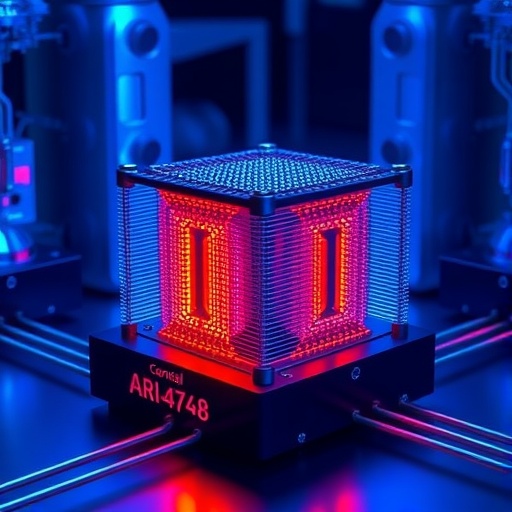
In a groundbreaking advancement merging quantum mechanics with thermodynamics, researchers at Aalto University have constructed the world’s first superconducting quantum heat engine. This tiny yet sophisticated device operates inside a superconducting circuit, bringing the age-old concept of heat engines into the quantum realm. By harnessing the unique properties of superconducting qubits and quantum refrigerators, the team has demonstrated an innovative Otto cycle, a thermodynamic process fundamental to many classical engines.
At the heart of this quantum engine lies a transmon qubit, a central component in many quantum computing architectures. Unlike conventional heat engines that require distinct hot and cold sources, this quantum heat engine employs a single, quantum-circuit refrigerator capable of acting as both heat source and sink. Tunable on demand, this element controls heat flow at an unprecedented quantum scale, allowing the engine to cyclically produce measurable positive work from minuscule ultracold energy fluctuations.
This experimental setup is a significant leap forward, proving that quantum thermodynamics can be engineered with precision in superconducting systems. The researchers designed their engine to operate near absolute zero inside a cryostat, carefully orchestrating microwave pulses that manage the cyclic Otto process. By monitoring the quantum state of the transmon, they showed direct evidence of work extraction—a feat that had long eluded quantum engineers.
The implications of this breakthrough extend beyond the laboratory. Autonomous quantum heat engines could help overcome significant challenges faced by the burgeoning quantum computing industry. Presently, high-qubit quantum computers rely on millions of costly microwave cables for qubit control and readout, cables that also introduce noise and complexity. Integrating heat engines capable of operating independently on-chip promises to drastically simplify these systems, reducing costs and improving stability.
Finland’s ambitious Quantum Technology Strategy foresees quantum computers with thousands of logical qubits on the horizon, demanding vast physical qubit arrays. Innovations like this superconducting quantum engine pave the way to meet such demands by minimizing external control infrastructure. The technology could enable quantum processors to perform essential functions such as qubit readout autonomously at cryogenic temperatures, bypassing the noisy transition to room temperature electronics.
This pioneering research was led by Academy Professor Mikko Möttönen and first author Tuomas Uusnäkki. Their paper detailing the construction and operation of the cyclic quantum heat engine was published in Nature Communications on July 13, 2026. Utilizing the state-of-the-art facilities at OtaNano, Finland’s national infrastructure for nano and quantum tech, the team demonstrated a clear proof of concept for a new class of quantum devices melding thermodynamics with quantum information science.
As quantum technologies continue to evolve, this fusion of quantum physics and thermodynamics may unlock novel functionalities and efficiencies. This development stands as a milestone indicating not only the feasibility of quantum heat engines but also their potential to reduce technological barriers in scaling future quantum computing systems.
Keywords
Quantum heat engine, superconducting circuits, transmon qubit, quantum thermodynamics, Otto cycle, quantum refrigerator, quantum computing, cryogenic technology, autonomous quantum devices
Cite Scienmag News
Katie Riggs. (July 13, 2026). First Superconducting Quantum Heat Engine Paves Way for Bigger Quantum Computers. Scienmag. https://scienmag.com/first-superconducting-quantum-heat-engine-paves-way-for-bigger-quantum-computers/
Katie Riggs. "First Superconducting Quantum Heat Engine Paves Way for Bigger Quantum Computers." Scienmag, 13 July 2026, https://scienmag.com/first-superconducting-quantum-heat-engine-paves-way-for-bigger-quantum-computers/. Accessed 4 September 2026.
Katie Riggs. "First Superconducting Quantum Heat Engine Paves Way for Bigger Quantum Computers." Scienmag. July 13, 2026. https://scienmag.com/first-superconducting-quantum-heat-engine-paves-way-for-bigger-quantum-computers/


