

Friday, July 10, 2026
Science
No Result
View All Result
  • Login
  • HOME
  • SCIENCE NEWS
  • CONTACT US
  • HOME
  • SCIENCE NEWS
  • CONTACT US
No Result
View All Result
Scienmag
No Result
View All Result
Home Science News Chemistry

Blue Light and Chemistry Simplify Complex Drug Production Steps

July 10, 2026
in Chemistry
Reading Time: 2 mins read
0
Blue Light and Chemistry Simplify Complex Drug Production Steps

Blue Light and Chemistry Simplify Complex Drug Production Steps

65
SHARES
587
VIEWS
Share on FacebookShare on Twitter
ADVERTISEMENT

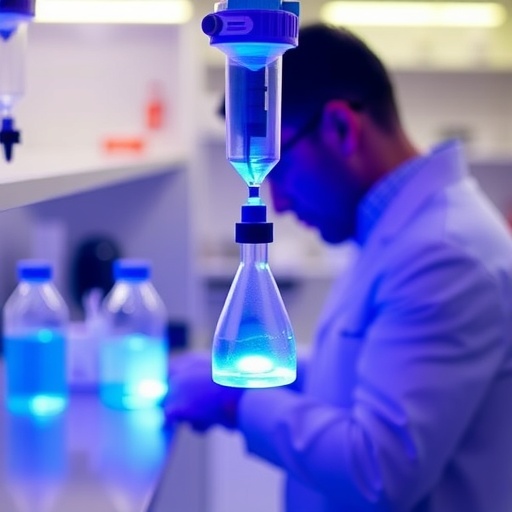
In the quest for faster and more efficient drug discovery, researchers have uncovered a novel method to enhance molecular complexity using a surprisingly straightforward tool: blue LED light. A recent study led by chemists from the University at Buffalo reveals that visible blue light can activate a catalyst to modify drug-relevant molecules in ways previously unattainable, streamlining the synthesis of complex, three-dimensional structures critical for modern pharmaceuticals.

Traditional organic synthesis often relies on carbon-halogen bonds as starting points to introduce functional groups onto drug molecules. Typically, modifications occur only at the carbon atom bonded to the halogen, limiting structural diversity in a single reaction step. However, the University at Buffalo team employed blue LED light to initiate a photocatalytic process that transiently converts these molecules into more reactive intermediates. This innovative activation allows chemists to simultaneously alter two adjacent carbon atoms instead of just one, effectively doubling the molecular modifications achieved per step.

This breakthrough exploits relatively mild visible light conditions, avoiding the harshness of ultraviolet radiation commonly used in photochemistry, which can degrade sensitive organic compounds. The blue LEDs power discrete “Buffalo boxes” — custom-built compartments outfitted to precisely control light exposure — leading to efficient catalyst activation and targeted chemical transformations. Such gentle conditions ensure greater control and preservation of the delicate molecular architecture necessary for drug candidates.

By enabling vicinal disubstitution through alkene radical cation generation, the method facilitates the incorporation of additional functional groups directly adjacent to existing substituents. This capability offers medicinal chemists a powerful strategy to rapidly build molecular complexity, which is vital for improving drug potency and selectivity. The ability to introduce multiple changes in fewer synthetic steps promises to reduce both time and cost in the drug development pipeline.

The potential applications extend beyond the current study, with the research team planning collaborations with pharmaceutical companies to tailor this photocatalytic approach toward specific therapeutic targets. The goal is to accelerate the creation of novel drugs capable of addressing challenging medical conditions through more precise molecular design.

This pioneering research highlights the untapped potential of visible light in catalysis and drug synthesis, showcasing how simple, commercially available tools can revolutionize complex organic transformations. As the pharmaceutical industry continuously seeks faster routes to innovative drugs, this visible-light mediated technique may become a cornerstone of future medicinal chemistry.

Subject of Research:
Not applicable

Article Title:
Vicinal disubstitution of alkyl C–X synthons via alkene radical cation generation

News Publication Date:
9-Jul-2026

Web References:
http://dx.doi.org/10.1126/science.aef0766

Image Credits:
Meredith Forrest Kulwicki/University at Buffalo

Keywords

Drug development, Photochemical reactions

Tags: blue LED light-driven chemical reactionsblue light-mediated functional group modificationscustom photoreaction chambersinnovative drug discovery methodsmild photochemical reaction conditionsmolecular complexity enhancement in pharmaceuticalsmulti-site molecular modificationsphotocatalysis in drug synthesisphotochemical activation of catalystsstreamlined drug molecule synthesissustainable photochemistry in pharmaceutical developmentvisible light activation in organic chemistry
Share26Tweet16
Previous Post

UCSF Study Finds Rapid Rise in Breast Cancer Among Asian American Women

Next Post

Soil Type Influences Impact of Carbon and Nitrogen on Nitrous Oxide Emissions

Related Posts

New Discovery Promises Brighter, More Energy-Efficient Digital Displays
Chemistry

New Discovery Promises Brighter, More Energy-Efficient Digital Displays

July 10, 2026
New Crystalline 3D Frameworks Linked by Spiroborates Developed
Chemistry

New Crystalline 3D Frameworks Linked by Spiroborates Developed

July 10, 2026
IBEC Joins Major European Grant on Living Matter Physics
Chemistry

IBEC Joins Major European Grant on Living Matter Physics

July 10, 2026
Innovative Ligand Design Enhances Nanocluster Catalyst Activity
Chemistry

Innovative Ligand Design Enhances Nanocluster Catalyst Activity

July 10, 2026
New Fluorescent Sensor Quickly Detects Pesticide Phoxim Visually
Chemistry

New Fluorescent Sensor Quickly Detects Pesticide Phoxim Visually

July 10, 2026
Advances in NASICON Cathodes: Structure, Electrochemistry, and Stability Explored
Chemistry

Advances in NASICON Cathodes: Structure, Electrochemistry, and Stability Explored

July 10, 2026
Next Post
Soil Type Influences Impact of Carbon and Nitrogen on Nitrous Oxide Emissions

Soil Type Influences Impact of Carbon and Nitrogen on Nitrous Oxide Emissions

  • Mothers who receive childcare support from maternal grandparents show more

    Mothers who receive childcare support from maternal grandparents show more parental warmth, finds NTU Singapore study

    27656 shares
    Share 11059 Tweet 6912
  • University of Seville Breaks 120-Year-Old Mystery, Revises a Key Einstein Concept

    1061 shares
    Share 424 Tweet 265
  • Bee body mass, pathogens and local climate influence heat tolerance

    682 shares
    Share 273 Tweet 171
  • Researchers record first-ever images and data of a shark experiencing a boat strike

    546 shares
    Share 218 Tweet 137
  • Groundbreaking Clinical Trial Reveals Lubiprostone Enhances Kidney Function

    531 shares
    Share 212 Tweet 133
Science

Embark on a thrilling journey of discovery with Scienmag.com—your ultimate source for cutting-edge breakthroughs. Immerse yourself in a world where curiosity knows no limits and tomorrow’s possibilities become today’s reality!

RECENT NEWS

  • Han directs new $15M NIH center for organ-on-chip technology
  • Stress-Coping Traits Influence Fat Tissue Function and Metabolic Resilience
  • FMR1 Gene Therapy Rescues Fragile X Syndrome Traits in Mice
  • AGA Introduces Nigel, AI Assistant for Gastroenterology and Hepatology

Categories

  • Agriculture
  • Anthropology
  • Archaeology
  • Athmospheric
  • Biology
  • Biotechnology
  • Blog
  • Bussines
  • Cancer
  • Chemistry
  • Climate
  • Earth Science
  • Editorial Policy
  • Marine
  • Mathematics
  • Medicine
  • Pediatry
  • Policy
  • Psychology & Psychiatry
  • Science Education
  • Social Science
  • Space
  • Technology and Engineering

Subscribe to Blog via Email

Enter your email address to subscribe to this blog and receive notifications of new posts by email.

Join 5,146 other subscribers

© 2025 Scienmag - Science Magazine

Welcome Back!

Login to your account below

Forgotten Password?

Retrieve your password

Please enter your username or email address to reset your password.

Log In
No Result
View All Result
  • HOME
  • SCIENCE NEWS
  • CONTACT US

© 2025 Scienmag - Science Magazine

Discover more from Science

Subscribe now to keep reading and get access to the full archive.

Continue reading
