


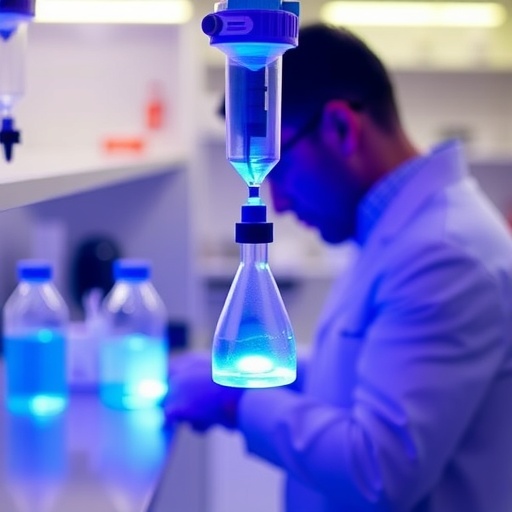
In the quest for faster and more efficient drug discovery, researchers have uncovered a novel method to enhance molecular complexity using a surprisingly straightforward tool: blue LED light. A recent study led by chemists from the University at Buffalo reveals that visible blue light can activate a catalyst to modify drug-relevant molecules in ways previously unattainable, streamlining the synthesis of complex, three-dimensional structures critical for modern pharmaceuticals.
Traditional organic synthesis often relies on carbon-halogen bonds as starting points to introduce functional groups onto drug molecules. Typically, modifications occur only at the carbon atom bonded to the halogen, limiting structural diversity in a single reaction step. However, the University at Buffalo team employed blue LED light to initiate a photocatalytic process that transiently converts these molecules into more reactive intermediates. This innovative activation allows chemists to simultaneously alter two adjacent carbon atoms instead of just one, effectively doubling the molecular modifications achieved per step.
This breakthrough exploits relatively mild visible light conditions, avoiding the harshness of ultraviolet radiation commonly used in photochemistry, which can degrade sensitive organic compounds. The blue LEDs power discrete “Buffalo boxes” — custom-built compartments outfitted to precisely control light exposure — leading to efficient catalyst activation and targeted chemical transformations. Such gentle conditions ensure greater control and preservation of the delicate molecular architecture necessary for drug candidates.
By enabling vicinal disubstitution through alkene radical cation generation, the method facilitates the incorporation of additional functional groups directly adjacent to existing substituents. This capability offers medicinal chemists a powerful strategy to rapidly build molecular complexity, which is vital for improving drug potency and selectivity. The ability to introduce multiple changes in fewer synthetic steps promises to reduce both time and cost in the drug development pipeline.
The potential applications extend beyond the current study, with the research team planning collaborations with pharmaceutical companies to tailor this photocatalytic approach toward specific therapeutic targets. The goal is to accelerate the creation of novel drugs capable of addressing challenging medical conditions through more precise molecular design.
This pioneering research highlights the untapped potential of visible light in catalysis and drug synthesis, showcasing how simple, commercially available tools can revolutionize complex organic transformations. As the pharmaceutical industry continuously seeks faster routes to innovative drugs, this visible-light mediated technique may become a cornerstone of future medicinal chemistry.
News Publication Date:
9-Jul-2026
Web References:
http://dx.doi.org/10.1126/science.aef0766
Keywords
Drug development, Photochemical reactions
Cite Scienmag News
Bethany Barker. (July 10, 2026). Blue Light and Chemistry Simplify Complex Drug Production Steps. Scienmag. https://scienmag.com/blue-light-and-chemistry-simplify-complex-drug-production-steps/
Bethany Barker. "Blue Light and Chemistry Simplify Complex Drug Production Steps." Scienmag, 10 July 2026, https://scienmag.com/blue-light-and-chemistry-simplify-complex-drug-production-steps/. Accessed 4 September 2026.
Bethany Barker. "Blue Light and Chemistry Simplify Complex Drug Production Steps." Scienmag. July 10, 2026. https://scienmag.com/blue-light-and-chemistry-simplify-complex-drug-production-steps/


