


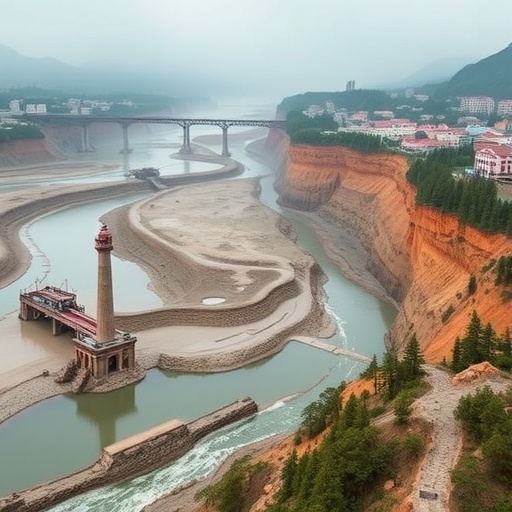
A recent study published in Communications Earth & Environment reveals a stark reality underlying water use in Northern China: despite apparent improvements driven by climatic changes, the region’s water crisis remains predominantly fueled by human activities. This groundbreaking research, led by Gao, Huang, Bi, and colleagues, dissects the complex interplay between natural and anthropogenic factors affecting water resources in one of the world’s most water-stressed regions.
Northern China has long grappled with water scarcity, impacting agriculture, industry, and urban populations. Traditionally, fluctuations in precipitation and temperature patterns were thought to be the primary drivers of changes in water availability. However, this new analysis challenges that notion by showing that gains in water supply attributed to recent climate variations are insufficient to offset the extensive pressures exerted by population growth, economic development, and intensive land use.
The team employed a combination of hydrological modeling and observational data spanning multiple decades to isolate the respective impacts of climate variability and human water consumption. Their findings indicate that while climate-driven increases in precipitation have moderately enhanced water availability in some parts of the region, these benefits are overwhelmingly outweighed by escalating water withdrawals for agriculture, industry, and domestic use. Such withdrawals have led to groundwater depletion, reduction in river flow volumes, and deterioration of water quality.
One of the technical highlights of the study is the integration of satellite-based remote sensing with ground-level hydrological measurements. This approach enabled the researchers to provide a high-resolution temporal and spatial assessment of water resources, unmasking hidden declines in groundwater levels that are not immediately apparent from surface water data alone. The results underscore the critical role of groundwater overexploitation as a key contributor to the ongoing water crisis.
Furthermore, the analysis revealed that policy measures aimed at water conservation have yet to achieve significant impacts due to the scale and pace of anthropogenic pressures. The authors argue that reliance on natural climatic gains to alleviate water stress is misguided and may foster complacency among policymakers and stakeholders. Instead, effective management strategies must prioritize reducing human water demand through technological innovation, improved irrigation efficiency, and stricter regulation of industrial water use.
The study’s implications extend beyond Northern China, serving as a cautionary tale for other arid and semi-arid regions confronting similar environmental challenges. With climate change expected to increase the unpredictability of water resources globally, disentangling the effects of natural and human factors is essential for developing resilient water management frameworks.
By highlighting the dominance of anthropogenic drivers over climatic influences in shaping water availability, this research advocates for urgent, coordinated action to curb unsustainable water use. Without such measures, the fragile gains induced by climate variability will remain little more than a temporary reprieve, masking an escalating crisis beneath the surface.
In summary, the findings of Gao and colleagues illuminate a critical but often overlooked dimension of water security: the need to address human impacts directly rather than relying on the uncertain benefits of climate variation. This study marks a pivotal step toward redefining water policy priorities in Northern China and beyond.
Gao, R., Huang, Z., Bi, P. et al. Climate-driven gains fail to mask the anthropogenic water crisis in Northern China.
Commun Earth Environ (2026). https://doi.org/10.1038/s43247-026-03802-7
Cite Scienmag News
Sloane Callahan. (July 10, 2026). Climate Change Cannot Hide Human-Caused Water Crisis in Northern China. Scienmag. https://scienmag.com/climate-change-cannot-hide-human-caused-water-crisis-in-northern-china/
Sloane Callahan. "Climate Change Cannot Hide Human-Caused Water Crisis in Northern China." Scienmag, 10 July 2026, https://scienmag.com/climate-change-cannot-hide-human-caused-water-crisis-in-northern-china/. Accessed 3 September 2026.
Sloane Callahan. "Climate Change Cannot Hide Human-Caused Water Crisis in Northern China." Scienmag. July 10, 2026. https://scienmag.com/climate-change-cannot-hide-human-caused-water-crisis-in-northern-china/


