


In July 2024, the balloon-borne solar observatory Sunrise III embarked on a groundbreaking six-and-a-half-day mission across the stratosphere, journeying from the northernmost tip of Sweden to Canada’s Northwest Territories. During this high-altitude flight—approximately 35 kilometers above Earth—Sunrise III captured over 200 terabytes of unprecedented solar data. This vantage point allowed the observatory to bypass atmospheric disturbances that usually hinder ground-based telescopes, enabling continuous, high-resolution observations extending over several hours.
Sunrise III focused on a crucial 2,000-kilometer-thick solar layer encompassing both the photosphere—the visible surface of the Sun—and the adjacent chromosphere above it. These regions exhibit dynamic interactions between hot plasma, fluctuating magnetic fields, and waves, which govern some of the Sun’s most violent outbursts, including solar flares and particle ejections that impact space weather. This mission delivered an unparalleled view of these phenomena in action.
One of Sunrise III’s significant achievements was capturing an M5.3-class solar flare in exquisite detail. Utilizing TuMag, a magnetograph instrument designed to isolate specific wavelengths and polarization states of sunlight, scientists could discern the complex magnetic field structures and subtle changes within the photosphere and chromosphere during the flare. This data sheds light on how small-scale magnetic rearrangements in the chromosphere influence the development and intensity of solar flares.
The mission also revolutionized our understanding of solar oscillations. Previously, acoustic waves—produced by turbulent plasma flows—were observed primarily just above the Sun’s surface. Thanks to Sunrise III’s sensitivity, researchers traced these waves’ propagation throughout the entire photosphere and chromosphere, revealing intricate interactions with local magnetic fields. This deepened insight is crucial to comprehending energy transfer processes within the Sun’s atmosphere.
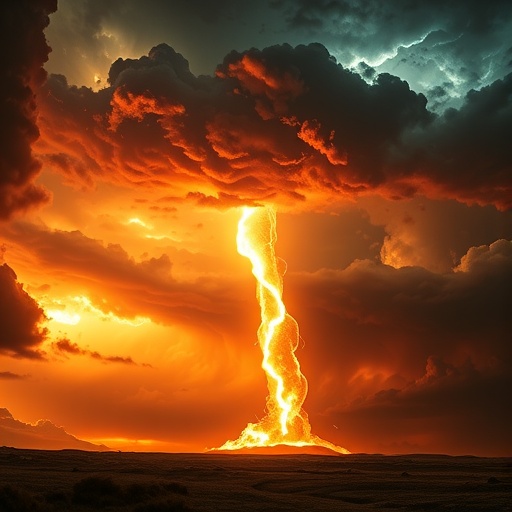
Additionally, Sunrise III challenged long-held assumptions regarding the Sun’s magnetic field. Rather than possessing a simple and orderly structure, magnetic field lines in quiet solar regions were found to twist and intertwine, creating fine-scale magnetic “tornadoes.” These structures govern plasma flows in the chromosphere and hint at previously unknown mechanisms for solar energy dissipation.
Equipped with a one-meter primary mirror telescope and three high-tech instruments—SUSI (ultraviolet spectropolarimeter), TuMag (magnetograph), and SCIP (infrared spectropolarimeter)—the observatory captured images with astonishing spatial resolution, revealing features as small as 50 kilometers across. By observing in a broad wavelength range from ultraviolet to infrared, Sunrise III provided comprehensive spectral data inaccessible to terrestrial observatories due to the Earth’s atmospheric absorption, especially in the ultraviolet domain.
Sunrise III’s successful observation campaign not only opens new frontiers in solar physics but also sets the stage for years of data analysis and discovery. As the mission continues to yield new insights, it promises to deepen our understanding of solar dynamics and their far-reaching effects on the heliosphere and Earth’s space environment.
Keywords
Sun, solar flare, photosphere, chromosphere, magnetic field, solar oscillations, solar tornadoes, solar observatory, stratospheric balloon, Sunrise III
Cite Scienmag News
Bethany Barker. (July 10, 2026). Solar Oscillations, Flares, and Tornadoes Unveiled by Scientists. Scienmag. https://scienmag.com/solar-oscillations-flares-and-tornadoes-unveiled-by-scientists/
Bethany Barker. "Solar Oscillations, Flares, and Tornadoes Unveiled by Scientists." Scienmag, 10 July 2026, https://scienmag.com/solar-oscillations-flares-and-tornadoes-unveiled-by-scientists/. Accessed 4 September 2026.
Bethany Barker. "Solar Oscillations, Flares, and Tornadoes Unveiled by Scientists." Scienmag. July 10, 2026. https://scienmag.com/solar-oscillations-flares-and-tornadoes-unveiled-by-scientists/


