

Thursday, July 9, 2026
Science
No Result
View All Result
  • Login
  • HOME
  • SCIENCE NEWS
  • CONTACT US
  • HOME
  • SCIENCE NEWS
  • CONTACT US
No Result
View All Result
Scienmag
No Result
View All Result
Home Science News Medicine

Exploring Advanced Methods for Drug Delivery Systems

July 9, 2026
in Medicine
Reading Time: 2 mins read
0
Exploring Advanced Methods for Drug Delivery Systems

Exploring Advanced Methods for Drug Delivery Systems

65
SHARES
587
VIEWS
Share on FacebookShare on Twitter
ADVERTISEMENT

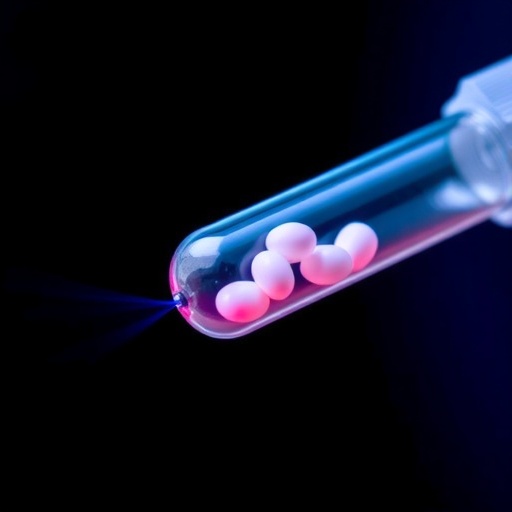
In a groundbreaking advancement for targeted drug delivery, an international team of scientists has successfully combined asymmetric-flow field-flow fractionation (AF4) with small-angle neutron scattering (SANS) for the first time. This novel approach, demonstrated on the Institut Laue-Langevin’s D11 instrument, allows unprecedented insight into the structural intricacies of lipid-based nanoparticles designed for efficient therapeutic delivery.

Targeted drug delivery relies heavily on nanoparticles to transport medication directly to diseased cells or specific organs, minimizing side effects and boosting treatment efficacy. Key factors influencing delivery success include the nanoparticle’s size, shape, internal organization, and batch uniformity. Traditional characterization methods often fall short in providing comprehensive nanoscale detail, especially about internal structures, essential for understanding how drugs are encapsulated and released.

AF4 is widely used to separate particles by size in solution, facilitating determination of size distributions. However, it does not reveal much about shape or inner architecture. Previously, AF4 was combined with small-angle X-ray scattering (SAXS) to probe particle morphology. The latest breakthrough enhances this capability by integrating SANS—leveraging the unique interaction of neutrons with matter, particularly their sensitivity to hydrogen and deuterium atoms. This contrast mechanism enables researchers to distinguish specific components inside nanoparticles by selectively substituting hydrogen with deuterium, a feat challenging for X-ray methods alone.

The research team utilized AF4 coupled simultaneously to multi-angle light scattering and SANS, allowing simultaneous fractionation and detailed scattering analysis. This multidimensional data gives not only size and shape information but also reveals the homogeneity of internal structures and spatial location of drug molecules within nanoparticles at sub-10-nanometer resolution. These insights are vital for optimizing nanoparticle design for controlled drug release and stability.

One major experimental hurdle was the dilution of samples inherent to AF4 fractionation, which weakens scattering signals and can lengthen experiments. The team introduced an innovative compensation technique that selectively focused detection on nanoparticle-enriched fractions, enhancing measurement efficiency and accuracy without compromising sample integrity.

Prof. Albena Lederer of the Leibniz Institute for Polymer Research Dresden highlights the significance: “Coupling AF4 with SANS represents a leap forward in nanoparticle characterization, enabling extraction of complementary information from minute sample amounts. This multidetection approach is poised to revolutionize biomedical polymer research and guide next-generation drug delivery system design.”

As targeted therapeutics become more sophisticated, precise characterization of delivery vehicles is paramount. The demonstrated AF4-SANS platform opens new avenues for biomedical research using neutron scattering, offering unparalleled detail that can drive innovations in nanomedicine and ultimately improve patient outcomes.

Subject of Research: Not applicable
Article Title: Structural Profiling of Lipid Nanoparticles at Sub-10 nm Resolution via AF4 Coupled Online to SAXS and SANS
News Publication Date: 30-Mar-2026
Web References: http://dx.doi.org/10.1002/smtd.70639
Image Credits: Small Methods (2026)
Keywords: Drug delivery systems, Nanomaterials, Pharmaceuticals, Neutrons

Tags: advanced techniques combining AF4 and SANSasymmetric-flow field-flow fractionation for nanoparticle separationbatch uniformity and reproducibility in nanomedicinecontrast variation using hydrogen/deuterium in nanoparticlesinnovative methods for therapeutic nanoparticle analysisintegration of AF4internal nanoparticle architecture insightslipid-based nanoparticles for drug transportnanoparticle size and shape influence on drug deliverynanoscale internal organization of drug carrierssmall-angle neutron scattering for structural analysistargeted drug delivery nanoparticle characterization
Share26Tweet16
Previous Post

Economic Analysis Backs Naldemedine for Opioid Constipation in Cancer Care

Next Post

New Tool Accelerates Discovery of 2D Quantum Materials

Related Posts

AI system automates biomedical research workflows to enhance efficiency
Medicine

AI system automates biomedical research workflows to enhance efficiency

July 9, 2026
Unraveling Human Cell Fate to Create Stem Cell-Derived Islets
Medicine

Unraveling Human Cell Fate to Create Stem Cell-Derived Islets

July 9, 2026
Global Change Threatens the World’s Forests and Their Knowledge
Medicine

Global Change Threatens the World’s Forests and Their Knowledge

July 9, 2026
Unified Vision-Language Model Advances Neuroblastoma Precision Oncology and Biomarker Prediction
Medicine

Unified Vision-Language Model Advances Neuroblastoma Precision Oncology and Biomarker Prediction

July 9, 2026
Portable Cd-109/CZT KXRF System Measures Bone Lead Exposure in Field
Medicine

Portable Cd-109/CZT KXRF System Measures Bone Lead Exposure in Field

July 9, 2026
Cognitive-Motor Interference and Brain Links in Parkinson’s Disease Explored
Medicine

Cognitive-Motor Interference and Brain Links in Parkinson’s Disease Explored

July 9, 2026
Next Post
New Tool Accelerates Discovery of 2D Quantum Materials

New Tool Accelerates Discovery of 2D Quantum Materials

  • Mothers who receive childcare support from maternal grandparents show more

    Mothers who receive childcare support from maternal grandparents show more parental warmth, finds NTU Singapore study

    27656 shares
    Share 11059 Tweet 6912
  • University of Seville Breaks 120-Year-Old Mystery, Revises a Key Einstein Concept

    1061 shares
    Share 424 Tweet 265
  • Bee body mass, pathogens and local climate influence heat tolerance

    682 shares
    Share 273 Tweet 171
  • Researchers record first-ever images and data of a shark experiencing a boat strike

    546 shares
    Share 218 Tweet 137
  • Groundbreaking Clinical Trial Reveals Lubiprostone Enhances Kidney Function

    531 shares
    Share 212 Tweet 133
Science

Embark on a thrilling journey of discovery with Scienmag.com—your ultimate source for cutting-edge breakthroughs. Immerse yourself in a world where curiosity knows no limits and tomorrow’s possibilities become today’s reality!

RECENT NEWS

  • Satellites Track Penguin Poo Color to Reveal Climate Change Impact
  • Doctors struggle to learn from experiences that challenge AI recommendations
  • Genome Editing in Rats Advances Accurate ER+ Breast Cancer Models
  • Quantum optics could transform rare visual effects into innovative eye exams

Categories

  • Agriculture
  • Anthropology
  • Archaeology
  • Athmospheric
  • Biology
  • Biotechnology
  • Blog
  • Bussines
  • Cancer
  • Chemistry
  • Climate
  • Earth Science
  • Editorial Policy
  • Marine
  • Mathematics
  • Medicine
  • Pediatry
  • Policy
  • Psychology & Psychiatry
  • Science Education
  • Social Science
  • Space
  • Technology and Engineering

Subscribe to Blog via Email

Enter your email address to subscribe to this blog and receive notifications of new posts by email.

Join 5,146 other subscribers

© 2025 Scienmag - Science Magazine

Welcome Back!

Login to your account below

Forgotten Password?

Retrieve your password

Please enter your username or email address to reset your password.

Log In
No Result
View All Result
  • HOME
  • SCIENCE NEWS
  • CONTACT US

© 2025 Scienmag - Science Magazine

Discover more from Science

Subscribe now to keep reading and get access to the full archive.

Continue reading
