


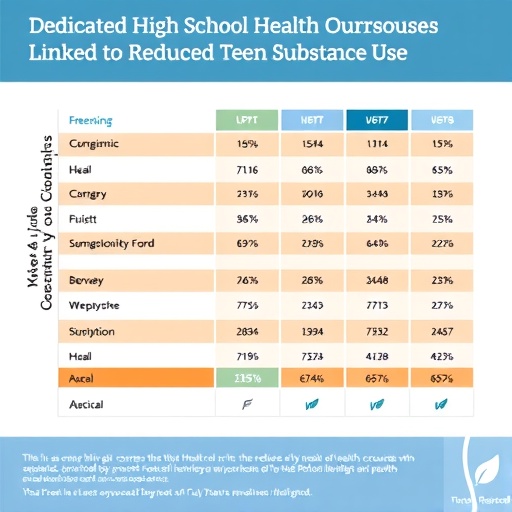
In a comprehensive cohort study targeting California’s public high schools, researchers have uncovered compelling evidence that sustained access to dedicated health education courses correlates with a modest yet significant reduction in adolescent substance use. This large-scale investigation utilized longitudinal data to explore the influence of consistent health curriculum availability on various patterns of substance use among teenagers, providing a fresh perspective on preventive strategies within educational settings.
The study, conducted over several academic years, emphasizes the critical role schools play as a frontline in public health intervention. By embedding dedicated health courses that span multiple years and maintain continuous presence in the curriculum, schools create an environment conducive to imparting essential knowledge regarding the risks associated with substance use. The findings highlight that when these courses are sustained, students are less likely to engage in behaviors such as smoking, binge drinking, and illicit drug consumption.
Methodologically, the research team employed a cohort design, tracking student behaviors and health course availability to draw robust associations while controlling for confounding variables often present in observational studies. This rigorous approach enhances the reliability of the conclusions and sets a precedent for future studies aiming to evaluate educational interventions through a public health lens.
The implications of this study are twofold. Firstly, it validates the hypothesis that education—specifically, well-structured health coursework—can be a scalable and effective component of substance use prevention frameworks. Secondly, it challenges policymakers and educators to prioritize sustained health education funding and implementation as a strategic investment in youth health outcomes.
Interestingly, the reduction in substance use prevalence associated with dedicated health classes was marked as modest but consistent, underscoring that prevention efforts in schools should be part of a multifaceted approach. While the health courses alone may not eradicate adolescent substance use, they contribute significantly to lowering the incidence rates, which, when scaled, can yield substantial public health benefits.
Furthermore, this research adds to the growing body of evidence supporting preventive medicine initiatives that intersect with the educational system. It suggests that school-based programs can efficiently reach a broad demographic, making them an invaluable tool in promoting human health and behavioral change during formative years.
The study’s lead author, Brennan Davis, PhD, highlights the potential for these findings to inform national policy and school curricula, advocating for increased integration of consistent health education. By doing so, schools could serve not only as academic institutions but also as vital agents in improving adolescent health trajectories.
Published in JAMA Network Open, this study invites further investigation into the optimal content, duration, and pedagogical methods of health courses that yield the greatest preventive impact. The current results support expanding access to these courses and suggest that their sustained delivery is key.
As substance use continues to pose a significant challenge among adolescents, this research provides a hopeful avenue for mitigation through educational reinforcement. It underscores the importance of continuous, dedicated health education as a strategic lever to enhance public health on a population scale.
Cite Scienmag News
Leah Spencer. (July 9, 2026). Dedicated High School Health Courses Linked to Reduced Teen Substance Use. Scienmag. https://scienmag.com/dedicated-high-school-health-courses-linked-to-reduced-teen-substance-use/
Leah Spencer. "Dedicated High School Health Courses Linked to Reduced Teen Substance Use." Scienmag, 9 July 2026, https://scienmag.com/dedicated-high-school-health-courses-linked-to-reduced-teen-substance-use/. Accessed 4 September 2026.
Leah Spencer. "Dedicated High School Health Courses Linked to Reduced Teen Substance Use." Scienmag. July 9, 2026. https://scienmag.com/dedicated-high-school-health-courses-linked-to-reduced-teen-substance-use/


