


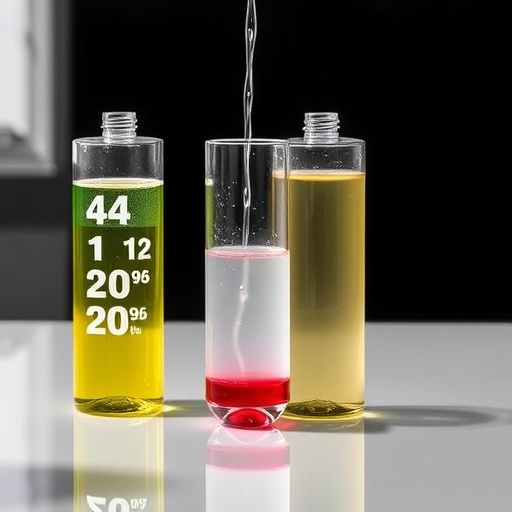
In a groundbreaking advance in lithium metal battery technology, researchers have unveiled a novel electrolyte design that significantly enhances the stability and longevity of high-energy cells. Ether-based electrolytes have long been favored for lithium metal electrodes due to their ability to form stable solid-electrolyte interphases; however, their performance in high-voltage full cells has been limited by accelerated oxidative decomposition during charging cycles. This new study introduces a carefully engineered single-phase gradient solvation electrolyte that mitigates these challenges, paving the way for more durable and energy-dense lithium metal batteries.
Traditional ether-based electrolytes face a critical hurdle during the charging process. As lithium ions are released from the cathode, the solvents and anions must desolvate to accommodate ion transport. This dynamic desolvation intensifies oxidative breakdown of the electrolyte and perpetuates continuous consumption of electrolyte components, which in turn degrades the solvation structure and undermines redox stability over extended cycling. The result is a progressive decline in battery performance and lifespan.
To counteract these issues, the research team developed an innovative approach by incorporating a targeted ligand anti-solvent (TLAS) into an anion-rich ether electrolyte matrix. In its static state, the TLAS exhibits minimal interaction with lithium ions, thus maintaining the original solvation environment. However, under the influence of the intense electric field present at the positive electrode during high-voltage operation, the TLAS dynamically reorients and actively coordinates at the interface. This unique adaptive coordination effectively replaces the conventional solvent and anion decoordination-recoordination process on the cathode surface.
This TLAS-driven dynamic solvation mechanism significantly curtails electrolyte reconstruction and stabilizes the interphase, effectively reducing oxidative decomposition. The result is a markedly improved cycling stability, as confirmed by performance metrics from lithium metal pouch cells assembled with this gradient solvation electrolyte. One such cell demonstrated an impressive energy density of 450 Wh kg⁻¹ and sustained over 750 cycles while retaining 80% of its capacity—a remarkable improvement over existing systems.
Taking this strategy further, the researchers validated a high-energy pouch cell configuration that achieved an even higher energy density of 605 Wh kg⁻¹. This cell maintained 96% capacity retention after 150 cycles, underscoring the robustness of the gradient electrolyte design under demanding conditions. These results not only highlight the practical viability of this electrolyte engineering approach but also suggest its potential scalability toward commercial battery applications.
The implications of these advancements extend beyond lithium metal batteries. The concept of gradient solvation, enabled by dynamic solvation and targeted ligand anti-solvents, opens up new avenues for electrolyte design in various metal-ion battery chemistries. By modulating solvation behavior at electrified interfaces, it becomes possible to tailor electrolyte properties for enhanced electrochemical stability and longevity.
As the demand for high-energy, durable battery systems continues to surge in electric vehicles and grid storage, this discovery offers a promising pathway to overcoming longstanding limitations. The integration of gradient solvation electrolytes not only elevates lithium metal battery performance but also accelerates the broader quest for next-generation energy storage solutions with superior safety, efficiency, and lifespan.
This pioneering work showcases the power of molecular-level manipulation within electrolytes to transform battery technologies. Future efforts will likely explore optimizing the composition and operational conditions of gradient solvation systems to further enhance their commercial appeal and functional adaptability.
Cite Scienmag News
Denise Maddox. (July 9, 2026). Single-Phase Gradient Electrolytes Enhance Stability in Lithium Metal Batteries. Scienmag. https://scienmag.com/single-phase-gradient-electrolytes-enhance-stability-in-lithium-metal-batteries/
Denise Maddox. "Single-Phase Gradient Electrolytes Enhance Stability in Lithium Metal Batteries." Scienmag, 9 July 2026, https://scienmag.com/single-phase-gradient-electrolytes-enhance-stability-in-lithium-metal-batteries/. Accessed 4 September 2026.
Denise Maddox. "Single-Phase Gradient Electrolytes Enhance Stability in Lithium Metal Batteries." Scienmag. July 9, 2026. https://scienmag.com/single-phase-gradient-electrolytes-enhance-stability-in-lithium-metal-batteries/


