

Thursday, July 9, 2026
Science
No Result
View All Result
  • Login
  • HOME
  • SCIENCE NEWS
  • CONTACT US
  • HOME
  • SCIENCE NEWS
  • CONTACT US
No Result
View All Result
Scienmag
No Result
View All Result
Home Science News Technology and Engineering

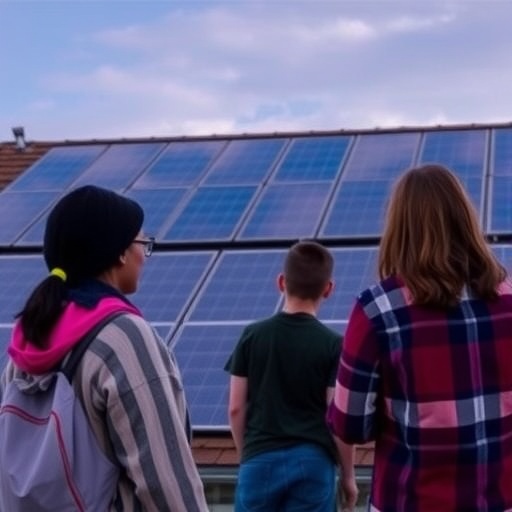
Family Dynamics Key to Understanding Home Solar Panel Adoption

July 9, 2026
in Technology and Engineering
Reading Time: 2 mins read
0
Family Dynamics Key to Understanding Home Solar Panel Adoption

Family Dynamics Key to Understanding Home Solar Panel Adoption

65
SHARES
587
VIEWS
Share on FacebookShare on Twitter
ADVERTISEMENT

In a groundbreaking exploration into the social fabric underpinning residential solar adoption, recent research illuminates the pivotal role of family dynamics— a factor long overshadowed by individualistic frameworks. Traditional models have largely viewed the decision to install solar panels through the lens of individual cost-benefit analysis, yet this fresh study reveals a much more intricate web of relational interplay within households that can dictate whether or not solar technology is embraced.

Researchers sifted through qualitative interviews with 39 couples, unveiling two distinct “role sets” influencing solar decisions. The first, termed “in sync,” characterized households where partners shared aligned sustainability goals and a clear division of labor in the adoption process. These households displayed cohesion, setting the stage for eventual solar uptake. In contrast, the “oppositional” group, comprising non-adopters, was marked by discord and fragmented decision-making, underscoring how intrahousehold disagreements can hinder progress toward clean energy transitions.

However, alignment alone proved insufficient. The research identified that adoption often required external catalysts—such as the looming expiration of government tax credits or sudden spikes in electricity bills—to spur action even among cooperative couples. This indicates that while household harmony is foundational, tangible economic or policy incentives are essential triggers for moving from intent to installation.

Expanding the inquiry, a second phase of the study deployed surveys encompassing 394 current and former solar adopters. Here, the nuanced contributions of various family members emerged. Notably, romantic partners and parents were found to play disproportionately influential roles, from initiating conversations about solar options to managing technical tasks involved in installation. Their active engagement and positive attitudes were significantly higher in adopter households compared to those who had abandoned the process.

Intriguingly, the research also found that even intrahousehold disagreement was not inherently detrimental. In fact, the presence of constructive debate seemed to fuel deeper consideration and eventual commitment to solar technology. This challenges assumptions that consensus is always a prerequisite for sustainable decision-making within families.

These insights present a compelling argument for integrating household relational dynamics into solar adoption models, highlighting the complex choreography behind seemingly simple consumer choices. Utility companies and policy makers could leverage these findings by designing targeted interventions that address not just financial, but also social motivations and barriers.

Ultimately, this study reframes residential solar adoption as a collective endeavor where communication, division of roles, and external economic drivers converge. It propels the notion that clean energy transitions are as much about negotiating human relationships as they are about technological feasibility or cost-effectiveness.

This novel lens also paves the way for bespoke engagement strategies that empower households as dynamic units of change, rather than isolated consumers. By embracing the full scope of familial interaction, the path to widespread solar integration looks markedly more achievable—and profoundly human.


Subject of Research: Household decision-making dynamics influencing residential solar adoption

Article Title: Family dynamics are a missing piece in understanding residential solar adoption

Article References:
Sintov, N.D., Dillman-Hasso, N.H. & Hurst, K.F. Family dynamics are a missing piece in understanding residential solar adoption. Nat Energy (2026). https://doi.org/10.1038/s41560-026-02104-8

DOI: https://doi.org/10.1038/s41560-026-02104-8

Tags: barriers to solar uptake within fragmented householdseffect of government policies on family-based renewable energy adoptionfamily decision-making in solar energy adoptionhousehold dynamics and renewable energy choicesimpact of intrahousehold disagreements on clean energy transitioninfluence of couple relationships on solar panel installationlong-term household sustainability goals and solar technologyqualitative analysis of family roles in solar decision processrole of social cohesion in residential renewable energysignificance of external economic incentives for solar adoptionsocial factors shaping residential solar panel decisions
Share26Tweet16
Previous Post

PALACE Enables High-Quality Phage Assembly from Metagenomic Data

Next Post

Air-Permeable Hydrogels Created via Viscoelastic Aerogel Phase Separation

Related Posts

DISSECT combines cytology and spatial transcriptomics for precise cell segmentation
Technology and Engineering

DISSECT combines cytology and spatial transcriptomics for precise cell segmentation

July 9, 2026
Single-Phase Gradient Electrolytes Enhance Stability in Lithium Metal Batteries
Medicine

Single-Phase Gradient Electrolytes Enhance Stability in Lithium Metal Batteries

July 9, 2026
Forus and AGA partner to enhance GI medication access
Technology and Engineering

Forus and AGA partner to enhance GI medication access

July 9, 2026
Air-Permeable Hydrogels Created via Viscoelastic Aerogel Phase Separation
Medicine

Air-Permeable Hydrogels Created via Viscoelastic Aerogel Phase Separation

July 9, 2026
Plasma Metasurfaces Enable Ultra-Intensive Electromagnetic Field Control
Technology and Engineering

Plasma Metasurfaces Enable Ultra-Intensive Electromagnetic Field Control

July 9, 2026
Epitope Editing Enables Safe Transplantation and In Vivo Cell Selection
Medicine

Epitope Editing Enables Safe Transplantation and In Vivo Cell Selection

July 9, 2026
Next Post
Air-Permeable Hydrogels Created via Viscoelastic Aerogel Phase Separation

Air-Permeable Hydrogels Created via Viscoelastic Aerogel Phase Separation

  • Mothers who receive childcare support from maternal grandparents show more

    Mothers who receive childcare support from maternal grandparents show more parental warmth, finds NTU Singapore study

    27656 shares
    Share 11059 Tweet 6912
  • University of Seville Breaks 120-Year-Old Mystery, Revises a Key Einstein Concept

    1061 shares
    Share 424 Tweet 265
  • Bee body mass, pathogens and local climate influence heat tolerance

    682 shares
    Share 273 Tweet 171
  • Researchers record first-ever images and data of a shark experiencing a boat strike

    546 shares
    Share 218 Tweet 137
  • Groundbreaking Clinical Trial Reveals Lubiprostone Enhances Kidney Function

    531 shares
    Share 212 Tweet 133
Science

Embark on a thrilling journey of discovery with Scienmag.com—your ultimate source for cutting-edge breakthroughs. Immerse yourself in a world where curiosity knows no limits and tomorrow’s possibilities become today’s reality!

RECENT NEWS

  • Biological Causes of Different Cortical Abnormalities in Psychiatric Disorders
  • Early VOC Control Key to Aligning China’s Climate and Air Quality Goals
  • DISSECT combines cytology and spatial transcriptomics for precise cell segmentation
  • Stochastic Models Reveal Rapid Smallpox Spread and High Indigenous Mortality Post-Colonial Contact

Categories

  • Agriculture
  • Anthropology
  • Archaeology
  • Athmospheric
  • Biology
  • Biotechnology
  • Blog
  • Bussines
  • Cancer
  • Chemistry
  • Climate
  • Earth Science
  • Editorial Policy
  • Marine
  • Mathematics
  • Medicine
  • Pediatry
  • Policy
  • Psychology & Psychiatry
  • Science Education
  • Social Science
  • Space
  • Technology and Engineering

Subscribe to Blog via Email

Enter your email address to subscribe to this blog and receive notifications of new posts by email.

Join 5,146 other subscribers

© 2025 Scienmag - Science Magazine

Welcome Back!

Login to your account below

Forgotten Password?

Retrieve your password

Please enter your username or email address to reset your password.

Log In
No Result
View All Result
  • HOME
  • SCIENCE NEWS
  • CONTACT US

© 2025 Scienmag - Science Magazine

Discover more from Science

Subscribe now to keep reading and get access to the full archive.

Continue reading
