


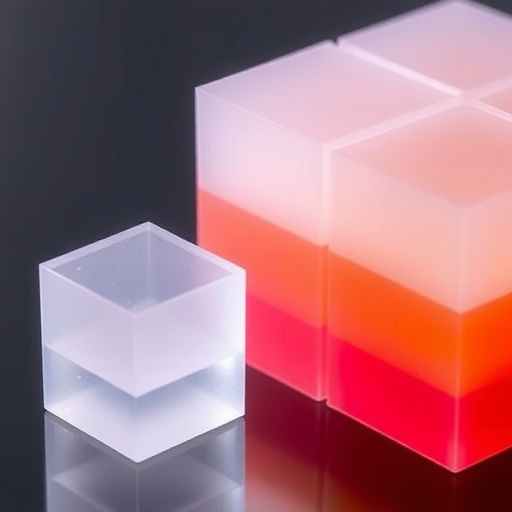
A groundbreaking advancement in hydrogel technology has been unveiled with the development of an air-permeable hydrogel derived from viscoelastic phase separation (VPS) of aerogels. This innovative material simultaneously achieves high water content and exceptional air permeability—a rare combination that opens up new horizons in biomedical applications. Traditional hydrogels often suffer from limited breathability, restricting their use in scenarios where oxygen exchange is critical, such as in wound care or wearable biosensors. The VPS hydrogel effectively overcomes these limitations, offering a breathable yet moist environment conducive to cell viability and comfort.
At the core of this advancement lies the exploitation of viscoelastic phase separation processes shaping the internal microarchitecture of the hydrogel. By integrating aerogel components, which are known for their porous and lightweight characteristics, the resulting structure maintains water retention while allowing free passage of air molecules. This enhanced breathability supports oxygen transport across the material, a much-needed feature for interfaces involving living tissues or long-term wearable devices.
One of the key potential applications highlighted is in healthcare wearables, where prolonged, continuous physiological monitoring is essential. The VPS hydrogel’s superior air permeability reduces skin irritation and enhances user comfort, enabling a shift from daily use to continuous weekly wear. Such a development promises to revolutionize chronic disease management by facilitating more reliable and non-invasive health monitoring over extended durations.
While the current VPS hydrogel formulation is not intrinsically adhesive, the researchers foresee future iterations incorporating wet-adhesion mechanisms. Techniques such as supramolecular interactions or reactive interfacial groups could enable the hydrogel to adhere securely yet gently to biological surfaces. This would broaden the material’s applicability in dynamic environments, particularly for adhesive biomedical patches or implantable devices.
Further improvements could be achieved by increasing the aerogel content within the hydrogel matrix, potentially amplifying its air permeation capabilities. This tunability might prove invaluable in tailoring the hydrogel for specific biomedical contexts, including wound healing, where oxygen tension critically influences tissue regeneration and microbial defense. Additionally, the ability to blend with diverse biomaterials and bioelectronics production techniques enhances the VPS hydrogel’s flexibility for integrated healthcare solutions.
The scalable manufacturing processes associated with this material also promise commercial viability, bridging the gap between laboratory innovation and real-world healthcare needs. By merging high moisture retention with efficient gas exchange, the VPS hydrogel stands poised to empower the next generation of living materials and breathable interfaces, extending far beyond conventional hydrogel applications.
Overall, this new class of air-permeable hydrogels marks a significant step forward in material science with profound implications for biomedicine. It exemplifies how fundamental insights into phase separation phenomena and aerogel chemistry can converge to solve longstanding challenges in wearable devices and tissue engineering. As research continues, these hydrogels are expected to catalyze transformative improvements across healthcare monitoring and therapeutic material design.
Cite Scienmag News
Denise Maddox. (July 9, 2026). Air-Permeable Hydrogels Created via Viscoelastic Aerogel Phase Separation. Scienmag. https://scienmag.com/air-permeable-hydrogels-created-via-viscoelastic-aerogel-phase-separation/
Denise Maddox. "Air-Permeable Hydrogels Created via Viscoelastic Aerogel Phase Separation." Scienmag, 9 July 2026, https://scienmag.com/air-permeable-hydrogels-created-via-viscoelastic-aerogel-phase-separation/. Accessed 3 September 2026.
Denise Maddox. "Air-Permeable Hydrogels Created via Viscoelastic Aerogel Phase Separation." Scienmag. July 9, 2026. https://scienmag.com/air-permeable-hydrogels-created-via-viscoelastic-aerogel-phase-separation/


