


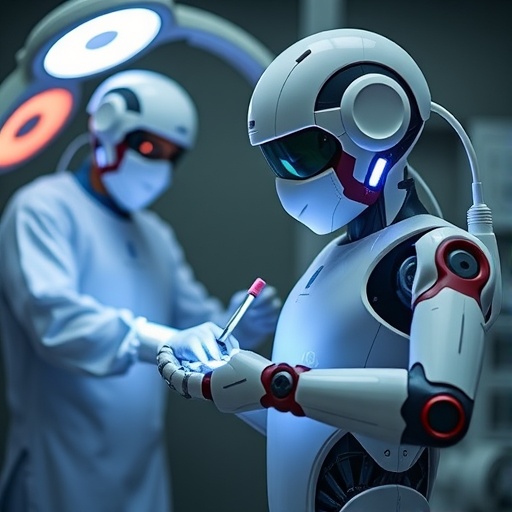
Recent strides in robotics have progressively advanced humanoid robots from conceptual prototypes to devices with tangible real-world applications. Among sectors poised for transformation by this technology, healthcare faces acute challenges, including critical workforce shortages and soaring demand for skilled care. While automation to date has primarily targeted digital and logistical processes, much of hospital labor remains fundamentally physical, entailing sophisticated mobility, dexterity, and safe human interaction. This dynamic sets the stage for humanoid robots, which share human-like form factors, to potentially revolutionize surgical assistance, particularly in delicate laparoscopic interventions.
Historically, robot-assisted surgery has relied on specialized platforms purpose-built for precise tasks, such as Intuitive Surgical’s da Vinci system. However, the degree to which modern humanoid robots can match or approach the rigorous control, accuracy, and safety standards for minimally invasive surgery has remained uncertain. Addressing this gap, a recent study systematically evaluates contemporary humanoid robots’ aptitude for laparoscopic surgery through a comprehensive framework encompassing teleoperated control using general-purpose instruments.
This pioneering research incorporated multiple experimental tiers: benchtop system characterization, dry-laboratory trials involving users with varied surgical expertise, and in vivo experiments using porcine models. These methodical assessments quantified the humanoids’ technical capabilities, operational performance in surgical tasks, and readiness for clinical environments compared to established robotic surgical platforms.
Findings reveal that humanoid robots exhibit promising dexterity and control potentials, able to manipulate laparoscopic tools with precision under teleoperation. However, several technical hurdles remain, including optimizing actuator responsiveness for rapid adjustments, refining whole-body control algorithms to handle complex articulated motions, and ensuring consistent haptic feedback to improve operator perception during interventions. The research underscores the criticality of integrating advanced model-predictive control and innovative learning-based approaches to bridge these gaps.
Moreover, the experiments highlight the robots’ handling of dynamic intraoperative conditions, demonstrating their capacity to perform essential surgical maneuvers while maintaining stability in unpredictable settings. The porcine in vivo results particularly validate the feasibility of humanoid-based systems to assist in minimally invasive procedures without compromising safety or accuracy.
Despite the encouraging outcomes, the study emphasizes that current humanoid robots are not yet fully mature for direct clinical deployment. Further technical refinements and extensive validations remain essential. The ability to safely and effectively collaborate with human surgeons, adapt to diverse intraoperative scenarios, and achieve the finesse required for intricate tissue manipulation are paramount goals that future research must target.
This investigation represents a milestone in assessing how general-purpose humanoid robots can be adapted for high-stakes medical roles. It delivers an evidence-based roadmap outlining both the capabilities realized and the challenges ahead, shaping the trajectory of robotic technologies poised to transform surgical care.
As healthcare systems worldwide grapple with workforce shortages and increasing surgical demands, the integration of humanoid robots offers a transformative vision—augmented surgical teams equipped with versatile robotic collaborators, enhancing precision, safety, and accessibility of minimally invasive surgery.
Cite Scienmag News
Denise Maddox. (July 9, 2026). Humanoid Robots Tested for Surgical Use in Live Feasibility Study. Scienmag. https://scienmag.com/humanoid-robots-tested-for-surgical-use-in-live-feasibility-study/
Denise Maddox. "Humanoid Robots Tested for Surgical Use in Live Feasibility Study." Scienmag, 9 July 2026, https://scienmag.com/humanoid-robots-tested-for-surgical-use-in-live-feasibility-study/. Accessed 3 September 2026.
Denise Maddox. "Humanoid Robots Tested for Surgical Use in Live Feasibility Study." Scienmag. July 9, 2026. https://scienmag.com/humanoid-robots-tested-for-surgical-use-in-live-feasibility-study/


