

Thursday, September 3, 2026
Science
No Result
View All Result
  • Login
  • HOME
  • SCIENCE NEWS
  • CONTACT US
  • HOME
  • SCIENCE NEWS
  • CONTACT US
No Result
View All Result
Scienmag
No Result
View All Result
Home Science News Space

Astronomer Helps Weigh Dormant Black Hole from 10 Billion Years Ago

July 9, 2026
in Space
Grant Pearson
By Grant Pearson Scienmag Editorial Profile - Observational Astronomy
Reading Time: 3 mins read
0
Astronomer Helps Weigh Dormant Black Hole from 10 Billion Years Ago

Astronomer Helps Weigh Dormant Black Hole from 10 Billion Years Ago

65
SHARES
587
VIEWS
Share on FacebookShare on Twitter
ADVERTISEMENT

An international team of astronomers has achieved a groundbreaking feat by directly measuring the mass of an inactive supermassive black hole from the early Universe, approximately 10 billion years ago. This accomplishment, led by Dr. Andrew Newman at Carnegie Observatories with significant contributions from Professor Meng Gu—formerly affiliated with The University of Hong Kong—pushes the limits of black hole research beyond our cosmic neighborhood.

Supermassive black holes are understood to reside at the centers of massive galaxies, influencing their surroundings through immense gravitational forces. Traditionally, black hole masses in nearby galaxies are inferred by analyzing the motions of stars within the sphere of influence—a region dominated by the black hole’s gravity. However, with increasing distance, resolving this sphere becomes challenging due to limited spatial resolution.

The breakthrough relied heavily on the James Webb Space Telescope (JWST) combined with a natural phenomenon known as gravitational lensing. A massive foreground galaxy cluster magnified the light from the distant galaxy MRG-M0138 by roughly 30 times, effectively acting as a cosmic telescope. This magnification allowed researchers to observe the stellar dynamics near the galaxy’s core in unprecedented detail, revealing the black hole’s presence through the gravitational impact on local star velocities rather than electromagnetic emissions, as the black hole is currently inactive.

The team found the black hole’s mass to be about six billion times that of the Sun, surprisingly large given the comparatively modest stellar bulge mass of its host galaxy. When compared to local galactic correlations, this black hole is approximately 12 times more massive than expected relative to the galaxy’s bulge. However, the velocity dispersion of stars—the range of their speeds influenced by gravitational potential—aligns well with typical black hole-galaxy relationships known today. This suggests that while the galaxy’s stellar mass was still assembling, possibly through later mergers, the central black hole and the gravitational environment in its vicinity were already mature.

These findings challenge prevailing assumptions that black holes and their host galaxies grow synchronously. Instead, this study presents compelling evidence that supermassive black holes can reach significant masses well ahead of the full assembly of their surrounding stellar populations. This has profound implications for understanding galaxy formation and the co-evolution of galaxies and black holes.

The ability to weigh inactive black holes at such high redshifts opens new avenues for characterizing the early Universe’s cosmic structures. By extending dynamical mass measurements out to redshift 2, astronomers can now test and refine models of galaxy and black hole growth with direct observational benchmarks.

Professor Gu emphasized the importance of combining JWST’s sensitivity with the magnifying power of gravitational lensing, stating that it unlocks the capability to examine distant galaxies in detail previously thought unattainable. This synergy heralds a new era in observational cosmology, allowing researchers to peer back into epochs when the Universe was still forming many of its fundamental components.

This study, published in Science, serves as a pivotal reference for future research seeking to unravel the timelines of black hole growth and galaxy evolution, marking a significant milestone in extragalactic astronomy.


Keywords

Supermassive black hole, JWST, gravitational lensing, early Universe, galaxy evolution, stellar dynamics, redshift 2, inactive black hole, galaxy bulge, velocity dispersion

Subject of Research: Not applicable
Article Title: A stellar dynamical mass measurement of an inactive black hole at redshift 2
News Publication Date: 4-Jun-2026
Web References: https://www.science.org/doi/10.1126/science.adx5816
References: DOI 10.1126/science.adx5816
Image Credits: Navid Marvi/Carnegie Science

Article Title: Astronomer Helps Weigh Dormant Black Hole from 10 Billion Years Ago

Article References: Original research article

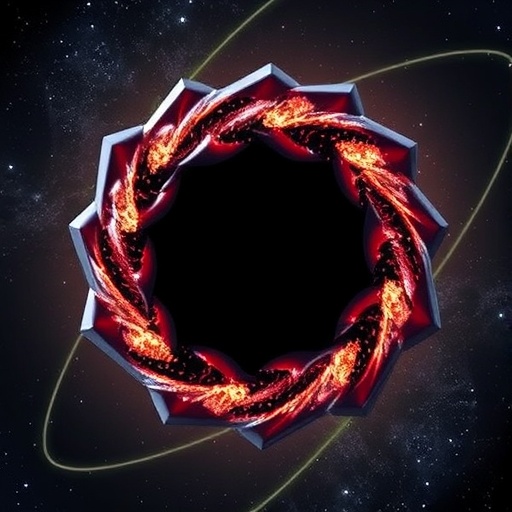
Image Credits: AI Generated

DOI: Not provided

Keywords: black hole influence on galaxy evolution, black hole research beyond local universe, cosmic telescope techniques, dormant black hole analysis, early universe black holes, galaxy cluster gravitational effects, galaxy core stellar dynamics, gravitational lensing in astronomy, high-redshift galaxy observations, James Webb Space Telescope discoveries, star velocity measurement methods, Supermassive black hole mass measurement

Cite Scienmag News

Grant Pearson. (July 9, 2026). Astronomer Helps Weigh Dormant Black Hole from 10 Billion Years Ago. Scienmag. https://scienmag.com/astronomer-helps-weigh-dormant-black-hole-from-10-billion-years-ago/

Grant Pearson. "Astronomer Helps Weigh Dormant Black Hole from 10 Billion Years Ago." Scienmag, 9 July 2026, https://scienmag.com/astronomer-helps-weigh-dormant-black-hole-from-10-billion-years-ago/. Accessed 3 September 2026.

Grant Pearson. "Astronomer Helps Weigh Dormant Black Hole from 10 Billion Years Ago." Scienmag. July 9, 2026. https://scienmag.com/astronomer-helps-weigh-dormant-black-hole-from-10-billion-years-ago/


Tags: black hole influence on galaxy evolutionblack hole research beyond local universecosmic telescope techniquesdormant black hole analysisearly universe black holesgalaxy cluster gravitational effectsgalaxy core stellar dynamicsgravitational lensing in astronomyhigh-redshift galaxy observationsJames Webb Space Telescope discoveriesstar velocity measurement methodsSupermassive black hole mass measurement
Share26Tweet16
Previous Post

KAIST Develops AI to Accelerate Discovery of Ideal 2D Semiconductors

Next Post

New framework explains depth and scaling of slow earthquakes

Related Posts

Depth-graded W/Si multilayers boost silicon pore optics for WXPT mission
Space

Depth-graded W/Si multilayers boost silicon pore optics for WXPT mission

September 3, 2026
Velocity surfaces method speeds analysis of Earth–Moon transfer orbit controllable sets
Space

Velocity surfaces method speeds analysis of Earth–Moon transfer orbit controllable sets

September 3, 2026
Smarter Missile Swarms: New Algorithm Weighs Survival Odds Mid-Flight
Space

Smarter Missile Swarms: New Algorithm Weighs Survival Odds Mid-Flight

September 3, 2026
Trafficability and excavatability of icy lunar regolith simulants quantified using cone penetration
Space

Trafficability and excavatability of icy lunar regolith simulants quantified using cone penetration

September 3, 2026
Why Decoding Alien Atmospheres Is Pushing Supercomputers to Their Limits
Space

Why Decoding Alien Atmospheres Is Pushing Supercomputers to Their Limits

September 3, 2026
Developing a sustainable human lunar presence using space resources
Space

Developing a sustainable human lunar presence using space resources

September 3, 2026
Next Post
New framework explains depth and scaling of slow earthquakes

New framework explains depth and scaling of slow earthquakes

  • Mothers who receive childcare support from maternal grandparents show more optimized

    Mothers who receive childcare support from maternal grandparents show more parental warmth, finds NTU Singapore study

    27656 shares
    Share 11059 Tweet 6912
  • University of Seville Breaks 120-Year-Old Mystery, Revises a Key Einstein Concept

    1061 shares
    Share 424 Tweet 265
  • Bee body mass, pathogens and local climate influence heat tolerance

    682 shares
    Share 273 Tweet 171
  • Researchers record first-ever images and data of a shark experiencing a boat strike

    546 shares
    Share 218 Tweet 137
  • Groundbreaking Clinical Trial Reveals Lubiprostone Enhances Kidney Function

    531 shares
    Share 212 Tweet 133
Science

Embark on a thrilling journey of discovery with Scienmag.com—your ultimate source for cutting-edge breakthroughs. Immerse yourself in a world where curiosity knows no limits and tomorrow’s possibilities become today’s reality!

RECENT NEWS

  • Objective and Subjective Measures Differ in Rating Older Adults’ Well-Being
  • Climate Change Drives New Models for Assessing Aquifer Vulnerability Worldwide
  • DiffKT diffusion model advances fine-grained knowledge tracing
  • Attributed hypergraphs capture structure and attributes realistically, beyond binary links

Categories

  • Agriculture
  • Anthropology
  • Archaeology
  • Athmospheric
  • Biology
  • Biotechnology
  • Blog
  • Bussines
  • Cancer
  • Chemistry
  • Climate
  • Earth Science
  • Editorial Policy
  • Marine
  • Mathematics
  • Medicine
  • Pediatry
  • Policy
  • Psychology & Psychiatry
  • Science Education
  • Social Science
  • Space
  • Technology and Engineering

Subscribe to Blog via Email

Enter your email address to subscribe to this blog and receive notifications of new posts by email.

Join 5,151 other subscribers

© 2025 Scienmag - Science Magazine

Welcome Back!

Login to your account below

Forgotten Password?

Retrieve your password

Please enter your username or email address to reset your password.

Log In
No Result
View All Result
  • HOME
  • SCIENCE NEWS
  • CONTACT US

© 2025 Scienmag - Science Magazine

Discover more from Science

Subscribe now to keep reading and get access to the full archive.

Continue reading