


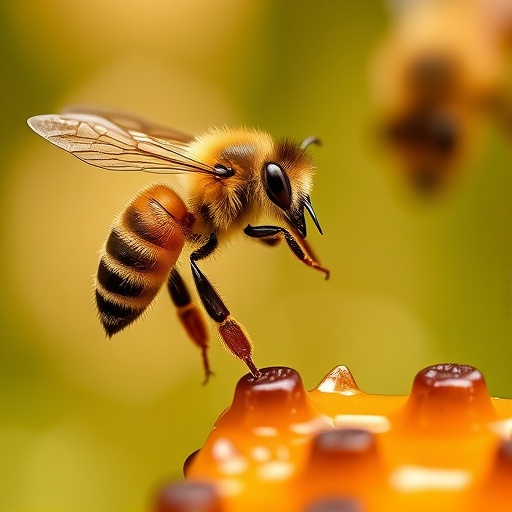
In a groundbreaking study published in PLOS One, researchers from Sweden, Canada, and Finland have unveiled new insights into the complex ecology of honeybees by integrating DNA analyses from multiple hive components. By extracting and examining genetic material from foraging bees, hive workers, and even the honey they produce, the team has illuminated the intricate web of microbial and plant interactions that shape bee health and environmental dynamics over time.
Honeybees are crucial pollinators, but their populations face threats from habitat loss, pathogens, and environmental stressors. Understanding the microscopic relationships between bees, their microbial communities, and the plants they visit is essential for safeguarding these vital insects. Traditional studies often focused on a single aspect, such as the microbiome of individual bees or the pollen diversity in nectar. This innovative research bridges those gaps by combining molecular data sources to construct a more comprehensive picture.
Utilizing advanced DNA sequencing techniques, the researchers compared microbial and plant DNA profiles collected from actively foraging bees, the worker bees inside the hive, and the colonies’ honey stores. This multi-layered approach revealed complementary ecological narratives: foragers reflected recent floral visits and environmental exposures, hive workers provided insights into colony-level microbial populations, and honey samples preserved a historical record of plant and microbial diversity over time.
Significantly, the study demonstrated that each sample type contributes unique but overlapping information. For example, microbial signatures in foragers highlighted transient environmental microbes, while hive workers’ samples captured more stable symbiotic microbes affected by the colony’s social environment. Meanwhile, honey analyzed from the same colonies acted as a time-integrated archive of plant species visited and persistent microbial communities.
This integrative perspective presents a powerful framework for monitoring honeybee health and understanding how ecological factors influence colony resilience. The findings could inform conservation strategies aimed at mitigating threats like colony collapse disorder by leveraging microbial and floral markers as early-warning indicators.
Moreover, the research incorporated sophisticated statistical methods supported by specialized software, enhancing the accuracy of microbial and plant DNA associations. The collaboration with Carex EcoLogics, providing custom statistical analysis, ensured robust data interpretation without compromising the integrity or independence of the scientific findings.
The study was funded by Umeå University and the Kone Foundation, emphasizing academic and non-commercial support for cutting-edge ecological research. By weaving together multiple biological data streams, this work exemplifies the future of integrative ecology—where understanding complex natural systems requires holistic approaches combining behavior, microbiology, and environment.
As we confront global challenges impacting pollinators, such high-resolution insights into plant-bee-microbe interactions will be indispensable. This research not only offers a novel toolkit for scientists but also deepens public appreciation of the hidden microbial worlds that sustain the bees essential to agriculture and biodiversity worldwide.
Keywords
Honeybee ecology, microbial interactions, plant DNA, honey analysis, foraging behavior, microbiome, environmental DNA, colony health, pollinator conservation, integrative ecology
Cite Scienmag News
Gavin Prescott. (July 8, 2026). DNA from bees and honey reveals honeybee ecology and interactions over time. Scienmag. https://scienmag.com/dna-from-bees-and-honey-reveals-honeybee-ecology-and-interactions-over-time/
Gavin Prescott. "DNA from bees and honey reveals honeybee ecology and interactions over time." Scienmag, 8 July 2026, https://scienmag.com/dna-from-bees-and-honey-reveals-honeybee-ecology-and-interactions-over-time/. Accessed 3 September 2026.
Gavin Prescott. "DNA from bees and honey reveals honeybee ecology and interactions over time." Scienmag. July 8, 2026. https://scienmag.com/dna-from-bees-and-honey-reveals-honeybee-ecology-and-interactions-over-time/


