


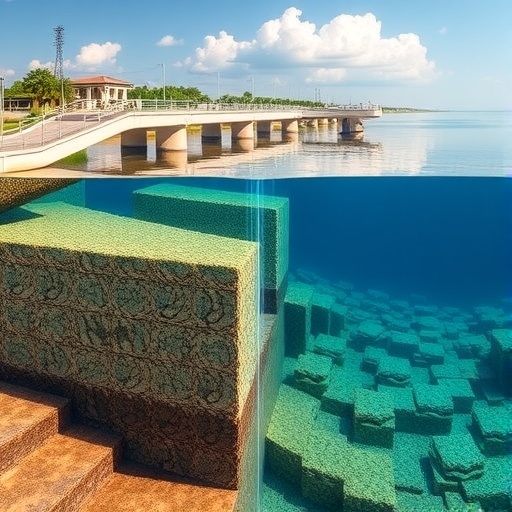
A groundbreaking study led by the Institute of Environmental Science and Technology at the Universitat Autònoma de Barcelona (ICTA-UAB) reveals a previously overlooked source of nutrient pollution driving the persistent ecological decline of the Mar Menor lagoon in southeastern Spain. Contrary to long-standing assumptions that agricultural runoff via surface streams is the primary culprit, over 90% of key degrading nutrients such as ammonium, phosphorus, and silica originate from the lagoon’s own sediment-water interface through complex groundwater recirculation processes.
The Mar Menor, once a coveted Mediterranean tourist destination, has suffered acute episodes of eutrophication since 2016. This process, characterized by explosive phytoplankton growth followed by oxygen depletion, has led to devastating fish kills, including the notable 2019 event. Traditional restoration efforts target visible pollution sources like the phosphate- and nitrate-laden freshwater inflows through the Albujón stream. Yet, this emergent research highlights a substantial nutrient pathway that had gone undetected until now.
Employing radium isotopes as tracers, researchers quantified distinct groundwater discharge mechanisms feeding into the lagoon. Two processes—recirculation of saline lagoon water through subterranean aquifers and rapid porewater exchange within sediment layers—dominate nutrient inputs. These mechanisms effectively mobilize nutrients accumulated over decades from agricultural and mining activities buried within the lagoon’s sediments and subsequently reintroduce them into the water column.
Intriguingly, the study documents that these nutrient fluxes occur on vastly different temporal scales. Large-scale exchanges can persist over months to years, influenced by shifts in water density, lagoon levels, and wave dynamics. Meanwhile, smaller-scale porewater movements transpire over hours or days, driven by wave pumping and the bioturbation activities of sediment-dwelling organisms. Both scales contribute to a persistent internal nutrient recycling loop aggravating eutrophication risks.
Seasonally, summer intensifies this phenomenon, with phosphorus inputs surging due to increased small-scale recirculation. This spike directly correlates with conditions favoring algal blooms and hypoxia, maladies that critically undermine the lagoon’s aquatic ecosystem and biodiversity. Current restoration frameworks fall short by neglecting these subterranean pathways, limiting their success despite efforts to curb external pollution sources.
The study’s revelations necessitate urgent revisions to management strategies for the Mar Menor. Effective restoration must incorporate mitigation of nutrient mobilization through groundwater and sediment interactions within the lagoon itself. The findings not only recast our understanding of coastal eutrophication dynamics but also emphasize the need for integrating geochemical and hydrological insights into environmental policy.
This research advances the broader science of coastal lagoon ecosystems, illustrating how internal nutrient cycling can exacerbate human-induced degradation. It underscores the importance of interdisciplinary investigation combining hydrology, oceanography, and biogeochemistry to tackle complex environmental challenges. As coastal zones globally confront similar issues, the Mar Menor serves as a critical case study for refining restoration approaches and sustaining fragile aquatic habitats.
Keywords
Groundwater, Limnology, Freshwater biology, Water resources, Oceanography, Coastal processes, Marine biology, Ocean chemistry, Ocean fertilization
Cite Scienmag News
Bethany Barker. (July 8, 2026). Over 90% of Mar Menor nutrient pollution stems from underground water flows. Scienmag. https://scienmag.com/over-90-of-mar-menor-nutrient-pollution-stems-from-underground-water-flows/
Bethany Barker. "Over 90% of Mar Menor nutrient pollution stems from underground water flows." Scienmag, 8 July 2026, https://scienmag.com/over-90-of-mar-menor-nutrient-pollution-stems-from-underground-water-flows/. Accessed 3 September 2026.
Bethany Barker. "Over 90% of Mar Menor nutrient pollution stems from underground water flows." Scienmag. July 8, 2026. https://scienmag.com/over-90-of-mar-menor-nutrient-pollution-stems-from-underground-water-flows/


