

Wednesday, July 8, 2026
Science
No Result
View All Result
  • Login
  • HOME
  • SCIENCE NEWS
  • CONTACT US
  • HOME
  • SCIENCE NEWS
  • CONTACT US
No Result
View All Result
Scienmag
No Result
View All Result
Home Science News Mathematics

Electron Repulsion in Cubic Crystals Triggers Weyl Topological Superconductivity

July 8, 2026
in Mathematics
Reading Time: 2 mins read
0
Electron Repulsion in Cubic Crystals Triggers Weyl Topological Superconductivity

Electron Repulsion in Cubic Crystals Triggers Weyl Topological Superconductivity

65
SHARES
587
VIEWS
Share on FacebookShare on Twitter
ADVERTISEMENT

In a groundbreaking advance for quantum materials, researchers have unveiled a new mechanism for realizing Weyl topological superconductivity in three-dimensional cubic lattices. This novel state, characterized by protected Bogoliubov point nodes and exotic surface states, was traditionally thought to require complex band structures and strong spin-orbit coupling. However, a recent theoretical study by a collaboration led by Fan Yang and Congjun Wu reveals that repulsive electron interactions alone can induce this exotic phase, potentially simplifying the search for such materials.

Topological superconductors are of great interest due to their ability to host Majorana fermions, quasiparticles anticipated to play a fundamental role in fault-tolerant quantum computing. Among these, Weyl topological superconductors stand out as they feature unique momentum space characteristics: point nodes called Weyl points, which act as monopoles and anti-monopoles of Berry curvature, connected by Fermi arc states on the surface. Realizing these systems experimentally has remained a challenge owing to the need for subtle relativistic effects and intricate electronic structures.

The key insight from this new work lies in the concept of geometric frustration in three-dimensional lattices. While in two-dimensional square lattices, electrons with repulsive interactions favor pairing states with a d-wave symmetry that changes sign between x and y directions, extending this idea to three dimensions leads to a mathematical contradiction. Specifically, it is impossible for the superconducting order parameter to flip sign along all three orthogonal axes simultaneously without frustration.

To resolve this conundrum, the system naturally adopts a chiral d+id pairing state that circumvents conventional sign-flipping. Instead of sharp phase changes of 0 or 180 degrees, the superconducting phase smoothly rotates by 120 degrees among the x, y, and z directions. This continuous phase winding avoids frustration and stabilizes the superconducting order.

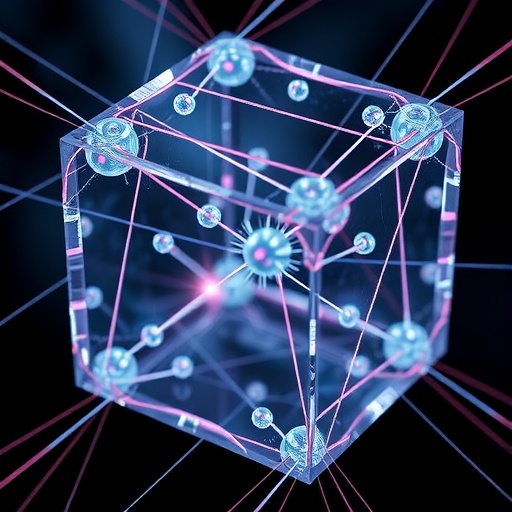
Unlike conventional chiral superconductors that exhibit net orbital angular momentum, this distinct 120-degree phase structure generates an octupolar symmetry. This symmetry is intimately linked to the emergence of eight Weyl nodes located along the body diagonals of the crystal lattice. These nodes alternate in topological charge, behaving as positive and negative magnetic monopoles in momentum space. The resulting state is aptly named an octupolar Weyl superconductor, reflecting the intricate topology of its gap nodes.

By demonstrating that spin-orbit coupling is not a prerequisite for Weyl topological superconductivity, this research opens the door to a broader range of candidate materials, including strongly correlated cubic compounds. Additionally, the findings provide a compelling platform for exploring unconventional superconductivity and topological phases in three-dimensional settings. The theoretical models also suggest that cold-atom quantum simulations could serve as versatile experimental testbeds for probing this novel state.

This discovery significantly advances our theoretical understanding and practical quest for Weyl superconductors, offering fresh opportunities to harness their exotic quasiparticles for next-generation quantum technologies. As experimental techniques evolve, the search for octupolar Weyl topological superconductors may soon transition from theory to reality, potentially revolutionizing quantum materials science.


Subject of Research: Topological superconductivity, Weyl superconductors, electron interactions in cubic lattices
Article Title: Octupolar Weyl Superconductivity Emerging from Electron Interaction Frustration in 3D Cubic Lattices
Web References: http://dx.doi.org/10.1093/nsr/nwag326
Image Credits: ©Science China Press
Keywords: Weyl topological superconductor, octupolar superconductivity, chiral d+id pairing, geometric frustration, Majorana fermions, quantum computing, Bogoliubov nodes, cubic lattice

Tags: Berry curvature monopolescubic lattice materialselectron-electron interactionsFermi Arc Surface Statesgeometric frustration in 3D latticesMajorana fermionsQuantum materialsspin-orbit coupling requirementstopological superconductivityunconventional pairing mechanismsWeyl points
Share26Tweet16
Previous Post

Sister Projects Urge Stronger EU Measures to Save Europe’s Wetlands

Next Post

Race and Ethnicity Influence How Socioeconomic Status Impacts Metabolic Disease in US

Related Posts

New algorithm delivers faster, cheaper genomic surveillance of global outbreaks
Mathematics

New algorithm delivers faster, cheaper genomic surveillance of global outbreaks

July 6, 2026
Physicists Capture Elusive 3D Quantum Hall Effect in Light—and Spot the Fermi Arcs
Mathematics

Physicists Capture Elusive 3D Quantum Hall Effect in Light—and Spot the Fermi Arcs

July 6, 2026
Adaptive Swarm Learning Clears a Smarter Path Through Vehicle Routing Problems
Mathematics

Adaptive Swarm Learning Clears a Smarter Path Through Vehicle Routing Problems

July 6, 2026
UOB and Singapore’s Centre for Quantum Technologies Break New Ground in Quantum Computing for Derivatives Valuation
Mathematics

UOB and Singapore’s Centre for Quantum Technologies Break New Ground in Quantum Computing for Derivatives Valuation

July 1, 2026
Advancing Weather Intervention Techniques to Enhance Future Disaster Mitigation
Mathematics

Advancing Weather Intervention Techniques to Enhance Future Disaster Mitigation

July 1, 2026
Physicists Team Up with Claude to Solve Decade-Old Jamming Conjecture
Mathematics

Physicists Team Up with Claude to Solve Decade-Old Jamming Conjecture

July 1, 2026
Next Post
Race and Ethnicity Influence How Socioeconomic Status Impacts Metabolic Disease in US

Race and Ethnicity Influence How Socioeconomic Status Impacts Metabolic Disease in US

  • Mothers who receive childcare support from maternal grandparents show more

    Mothers who receive childcare support from maternal grandparents show more parental warmth, finds NTU Singapore study

    27656 shares
    Share 11059 Tweet 6912
  • University of Seville Breaks 120-Year-Old Mystery, Revises a Key Einstein Concept

    1061 shares
    Share 424 Tweet 265
  • Bee body mass, pathogens and local climate influence heat tolerance

    682 shares
    Share 273 Tweet 171
  • Researchers record first-ever images and data of a shark experiencing a boat strike

    546 shares
    Share 218 Tweet 137
  • Groundbreaking Clinical Trial Reveals Lubiprostone Enhances Kidney Function

    531 shares
    Share 212 Tweet 133
Science

Embark on a thrilling journey of discovery with Scienmag.com—your ultimate source for cutting-edge breakthroughs. Immerse yourself in a world where curiosity knows no limits and tomorrow’s possibilities become today’s reality!

RECENT NEWS

  • Enhancing Person-Centred Care with Saliency and Tacit Knowledge Insights
  • NEP89 enables universal neuroevolution for 89 inorganic and organic elements
  • SwRI study links primordial mini-moons to meteorite compositions
  • ORNL Wins Five DOE Transportation Technologies Office Awards

Categories

  • Agriculture
  • Anthropology
  • Archaeology
  • Athmospheric
  • Biology
  • Biotechnology
  • Blog
  • Bussines
  • Cancer
  • Chemistry
  • Climate
  • Earth Science
  • Editorial Policy
  • Marine
  • Mathematics
  • Medicine
  • Pediatry
  • Policy
  • Psychology & Psychiatry
  • Science Education
  • Social Science
  • Space
  • Technology and Engineering

Subscribe to Blog via Email

Enter your email address to subscribe to this blog and receive notifications of new posts by email.

Join 5,147 other subscribers

© 2025 Scienmag - Science Magazine

Welcome Back!

Login to your account below

Forgotten Password?

Retrieve your password

Please enter your username or email address to reset your password.

Log In
No Result
View All Result
  • HOME
  • SCIENCE NEWS
  • CONTACT US

© 2025 Scienmag - Science Magazine

Discover more from Science

Subscribe now to keep reading and get access to the full archive.

Continue reading
