


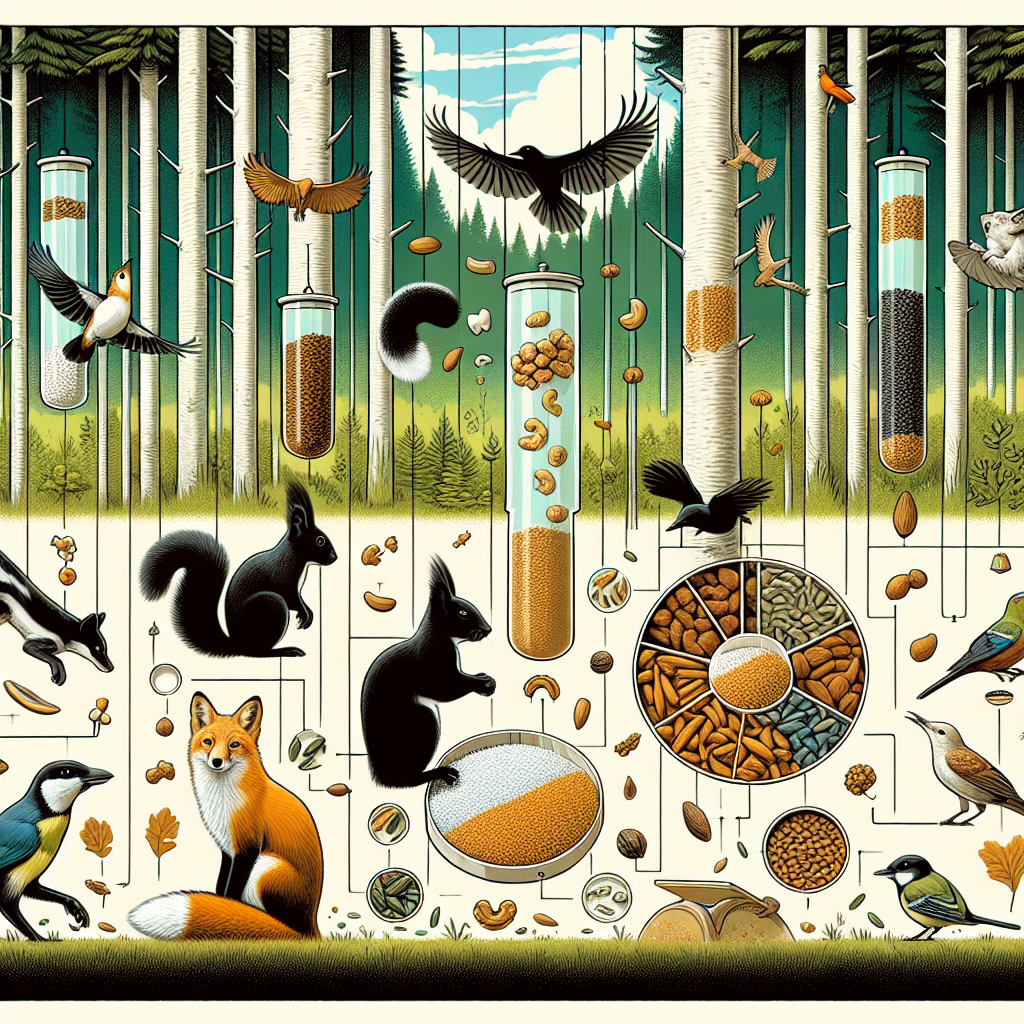
New research at Hebrew University proposes a novel, non-memory-based mechanism for how animals cache and retrieve food. Instead of relying on memory, the researchers suggest that animals use a neural mechanism similar to hash functions in computing, which allows for efficient storage and retrieval of cache locations. This is important because it challenges long-held beliefs about animal cognition and offers a more efficient explanation for how animals can manage thousands of food caches without overtaxing their memory systems. The proposed mechanism could have far-reaching implications for our understanding of animal behavior, brain function, and even the development of new artificial intelligence systems. By providing a simpler and more scalable model for information processing in the brain, this research opens up new avenues for exploring cognitive processes in both animals and humans.
New research at Hebrew University proposes a novel, non-memory-based mechanism for how animals cache and retrieve food. Instead of relying on memory, the researchers suggest that animals use a neural mechanism similar to hash functions in computing, which allows for efficient storage and retrieval of cache locations. This is important because it challenges long-held beliefs about animal cognition and offers a more efficient explanation for how animals can manage thousands of food caches without overtaxing their memory systems. The proposed mechanism could have far-reaching implications for our understanding of animal behavior, brain function, and even the development of new artificial intelligence systems. By providing a simpler and more scalable model for information processing in the brain, this research opens up new avenues for exploring cognitive processes in both animals and humans.
Researchers Dr. Oren Forkosh and Sharon Mordechay from the Department of Cognition and Brain Sciences and The Department of Animal Sciences at Hebrew University have proposed a new theory about how animals store and retrieve cached food. Their study, published in Scientific Report, challenges traditional views on animal caching behavior by suggesting a non-memory-based mechanism.
Revolutionizing Understanding of Caching Behavior
Contrary to the long-held belief that scatter-hoarding animals rely on memory to retrieve cached food items, Forkosh and Mordechay propose a static mechanism similar to hash functions used in computing. Hash functions in computing are algorithms that convert input data of any size into a fixed-size string of characters, which typically represents the data in a unique and efficient manner.
Key Findings
Hippocampal Spatial Cells: The researchers’ mathematical model aligns with the activity of hippocampal spatial cells, which respond to an animal’s positional attention. The remapping ensures that these cells activate consistently across subsequent visits to the same area but differ between areas.
Persistent Hash Functions: This remapping, combined with unique cognitive maps, generates persistent hash functions that can aid both food caching and retrieval.
Neural Network Architecture: The study presents a simple neural network architecture capable of producing a probabilistic hash unique to each animal, providing a virtually boundless capacity for encoding structured data.
Innovative Neural Framework
The proposed framework involves a biologically plausible realization of hashing through a neural network. The input layer encodes key environmental landmarks, while the output layer designates food cache locations. Both layers are arranged in a two-dimensional grid, with each cell corresponding to a specific location. The cache site is determined by the activity level of the output neurons, known as the cache score.
Implications and Future Research
This innovative approach offers a new perspective on animal behavior and cognitive processes, suggesting that animals may use non-memory-based mechanisms for complex tasks such as caching. The findings could have broader implications for understanding brain functions and developing artificial intelligence systems.
Journal
Scientific Reports
Method of Research
Computational simulation/modeling
Subject of Research
Not applicable
Article Title
A non-memory-based functional neural framework for animal caching behavior
Article Publication Date
6-Aug-2024
Cite Scienmag News
Reid Dalton. (August 8, 2024). A new mechanism for animal food caching behavior discovered. Scienmag. https://scienmag.com/a-new-mechanism-for-animal-food-caching-behavior-discovered/
Reid Dalton. "A new mechanism for animal food caching behavior discovered." Scienmag, 8 August 2024, https://scienmag.com/a-new-mechanism-for-animal-food-caching-behavior-discovered/. Accessed 3 September 2026.
Reid Dalton. "A new mechanism for animal food caching behavior discovered." Scienmag. August 8, 2024. https://scienmag.com/a-new-mechanism-for-animal-food-caching-behavior-discovered/


