


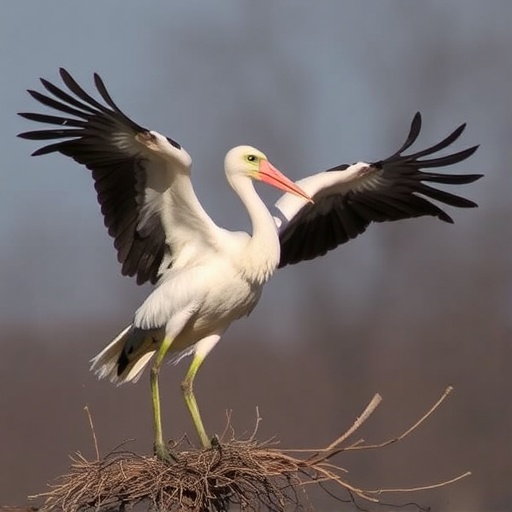
In a groundbreaking 15-year comprehensive study published in the open-access Biodiversity Data Journal, researchers have unveiled the stark and alarming impacts of extreme weather events on the rehabilitation and survival of White Storks (Ciconia ciconia) in Bulgaria. This extensive investigation sheds light on how intensifying climatic disasters—ranging from sudden spring frosts to devastating wildfires—are shaping the fate of this iconic migratory bird species under the duress of global climate change.
The collaborative research venture, spearheaded by Rusko Petrov, in conjunction with Eva Pastir from Trakia University and Gradimir Gradev from the Agricultural University of Plovdiv, meticulously analyzed data collected from the Wildlife Rescue and Breeding Centre (WRBC) of the Green Balkans NGO over a span of fifteen years, from 2010 to 2025. This unique dataset encompasses 3,690 admitted White Storks, with a specialized focus placed on 158 critical cases directly linked to extreme climatic conditions including storms, hail, tempestuous winds, snowfalls accompanied by low temperatures, and large-scale wildfires.
Central to the findings is a division of the weather-induced injury cases into two distinct categories, unveiling vastly different survival trajectories. The study highlights that just under half (49%) of the storks affected by such severe weather events were successfully rehabilitated and released back into the wild, underscoring the vital role of wildlife rescue operations. Meanwhile, a slightly higher proportion—51%—met fatal outcomes, with a marginal number surviving but sustaining permanent disabilities requiring transfer to sanctuaries or other specialized care facilities.
A particularly poignant revelation is the heightened vulnerability of juvenile storks. These birds, unable to evacuate nests during perilous conditions, suffer disproportionately amid extreme weather events. This vulnerability is most glaring during wildfires, where the destruction of nests in tandem with adult birds’ flight renders fledgling storks virtually defenseless. The consequence is stark: survival rates for wildfire-impacted individuals plummet to just 33%, a grim statistic underlining the catastrophic toll these disasters exact on future generations of the species.
Contrastingly, weather events such as storms, hail, and sudden, bitter snowfalls manifest a notably higher rehabilitation success of 74%. This disparity highlights the intricate interplay between the type of climatic event and the resilience or vulnerability of affected storks, stressing the need for event-specific conservation and rehabilitation protocols. Understanding these nuances offers critical insights into adaptive wildlife rescue strategies under increasingly erratic weather patterns.
Geospatial analysis within the study illuminates distinct environmental and climatic patterns driving these adverse events. Wildfire cases predominantly cluster within the Upper Thracian Plain—a warmer region characterized by increasingly frequent summer heatwaves, often exacerbated by anthropogenic factors. Conversely, cold-related weather injuries largely emanate from the Danubian Plain, where chilling continental air masses infiltrate during winter and in early spring, bringing abrupt frost and snow conditions that jeopardize returning migratory populations.
These geographic distributions align closely with broader global warming patterns, painting a grim portrait of shifting climatic zones. The researchers note a worrying phenological mismatch: warmer winters prompt earlier migrations by adult storks, exposing them to the deadly risks of unforeseen spring frosts and blizzards. This phenomenon underscores a complex biological feedback loop where changing climates disrupt evolutionary survival mechanisms finely tuned through millennia.
Beyond immediate species impacts, the study prompts concerns about broader ecosystem repercussions. According to Petrov, the crisis faced by White Storks serves as a bellwether for many other bird species, especially migratory and endangered taxa. The sensitivity of young, nest-dependent individuals to climatic extremes highlights a larger vulnerability across avian biodiversity—a potential cascade effect threatening ecosystem stability.
The research team emphasizes urgent, multifaceted conservation interventions to mitigate these emerging threats. They advocate for enhanced nest protection measures, including fireproofing efforts and strategic habitat management, alongside bolstered capacity for wildlife rescue centers. Additionally, they urge development and implementation of proactive climate adaptation strategies designed to buffer vulnerable species from escalating environmental volatility.
Underpinning the study’s significance is its meticulous integration of long-term empirical data with spatial climate modeling, delivering a granular understanding of how specific climatic hazards translate into population-level consequences. This depth facilitates predictive modeling to anticipate future impacts, crucial for tailoring conservation efforts in a rapidly warming world facing unprecedented ecological challenges.
Moreover, the research underscores the critical intersection of human activity and climate dynamics. The prevalence of wildfires driven not only by climatic heat extremes but also by anthropogenic ignition sources calls for intensified cross-sectoral collaboration to address root causes of habitat destruction. Coordinated efforts ranging from policy implementation to community awareness are vital to safeguarding White Stork populations and other threatened species alike.
Cumulatively, this landmark study not only furnishes rigorous scientific evidence of climate-driven wildlife crises but also galvanizes urgent action in the conservation arena. Its findings resonate as a clarion call highlighting the intertwined destinies of wildlife and human societies amidst an era marked by climate uncertainty. Protecting the White Stork thus symbolizes a broader imperative to preserve biodiversity against the mounting pressures of a changing planet.
News Publication Date: 14-Apr-2026
Web References:
http://dx.doi.org/10.3897/BDJ.14.e182547
https://bdj.pensoft.net/
References:
Petrov R, Pastir E, Gradev G (2026) Impact of extreme weather on White Stork (Ciconia ciconia) rehabilitation: admissions and outcomes (2010-2025). Biodiversity Data Journal 14: e182547.
Cite Scienmag News
Margaret Porter. (July 1, 2026). Extreme Weather Threatens White Stork Survival in Bulgaria, Study Finds. Scienmag. https://scienmag.com/extreme-weather-threatens-white-stork-survival-in-bulgaria-study-finds/
Margaret Porter. "Extreme Weather Threatens White Stork Survival in Bulgaria, Study Finds." Scienmag, 1 July 2026, https://scienmag.com/extreme-weather-threatens-white-stork-survival-in-bulgaria-study-finds/. Accessed 1 September 2026.
Margaret Porter. "Extreme Weather Threatens White Stork Survival in Bulgaria, Study Finds." Scienmag. July 1, 2026. https://scienmag.com/extreme-weather-threatens-white-stork-survival-in-bulgaria-study-finds/


