


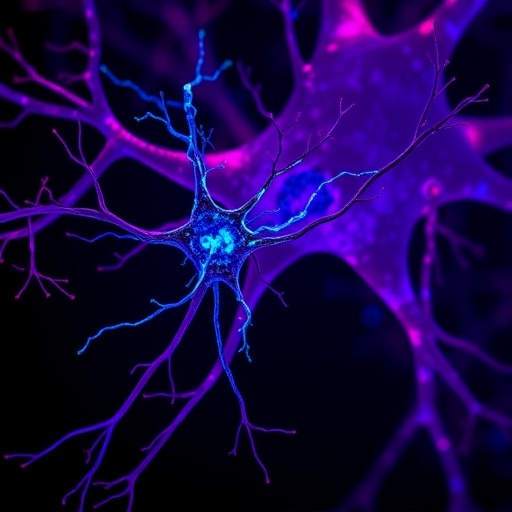
Parkinson’s disease, a progressive neurodegenerative disorder, continues to challenge researchers worldwide as they strive to unravel the molecular mechanisms underlying its pathology. A groundbreaking study published in npj Parkinson’s Disease in 2026 by Zhao, Chen, and Zhi et al. delivers a significant leap forward in our understanding of mitochondrial dynamics within nigrostriatal dopaminergic neurons, revealing how the loss of PINK1 protein triggers age-dependent deficits in mitochondrial trafficking through the aberrant activation of the p38 MAPK pathway. This revelation not only deepens our insight into Parkinsonian neurodegeneration but also opens new avenues for targeted therapeutic intervention.
Mitochondria, often described as the powerhouses of the cell, are essential for maintaining neuronal health by generating the adenosine triphosphate (ATP) necessary for diverse cellular activities. In dopamine-producing neurons of the nigrostriatal pathway, which are critically affected in Parkinson’s disease, mitochondrial function and positioning are vital for sustaining synaptic transmission and cellular viability. PINK1 (PTEN-induced kinase 1) is a mitochondrial serine/threonine-protein kinase known for its protective involvement in mitochondrial quality control, particularly through mitophagy—the removal of damaged mitochondria. The new research elucidates how PINK1 deficiency disrupts these protective mechanisms, leading to detrimental consequences on mitochondrial trafficking, especially as neurons age.
The researchers employed sophisticated in vivo and in vitro models targeting nigrostriatal dopaminergic neurons, combining advanced imaging techniques with molecular biology tools to trace mitochondrial movement along axons. Their findings demonstrated a pronounced impairment in mitochondrial trafficking in the absence of PINK1, which exacerbated progressively with age. Such deficits contribute to a decrease in energy supply at synaptic termini, culminating in synaptic dysfunction and neuronal degeneration, hallmark features of Parkinson’s pathology.
Mechanistically, the study identifies aberrant activation of the p38 mitogen-activated protein kinase (MAPK) pathway as a key mediator linking PINK1 loss to mitochondrial trafficking abnormalities. The p38 MAPK pathway, traditionally recognized for its role in cellular stress responses, inflammation, and apoptosis, appears hyperactivated in PINK1-deficient neurons. This hyperactivation triggers a cascade that interferes with the molecular machinery responsible for mitochondrial transport, including motor proteins and adaptor complexes.
Delving deeper into the signaling crosstalk, the authors revealed that p38 MAPK phosphorylates certain motor-adaptor proteins involved in mitochondrial trafficking, altering their function and leading to impaired cargo movement. This novel insight highlights the fine-tuned regulatory network that maintains mitochondrial distribution in neurons and how its disruption contributes to neurodegeneration in Parkinson’s disease.
Further experiments elucidated that pharmacological inhibition of p38 MAPK activity partially restored mitochondrial trafficking in PINK1-deficient neuronal cultures. This finding suggests a promising therapeutic target; interventions aimed at modulating the p38 MAPK pathway may ameliorate mitochondrial dysfunction and subsequent neuronal loss in Parkinsonian brains, especially if administered in early disease stages.
The age-dependent nature of these trafficking impairments emerged as a critical aspect of the study. Young PINK1-deficient neurons displayed milder mitochondrial transport issues compared to older neurons, which suffered markedly impaired mitochondrial dynamics. This age-related progression aligns with clinical observations wherein Parkinson’s disease typically manifests in late adulthood, underscoring the importance of aging as a compounding factor in disease development.
Importantly, the research situates mitochondrial trafficking deficits within the broader landscape of Parkinson’s disease pathophysiology. Alongside other mitochondrial impairments such as oxidative stress and bioenergetic failure, disrupted trafficking contributes to a vicious cycle amplifying neuronal vulnerability. This multidimensional disruption challenges prior understandings that focused predominantly on mitochondrial morphology and function without considering intracellular motility.
The study’s interdisciplinary approach incorporated genetic models with live-cell imaging, proteomic profiling, and biochemical assays, offering a comprehensive view of how PINK1 loss reshapes the intracellular environment. Notably, the use of transgenic animals expressing fluorescently labeled mitochondria allowed for real-time visualization of transport dynamics along axons, providing compelling visual evidence for the trafficking defects caused by PINK1 deficiency.
Moreover, the authors discuss potential interactions between PINK1-associated pathways and other neurodegenerative processes. Given that multiple Parkinson’s disease genes intersect at mitochondrial quality control, the aberrant p38 MAPK signaling identified here may represent a convergent point integrating various pathogenic insults. This convergence reinforces the therapeutic potential of targeting shared downstream effectors rather than isolated upstream mutations.
Beyond its implications for Parkinson’s disease, the study contributes broadly to neuroscience by elucidating fundamental principles governing neuronal organelle transport, especially under pathological stress conditions. Understanding how signaling pathways like p38 MAPK regulate intracellular trafficking extends to other disorders characterized by metabolic and transport deficits, potentially informing cross-disease strategies.
The findings also highlight the necessity of temporal considerations in neurodegenerative research. Since age distinctly modifies the impact of PINK1 loss on mitochondrial trafficking, future investigations must account for age-dependent variables to accurately model disease progression and evaluate therapeutic efficacy in preclinical and clinical trials.
While the study establishes a clear link between PINK1, p38 MAPK activation, and mitochondrial trafficking deficits, several questions remain open for exploration. It remains to be clarified how exactly the interplay between p38 MAPK and other kinases affects the broad landscape of intracellular transport mechanisms. Additionally, the potential side effects and systemic ramifications of prolonged p38 MAPK inhibition warrant careful assessment before translating these findings into clinical interventions.
In summary, Zhao and colleagues’ investigative work artfully delineates a previously underappreciated mechanism by which PINK1 deficiency induces mitochondrial trafficking deficits through age-dependent aberrant activation of the p38 MAPK pathway. This research enhances our mechanistic understanding of Parkinson’s disease at the cellular and molecular levels and underscores the importance of targeting mitochondrial trafficking dysfunction in the development of disease-modifying therapies. It is a landmark contribution poised to inspire a new wave of studies focused on integrating mitochondrial biology with signal transduction to combat neurodegeneration.
As Parkinson’s disease research accelerates, these discoveries promise to shift paradigms and energize therapeutic innovation, inching closer to halting or reversing the relentless neuronal loss that defines this devastating condition. With mitochondrial trafficking emerging as a critical nexus of vulnerability, harnessing insights from this study could ignite the next generation of targeted treatments aimed at restoring neuronal function and enhancing patient quality of life.
Cite Scienmag News
Cassandra Pierce. (June 24, 2026). PINK1 Loss Impairs Dopamine Neuron Mitochondria via p38. Scienmag. https://scienmag.com/pink1-loss-impairs-dopamine-neuron-mitochondria-via-p38/
Cassandra Pierce. "PINK1 Loss Impairs Dopamine Neuron Mitochondria via p38." Scienmag, 24 June 2026, https://scienmag.com/pink1-loss-impairs-dopamine-neuron-mitochondria-via-p38/. Accessed 3 September 2026.
Cassandra Pierce. "PINK1 Loss Impairs Dopamine Neuron Mitochondria via p38." Scienmag. June 24, 2026. https://scienmag.com/pink1-loss-impairs-dopamine-neuron-mitochondria-via-p38/


