


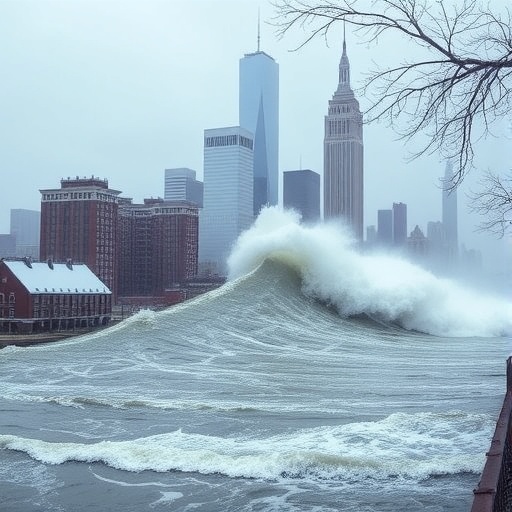
In a groundbreaking study combining decades of historical storm data with advanced computational modeling, researchers at Stevens Institute of Technology have unveiled new insights into a rarely understood natural phenomenon known as the continental shelf seiche. This phenomenon, capable of triggering significant flooding hours after a storm has passed, had historically been mistaken for tsunami events, leading to misinterpretations of coastal flooding risks along the New York and New Jersey coastlines. The findings hold critical implications for urban flood forecasting and emergency preparedness in one of the most densely populated and infrastructurally complex coastal regions in the United States.
A seiche is essentially a standing wave generated when an enclosed or semi-enclosed body of water, such as a bay or harbor, oscillates — rocking back and forth due to wind force or seismic activity. The mechanical analogy is elegant: likened to water sloshing in a bathtub after it has been disturbed, the water motion reflects repeatedly between shoreline boundaries before it gradually dissipates. This familiar seiche phenomenon is well-documented in limnology and coastal oceanography where defined physical boundaries confine the oscillations. However, continental shelf seiches operate on a much grander and less understood scale, often involving profound interactions at the edge of the continental margin where the ocean floor plunges steeply into the deep sea.
The edge of the continental shelf, which descends noticeably offshore, acts as a de facto reflective boundary in these scenarios. Unlike smaller bodies of water with clear lateral confines, the continental shelf does not have an obvious physical wall on its seaward side, which historically contributed to the underappreciation of its role as a reflective boundary driving seiche dynamics. In the case of the New York Bight — a broad, roughly triangular coastal expanse bordered by Cape May in New Jersey and Montauk Point on Long Island — the continental shelf lies about 100 miles offshore. When vigorous winds from coastal storms generate surges, water pushed toward shore rebounds off this submerged shelf edge and returns as oscillatory waves that can amplify coastal water levels unexpectedly hours after initial storm conditions subside.
Stevens researchers focused on understanding why the New York Bight exhibits particularly notable post-storm water level oscillations compared to other sections of the Mid-Atlantic Bight. By analyzing tidal gauge data from a network of 17 monitoring stations and coupling it with sophisticated numerical wave models, they identified unusually strong resurgence events triggered by rapid variations in wind forcing during and after tropical cyclones. Specifically, strong onshore winds drive heightened water volumes landward creating surge elevations, but when these winds abate or shift direction as storms weaken or move away, the accumulated water mass begins oscillatory motion akin to a giant, natural-scale seiche.
The phenomenon was historically elusive partly because these resurgence surges occurred well after the storm’s arrival, a delay that confused early observers. Indeed, in 1938 and 1944, two major hurricanes battering Long Island produced secondary surges hours later, which were misidentified as tsunamis due to their suddenness and intensity. More recent events, such as post-Hurricane Isaias in 2020, reaffirm the existence of this phenomenon as smaller but still hazardous secondary floods repeatedly disrupted New York Harbor and adjacent coastal communities. Understanding this delayed flood risk and its physical underpinning is vital for accurate hazard warning and for protecting vulnerable populations and infrastructure.
The scientific challenge lies in forecasting these seiche-induced surges, which can persist across several tidal cycles, making the hazard extend well into the post-storm timeframe when responders and residents might otherwise believe the worst has passed. Unlike typical storm surges that peak and recede quickly, continental shelf seiches generate oscillations with periodicities around seven to eight hours. This oscillation timing can coincide with astronomical high tides, exacerbating flood severity amid already elevated conditions, and leading to damaging currents within bays, harbors, and coastal inlets that threaten docks, vessels, roadways, transit tunnels, and flood-prone neighborhoods.
Added to this is the alarming context of accelerating sea level rise driven by climate change, which raises baseline water levels along the U.S. East Coast, thereby amplifying the consequences of even moderate resurgence waves. Incrementally higher seas effectively lower the threshold for flooding, meaning infrastructure once resilient to storm surges may face recurrent inundations as seiche oscillations arrive onshore hours after a storm’s initial impact. Consequently, this creates a compounded risk that necessitates rethinking flood defense designs and emergency response timelines in light of these secondary surge hazards.
Philip Orton, a research associate professor at Stevens, emphasizes that the densely urbanized New York Bight region — with its complex network of subways, electrical grids, seaports, and millions living adjacent to the shoreline — faces acute vulnerability to these post-storm seiche events. The inherent difficulty of predicting continental shelf seiches stems from their subtle generation mechanisms and less direct meteorological triggers compared to more straightforward storm surges. The new research aims to fill knowledge gaps and contribute to developing enhanced predictive models and early warning systems that account for this delayed secondary threat to coastal safety.
The research, detailed in the peer-reviewed article “Historical resurgences after tropical cyclones in the Mid-Atlantic Bight: A primary mechanism and hotspot,” published in the journal Continental Shelf Research, represents a significant advance in coastal oceanography and disaster risk reduction science. By rigorously documenting the New York Bight’s unique susceptibility to continental shelf seiches and analyzing their timing and magnitude, the study paves the way for improved forecasting tools that integrate these dynamics into broader flood hazard assessments.
This improved understanding of continental shelf seiches not only informs local coastal communities but has broader implications for other continental shelf environments globally. Coastal cities with similar shelf geometries may experience comparable post-storm oscillatory flooding, emphasizing the importance of extending research beyond the Mid-Atlantic Bight to formulate universally applicable flood resilience strategies. As climate change increases the frequency and intensity of tropical cyclones, coupling this knowledge with real-time monitoring and adaptive infrastructure planning becomes indispensable for safeguarding human life and property.
Beyond advancing the theoretical framework and practical forecasting capabilities, the study exemplifies multidisciplinary collaboration, integrating historical data analysis, physical oceanography, engineering, and climate science. It highlights the critical role of academic institutions in addressing complex natural hazards through innovative technology and rigorous empirical investigation. With better preparedness comes the potential to mitigate the surprise and disruption caused by delayed flooding events, returning not only improved safety but also economic stability to the affected metropolitan coastal zones.
In summary, the revelations surrounding continental shelf seiches reshape the understanding of coastal storm impacts by exposing a hidden wave dynamic that prolongs and intensifies flood risks beyond the initial storm phase. The New York Bight serves as a case study illuminating how natural oceanographic boundaries interact with atmospheric forces to create secondary hazard phases. This knowledge equips scientists, emergency managers, policy makers, and the public with the awareness and tools necessary to face future coastal storms with enhanced resilience and informed vigilance.
Keywords
coastal flooding, continental shelf seiche, New York Bight, storm surge, tidal oscillations, hurricane aftermath, flood forecasting, coastal resilience, climate change impacts, Mid-Atlantic Bight, secondary surge, oceanography
Cite Scienmag News
Denise Maddox. (June 23, 2026). Did Two Historic Hurricanes in New York and New Jersey Trigger Tsunamis? Stevens Scientists Uncover the Mystery and Assess Future Flooding Risks. Scienmag. https://scienmag.com/did-two-historic-hurricanes-in-new-york-and-new-jersey-trigger-tsunamis-stevens-scientists-uncover-the-mystery-and-assess-future-flooding-risks/
Denise Maddox. "Did Two Historic Hurricanes in New York and New Jersey Trigger Tsunamis? Stevens Scientists Uncover the Mystery and Assess Future Flooding Risks." Scienmag, 23 June 2026, https://scienmag.com/did-two-historic-hurricanes-in-new-york-and-new-jersey-trigger-tsunamis-stevens-scientists-uncover-the-mystery-and-assess-future-flooding-risks/. Accessed 5 September 2026.
Denise Maddox. "Did Two Historic Hurricanes in New York and New Jersey Trigger Tsunamis? Stevens Scientists Uncover the Mystery and Assess Future Flooding Risks." Scienmag. June 23, 2026. https://scienmag.com/did-two-historic-hurricanes-in-new-york-and-new-jersey-trigger-tsunamis-stevens-scientists-uncover-the-mystery-and-assess-future-flooding-risks/


