


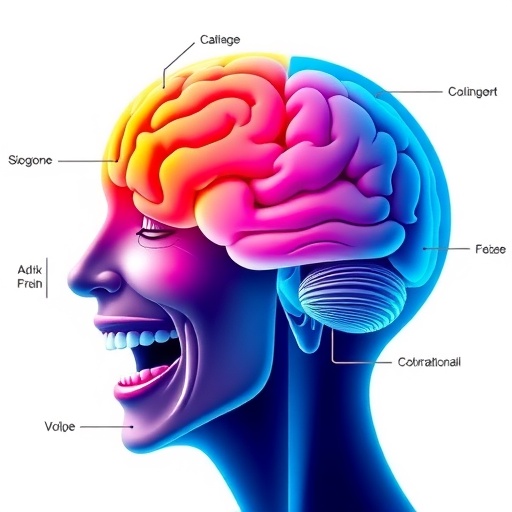
Laughter is a quintessential human behavior—an expressive social signal that forges immediate connections between people, transcending cultures and languages. Yet, despite its apparent universality, the neural substrates that orchestrate laughter remain enigmatic, primarily because eliciting authentic laughter in controlled laboratory environments has posed significant challenges. Recently, however, a comprehensive review published in the prestigious journal Trends in Neurosciences has cast new light on the complexity of laughter’s neural architecture by synthesizing data from direct brain stimulation studies in awake patients, alongside clinical and animal research.
The study unearths compelling evidence for two distinct cerebral networks governing laughter: one responsible for involuntary, spontaneous outbursts, and another managing voluntary, conversational laughter. These findings illuminate the dualistic nature of laughter, substantiating long-held behavioral observations with precise neurophysiological mechanisms. Spontaneous laughter, often uncontrollable and deeply intertwined with emotion, contrasts starkly with the finely tuned and intentionally timed voluntary laughter that punctuates everyday human interactions.
Historically, researchers have categorized laughter into these two primary types, noting their markedly different characteristics. Spontaneous laughter erupts suddenly and tends to be accompanied by intense mirth and physical manifestations that can be so overpowering individuals momentarily lose control. This form of laughter can, intriguingly, manifest as a symptom in various neurological and psychiatric disorders, such as certain seizure conditions, mood dysregulation disorders, Alzheimer’s disease, and schizophrenia, indicating its deep roots within limbic and motor systems governing affect.
In contrast, volitional laughter is the most commonly experienced type in daily life, especially within social conversations. It is precisely timed—often occurring at the culmination of a humorous remark or an amusing incident—and enables synchronous social breathing patterns between interlocutors. This coordination suggests that volitional laughter is under robust cortical control, allowing for rapid initiation and cessation aligned with the rhythm of speech and social context.
To dissect the cerebral underpinnings of these two laughter modalities, the researchers delved into rare but invaluable data arising from neurosurgical procedures involving awake brain stimulation, particularly in epilepsy patients. During pre-surgical mapping, specific cortical and subcortical areas are electrically stimulated to localize function and guide surgical resection. Occasionally, these stimulations evoke laughter unexpectedly, thereby providing a unique window into the responsible neural circuits, while patients’ conscious state allows for immediate subjective reporting of associated sensations and emotions.
From these observations, the team delineated two laughter-related networks in the brain. The spontaneous laughter circuit includes brain regions such as the pregenual anterior cingulate cortex, the nucleus accumbens, and the temporal pole. Electrical activation in these zones not only triggers laughter but also enhances positive affective states, producing euphoria and profound feelings of mirth. These regions play pivotal roles in motor control and emotional regulation, highlighting how spontaneous laughter is tightly coupled with affective processes and motor expression.
Conversely, the voluntary laughter network encompasses the rolandic operculum, globus pallidus, and the presupplementary motor area. Interestingly, stimulation of these areas induces laughter devoid of accompanying positive emotions, suggesting a purely motoric function. This dissociation underscores that voluntary laughter is primarily a controlled motor act rather than an involuntary emotional response, aligning neatly with its function in social communication rather than emotional release.
The evolutionary ramifications of these findings are profound. The spontaneous laughter network appears to be an ancient neural system that likely emerged from ancestral mammalian play behaviors—rough-and-tumble interactions characterized by laughter-like vocalizations. This form of laughter may have functioned as a non-threatening social cue to inhibit aggression and reinforce bonding, a hypothesis supported by evidence that several mammalian species produce laughter-equivalent sounds during playful social behavior.
On the other hand, the voluntary laughter circuit’s overlap with brain regions governing speech production suggests that this network evolved later to facilitate more sophisticated and goal-directed social vocalizations. This alignment supports the theory that the voluntary system integrates laughter into the fabric of human language and conversational pragmatics—providing nuanced social signals that enhance group cohesion and interpersonal rapport.
Beyond its fundamental neuroscientific contributions, this review highlights the translational potential of laughter research. By dissecting the neural bases of laughter, scientists can better understand pathological alterations seen in disorders marked by disrupted laughter patterns. Moreover, the authors propose that their findings may act as a “Rosetta stone” for interpreting vocal communication in social contexts, further bridging neuroscience with linguistics and conversation analysis.
One particularly fascinating aspect raised by the researchers is laughter’s capacity as a natural analgesic. Previous studies indicate that laughter can modulate pain perception, engaging endogenous pain-dampening systems. The identification of the anterior cingulate cortex within the spontaneous laughter network—an area instrumental in the brain’s pain regulatory circuits—raises intriguing possibilities for therapeutic exploitation of laughter in pain management.
Looking forward, the researchers express interest in exploring the analgesic functions of laughter more deeply, aiming to unravel the precise neural pathways that enable this effect. This avenue could open novel interventions for chronic pain sufferers, enriching the burgeoning field of psychoneuroimmunology and the biopsychosocial model of health.
This landmark synthesis by Caruana and Scott not only advances our understanding of laughter’s neurobiology but also rejuvenates the scientific appreciation of an everyday human phenomenon that binds us socially and emotionally, with vast implications for medicine, psychology, and social neuroscience.
Cite Scienmag News
Cassandra Pierce. (June 23, 2026). Spontaneous and Voluntary Laughter Originate in Distinct Brain Regions, Study Finds. Scienmag. https://scienmag.com/spontaneous-and-voluntary-laughter-originate-in-distinct-brain-regions-study-finds/
Cassandra Pierce. "Spontaneous and Voluntary Laughter Originate in Distinct Brain Regions, Study Finds." Scienmag, 23 June 2026, https://scienmag.com/spontaneous-and-voluntary-laughter-originate-in-distinct-brain-regions-study-finds/. Accessed 4 September 2026.
Cassandra Pierce. "Spontaneous and Voluntary Laughter Originate in Distinct Brain Regions, Study Finds." Scienmag. June 23, 2026. https://scienmag.com/spontaneous-and-voluntary-laughter-originate-in-distinct-brain-regions-study-finds/


