


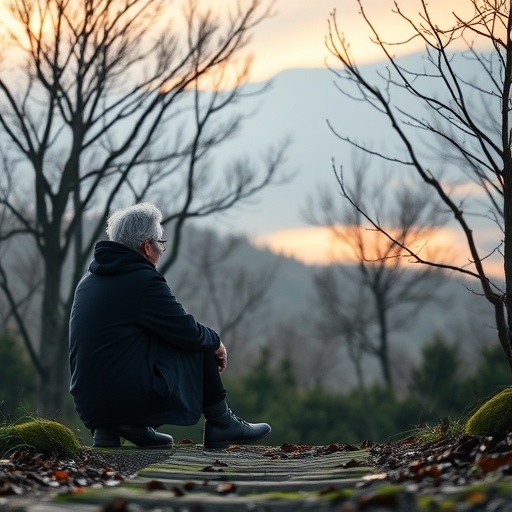
In a world grappling with the escalating threats of climate change, a new dimension of mental health concern has emerged, capturing the attention of researchers and clinicians alike: climate change anxiety. This form of psychological distress, grounded in fears about the environmental future, has profound implications, especially for vulnerable populations. A recent study, set to be published in BMC Geriatrics, delves deeply into the intricate relationship between climate change anxiety, death anxiety, and psychological resilience among older adults living with chronic illnesses. This pioneering research offers a nuanced understanding of the complex interplay between environmental stressors and mental health outcomes in a demographic often overlooked in psychological research.
The study emerges in the context of an aging global population, where chronic illnesses are prevalent and pose significant challenges to well-being and quality of life. Older adults with chronic health conditions already experience heightened vulnerability to mental health issues, and the infusion of climate-related anxieties compounds this burden. The researchers—Aydın, Karabulutlu, and Kavas—explored how worries about the planet’s deteriorating condition interface with fears surrounding mortality, and how these anxieties influence or are mitigated by psychological resilience, the capacity to withstand and adapt to stress.
At the heart of the investigation lies the concept of climate change anxiety, which transcends traditional environmental concern to manifest as sustained psychological distress. This form of anxiety is characterized by feelings of helplessness, dread, and catastrophic thinking related to future environmental scenarios. It is distinct from general anxiety disorders in its specificity and its rootedness in tangible, global threats. For older adults contending with chronic illnesses, such anxiety is not simply abstract or theoretical; it directly impacts their mental well-being and daily functioning.
Death anxiety, a well-studied phenomenon in gerontological and psychoanalytic literature, involves the fear or apprehension of death and dying. It is particularly pertinent in populations with chronic illnesses, where mortality perceptions are heightened. The study uniquely investigates how climate change anxiety may amplify feelings associated with death anxiety, adding layers of existential distress. This dual anxiety nexus presents a compounding psychological challenge that can exacerbate depressive symptoms and reduce life satisfaction.
Psychological resilience emerges as a critical moderating factor in this triadic relationship. Defined as an individual’s ability to recover from adversity and maintain psychological well-being, resilience acts as a buffer against the negative effects of anxiety. The researchers measured resilience in the study cohort to assess whether it could diminish the intensity of climate change and death anxiety, thereby offering potential pathways for therapeutic intervention.
The methodology used in this research involved a comprehensive assessment of psychological parameters through validated scales, targeting a sample of older adults diagnosed with a range of chronic illnesses. The researchers employed statistical modeling to discern patterns and correlations among the variables. This robust approach ensured that findings would reflect nuanced relationships rather than simplistic cause-effect assertions.
One significant finding was the strong positive correlation between climate change anxiety and death anxiety. Older adults who reported higher levels of concern about environmental degradation and its future implications also tended to experience heightened fears about mortality and dying. This suggests an intertwined psychological experience where fears about the environment trigger or exacerbate existential anxieties.
However, the presence of psychological resilience was shown to mitigate these anxiety levels significantly. Participants exhibiting higher resilience scores reported lower levels of both climate change and death anxiety. This protective effect underlines the importance of resilience-building interventions in older populations, especially those managing chronic health conditions. Such interventions could be crucial in enhancing mental health outcomes by equipping individuals with coping strategies that not only address their personal health struggles but also their broader existential concerns.
On a broader scale, these findings have profound implications for public health and geriatric care. Mental health services for older adults must evolve to incorporate environmental anxieties as legitimate and impactful concerns, especially as climate change continues to dominate global discourse and reality. Healthcare providers are thus urged to incorporate assessments of climate change anxiety into routine psychological evaluations and to tailor support accordingly.
The interplay between environmental threats and mental health also reflects societal and ethical considerations. Older adults with chronic illnesses occupy a unique position—they are among the most impacted by climate-induced hazards and yet often have limited agency in influencing large-scale environmental policies. Addressing their mental health needs related to climate anxiety is both a medical and moral imperative.
Furthermore, the study highlights the necessity of interdisciplinary approaches, blending environmental science, psychology, gerontology, and chronic disease management to develop holistic care models. Understanding how planetary health intersects with individual mental health can reshape healthcare paradigms, fostering resilience not only on a personal level but also within communities and systems.
As climate change continues to accelerate, the mental health sequelae will likely burgeon, extending beyond classic stress and anxiety disorders to encompass complex existential distress linked to planetary futures. This research advances knowledge by providing empirical evidence of these relationships specifically in a high-risk group, which can inform targeted policies and interventions designed to enhance psychological resilience.
In the era of climate emergencies, igniting global action often focuses on policy, technology, and mitigation strategies. The psychological dimension, however, is a silent but critical battlefield. Studies like this underscore that the mental health impacts of environmental crisis are not abstract future threats but current realities, particularly for older adults saddled with chronic conditions. Addressing this triad of anxieties with evidence-based psychological care is pivotal to promoting holistic health and well-being.
This study also invites future research to explore resilience-enhancing interventions tailored to older adults and to expand understanding of how social support systems, cultural contexts, and individual differences modulate these anxiety dynamics. The integration of adaptive psychological frameworks with environmental health perspectives promises to deepen our grasp of human responses to existential environmental challenges.
In sum, the investigation by Aydın and colleagues marks a vital contribution to a nascent but rapidly evolving field at the intersection of environmental change and geriatric mental health. It offers a clarion call for clinicians, policymakers, and researchers to recognize and address the mental health reverberations of climate change anxiety and death anxiety, while harnessing psychological resilience as a cornerstone of effective support for older adults with chronic illnesses.
Cite Scienmag News
Glenn Wilkins. (June 23, 2026). Climate, Death Anxiety, Resilience in Older Adults. Scienmag. https://scienmag.com/climate-death-anxiety-resilience-in-older-adults/
Glenn Wilkins. "Climate, Death Anxiety, Resilience in Older Adults." Scienmag, 23 June 2026, https://scienmag.com/climate-death-anxiety-resilience-in-older-adults/. Accessed 3 September 2026.
Glenn Wilkins. "Climate, Death Anxiety, Resilience in Older Adults." Scienmag. June 23, 2026. https://scienmag.com/climate-death-anxiety-resilience-in-older-adults/


