


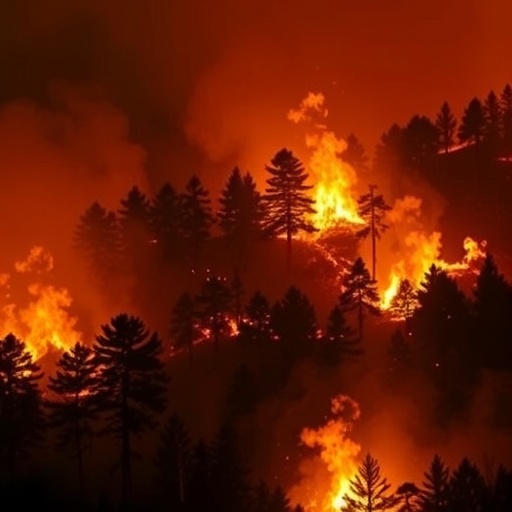
In early 2025, California was ravaged by two devastating wildfires—the Eaton and Palisades fires—that swept through residential areas of Los Angeles, including the communities of Altadena and Pacific Palisades. These fires tragically claimed 31 lives and destroyed over 16,000 buildings, a heart-wrenching loss primarily affecting residential homes. Beyond the immediate destruction, a less visible but potentially hazardous consequence emerged: contamination of soils and residual ash with toxic metals such as lead and arsenic. A detailed scientific investigation shed light on the nature and variability of this contamination, revealing critical insights pertinent to public health and environmental remediation.
The research, published in the prestigious journal Environmental Science and Technology Letters on May 12, 2026, was led by Daniel Richter, the Theodore S. Coile Distinguished Professor of Soils and Forest Ecology at Duke University’s Nicholas School of the Environment. Richter and his team undertook a comprehensive chemical analysis aimed at quantifying the presence of metals and metalloids in soils and structural ash from burned residences affected by these fires. Their findings offer a nuanced understanding of how urban wildfires may exacerbate metal contamination in residential environments, especially through the residue left behind following structural combustion.
At the core of the study is the recognition that homes themselves often harbor significant quantities of metals embedded in building materials and household products. When subjected to intense wildfire burning, these metals are volatilized and dispersed as airborne particulates but also become concentrated within the remnants of structural ash deposited on the ground. Distinct from the natural ash derived from burned vegetation, this structural ash is heterogeneous and can carry a complex mixture of contaminants, including legacy heavy metals such as lead that were historically used in building components like paint.
The study was initiated in collaboration with local partners. While the fires were still active, Daniel Richter was contacted by a colleague in Los Angeles who connected him with Robin Jones, founder of Honey Girl Grows, a local garden design enterprise. Jones mobilized and trained a network of volunteer homeowners to systematically collect soil and ash samples from over 30 burned properties across the affected communities. By March 2025, this community science effort had amassed approximately 300 samples, which were then transported to Duke University for rigorous laboratory analysis.
Under the supervision of Richter, the analysis was chiefly led by Ph.D. student Anselme Dossou and a team of student volunteers. Each sample underwent detailed assessment to ascertain concentrations of metal contaminants, with particular attention paid to lead and arsenic, recognized for their toxicity and persistence in the environment. The results revealed stark variability in contaminant levels both among and within sample types. Notably, the highest lead concentrations were found predominantly in structural ash from homes constructed prior to the 1970s, a period during which lead-based paints were commonly utilized in residential architecture.
Further temporal insights emerged from additional sampling conducted in June and July of the same year, subsequent to a large-scale remediation effort implemented by the U.S. Environmental Protection Agency (EPA) and the U.S. Army Corps of Engineers (USACE). This cleanup initiative entailed the removal of approximately 2.4 million tons of burned hazardous materials, targeting not only structurally compromised house foundations but also the top six inches of ash and soil—where contaminants were most concentrated. The post-cleanup samples, gathered within one meter of the initial locations, exhibited significantly reduced levels of lead and arsenic, demonstrating the effectiveness of the debris removal in mitigating soil contamination.
These findings hold profound implications for both environmental health and policy regulation. The study provides one of the rare comparative datasets illustrating contaminant levels before and after urban wildfire cleanup, filling a notable gap in existing knowledge since the USACE did not conduct post-fire testing. Richter emphasizes that such data are invaluable for validating current remediation strategies and informing best practices for future wildfire-affected urban areas, where the intersection of human habitation and wildfire risk continues to intensify.
Beyond the immediate findings, the research exposes a critical regulatory challenge. California uniquely enforces a residential soil lead standard that is less than half the corresponding threshold established by the EPA’s federal guidelines. This divergence creates confusion among residents and officials alike, complicating assessments of soil safety and the urgency of cleanup actions. Richter advocates for a thorough technical review of these differing lead standards to unify criteria and enhance public communication on soil contamination risks.
Perhaps one of the most striking conclusions of the study is the parallel it draws between soils impacted by these recent fires and the historically contaminated urban soils found across countless cities nationwide. The presence of residual metal contaminants in urban soils, a legacy of past industrial activity, paints, and other anthropogenic sources, is widely recognized but often overlooked in environmental risk assessments. The fires’ combustion of structures essentially re-mobilizes and soils these contaminants in new spatial patterns, effectively reminding us that “soils have long memories,” as Dossou metaphorically stated.
This research not only underscores the technical complexities inherent to urban wildfire aftermath but also highlights the critical need for community involvement in environmental monitoring. The successful collaboration between academic researchers and dedicated local volunteers illustrates a model for rapid response and data collection that empowers affected communities while generating high-quality scientific data. Such integrative approaches are essential for addressing the multifaceted challenges posed by urban conflagrations as climate change exacerbates wildfire frequency and intensity.
In light of these scientific insights, further research is warranted to deepen understanding of contaminant transport mechanisms post-wildfire, the long-term fate of metal contaminants in redeposited soils, and the development of more effective—and socially equitable—remediation protocols. As wildfires increasingly threaten densely populated areas, elucidating the environmental health impacts of structural ash contamination is vital for safeguarding communities, informing public policy, and advancing sustainable urban environmental management approaches.
For those seeking to explore the details of the study and the broader implications of urban wildfire contamination, a video discussion featuring the research authors offers an accessible summary and context. This resource further bridges the gap between complex scientific findings and public awareness, an essential step toward fostering informed community engagement and evidence-based decision-making in wildfire-prone regions.
News Publication Date: 12-May-2026
Web References:
– Environmental Science and Technology Letters article: https://pubs.acs.org/doi/full/10.1021/acs.estlett.6c00268
– Publicly available findings for Los Angeles Public Health Department: https://storymaps.arcgis.com/stories/667412ef37ee4392bddb5c90da3480f1?cover=false
– Video discussion by the study authors: https://www.youtube.com/watch?v=5qVyfpoFwoA
References:
Dossou SA, Kelly L, Lu PL, Jones R, O’Donnell O, Walsh JS, Richter DD. 2026. “Urban Conflagrations: Structural Ash and Soil Metal(loid) Contamination From California’s Eaton and Palisades Fires.” Environmental Science and Technology Letters.
Cite Scienmag News
Violet Maxwell. (June 22, 2026). Uncovering the Aftermath: Insights from the Palisades and Eaton Fires. Scienmag. https://scienmag.com/uncovering-the-aftermath-insights-from-the-palisades-and-eaton-fires/
Violet Maxwell. "Uncovering the Aftermath: Insights from the Palisades and Eaton Fires." Scienmag, 22 June 2026, https://scienmag.com/uncovering-the-aftermath-insights-from-the-palisades-and-eaton-fires/. Accessed 3 September 2026.
Violet Maxwell. "Uncovering the Aftermath: Insights from the Palisades and Eaton Fires." Scienmag. June 22, 2026. https://scienmag.com/uncovering-the-aftermath-insights-from-the-palisades-and-eaton-fires/


