


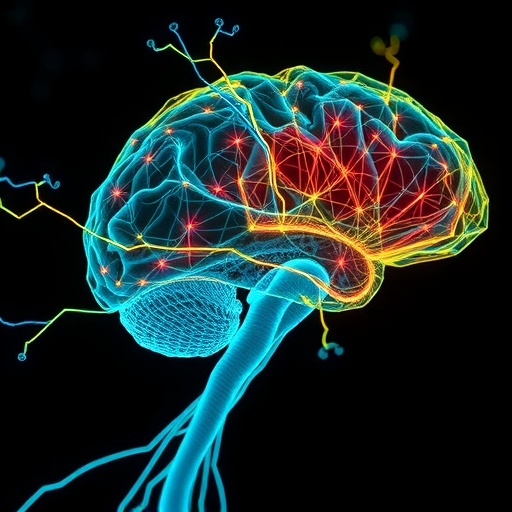
For decades, neuroscientists have grappled with the seemingly chaotic signals flowing through the brain’s electrical landscape. Human and animal electrophysiological recordings often appear as erratic, noisy traces without clear structure, making it challenging to extract meaningful patterns. While certain neural phenomena such as rhythmic oscillations or stimulus-evoked potentials stand out as distinct features, a large portion of brain signals historically relegated to “noise” are now emerging as rich sources of information. Among these, aperiodic neural activity—so named for its lack of regular rhythmicity—has garnered substantial interest, reshaping our understanding of how the brain operates on both physiological and functional levels.
Recent advances in computational modeling, signal processing, and experimental methodologies have revolutionized the study of aperiodic activity, peeling back layers to reveal systematic features embedded within what was once dismissed as stochastic irregularity. Rather than being mere background noise, aperiodic signals reflect complex neurophysiological processes, predominantly originating from postsynaptic transmembrane currents distributed throughout neuronal populations. This nuanced perspective challenges longstanding assumptions and invites a reevaluation of how brain electrical activity relates to cognition, behavior, developmental trajectories, aging, and neuropathology.
The physiological basis of aperiodic activity is multifaceted. Unlike oscillations that represent synchronized rhythmic firing patterns, aperiodic signals capture the aggregate voltage fluctuations arising from asynchronous postsynaptic potentials. These fluctuations are generated primarily by excitatory and inhibitory synaptic inputs impinging on dendritic membranes. By summating across vast networks of neurons, these transmembrane currents create a rich tapestry of spectral power that lacks a singular predominant frequency but nonetheless exhibits characteristic statistical properties, such as a power-law distribution across frequencies. Understanding this relationship is pivotal for linking macroscopic electrophysiological data with microcircuit-level mechanisms.
Emergent methods have empowered scientists to dissect this component of brain activity with unprecedented precision. Techniques such as spectral parameterization allow researchers to separate the aperiodic “background” from overlaid oscillatory elements. By fitting mathematical models to power spectral densities of neural recordings, investigators can quantify parameters that reflect the slope and intercept of the aperiodic spectrum, which in turn index underlying neurobiological states. This parameterization reveals how changes in excitation-inhibition balance or synaptic density may manifest as shifts in aperiodic signal characteristics, offering a window into cellular and network dynamics otherwise inaccessible through traditional measures.
The functional significance of aperiodic neural activity is now increasingly recognized. Cognitive processes, including attention, memory, and perceptual decision-making, have been linked to modulations in the aperiodic component of electrophysiological recordings. For instance, state-dependent changes in the slope of the power spectrum correspond to alterations in neural excitability and information processing efficiency. Moreover, developmental and aging studies highlight how aperiodic parameters evolve across the lifespan, reflecting maturation of synaptic architecture or neurodegenerative processes. Such insights underscore the potential of aperiodic metrics as biomarkers for cognitive health and disease progression.
In clinical neuroscience, the diagnostic and prognostic utility of aperiodic activity is gaining traction. Disorders characterized by synaptic dysfunction—such as schizophrenia, autism spectrum disorder, and epilepsy—exhibit distinctive alterations in aperiodic signal features. These electrophysiological signatures may provide non-invasive biomarkers for early detection, symptom monitoring, and therapeutic response evaluation. Importantly, because aperiodic activity reflects fundamental neurophysiological underpinnings, it complements traditional oscillatory analyses, thereby enriching the neurodiagnostic toolkit.
The interplay between aperiodic activity and other neural signal statistics invites a broader conceptual framework. While measures such as entropy, fractal dimension, and complexity indices capture aspects of signal unpredictability and self-similarity, aperiodic metrics are uniquely positioned to link these abstract descriptors directly to synaptic and cellular mechanisms. This bridging function encourages integrative models that can unify disparate electrophysiological phenomena under a common mechanistic umbrella, advancing both theoretical and applied neuroscience.
Computational modeling experiments have been instrumental in elucidating the biophysical mechanisms generating aperiodic activity. Simulations of cortical microcircuits reveal how variations in synaptic conductances, neuronal morphology, and network connectivity produce distinct spectral profiles. These models provide testable predictions about how disease-related perturbations—such as inhibitory interneuron loss or altered synaptic plasticity—manifest in altered aperiodic slopes and intercepts. By connecting micro- to macroscopic scales, modeling guides empirical investigations and informs interpretation of in vivo data.
Beyond basic science, the study of aperiodic neural activity invites provocative questions about the organization of brain function. Does the ubiquitous presence of aperiodic dynamics reflect an optimized balance between order and disorder, facilitating flexible yet stable information processing? Could modulation of this neural “background” underlie shifts in conscious states, from wakefulness to sleep and altered consciousness? These speculative frontiers tantalize neuroscientists eager to uncover universal principles governing complex brain dynamics.
Despite these advances, several open questions remain. The specific cellular and circuit-level contributors to aperiodic activity across brain regions and states require further elucidation. The temporal dynamics and causal relationships linking aperiodic changes to behavior and cognition are yet to be fully understood. Moreover, methodological standardization is needed to harmonize approaches for analyzing and interpreting aperiodic signals, enabling comparability across studies and populations.
Exciting future research directions involve integrating multimodal data, such as combining electrophysiology with neuroimaging and molecular profiling, to contextualize aperiodic activity within broader neural architectures. Longitudinal studies tracking aperiodic metrics across disease trajectories may yield powerful biomarkers and targets for intervention. Additionally, exploring how neuromodulatory systems shape the aperiodic landscape could reveal mechanisms by which pharmacological agents influence brain states.
In sum, the study of aperiodic neural activity reframes our understanding of the brain’s electrical signals, transforming perceived noise into a meaningful substrate of neural computation. This paradigm shift opens new horizons for deciphering the brain’s complexity, with profound implications for neuroscience research, clinical practice, and the quest to unravel the neural basis of cognition and behavior.
As this field matures, the ability to harness the diagnostic and therapeutic potential of aperiodic activity promises to revolutionize approaches to brain health and disease. By embracing the complexity inherent in neural signals and employing innovative analytic frameworks, scientists are poised to illuminate the dynamic interplay of neural circuits in health and pathology. The once-dismissed “noise” now stands as a frontier of discovery, challenging neuroscientists to rethink foundational assumptions and expand the limits of knowledge.
This transformative reconceptualization underscores a broader lesson: within apparent disorder, the brain harbors intricate patterns vital to its function. Appreciating and decoding these patterns holds the key to unlocking mysteries of the mind, enhancing human health, and advancing the neurosciences into a new era of understanding.
Cite Scienmag News
Cassandra Pierce. (June 22, 2026). Unraveling the Role of Aperiodic Neural Activity. Scienmag. https://scienmag.com/unraveling-the-role-of-aperiodic-neural-activity/
Cassandra Pierce. "Unraveling the Role of Aperiodic Neural Activity." Scienmag, 22 June 2026, https://scienmag.com/unraveling-the-role-of-aperiodic-neural-activity/. Accessed 5 September 2026.
Cassandra Pierce. "Unraveling the Role of Aperiodic Neural Activity." Scienmag. June 22, 2026. https://scienmag.com/unraveling-the-role-of-aperiodic-neural-activity/


