


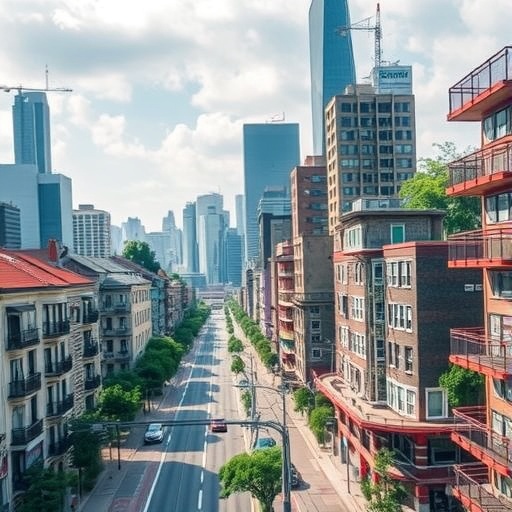
As global temperatures continue to escalate due to climate change, the need for effective urban cooling solutions has never been more urgent. A recent groundbreaking study published in Nature Communications penetrates the complex dynamics of cooling demand across thousands of cities worldwide, offering new insights into patterns, drivers, and evolving trends. This research not only sheds light on the escalating energy requirements but also provides a crucial foundation for policymakers and urban planners striving to mitigate the looming threat of urban heat stress.
Urban heat islands (UHIs)—localized regions where man-made structures cause significantly higher temperatures compared to surrounding rural areas—are a well-documented phenomenon, exacerbating warming in densely populated areas. The study meticulously quantifies how UHI effects contribute to rising cooling energy demands. By systematically analyzing data derived from satellite observations, climate models, and municipal energy use statistics spanning multiple decades, the researchers uncovered nuanced correlations between urban form, geographic location, and cooling necessities.
One pivotal revelation from the study is the differentiation in cooling demand patterns between cities based on climatic zones. Tropical cities, already grappling with intense heat, exhibit a persistently high and growing demand for air conditioning, while temperate and arid cities reveal seasonal spikes coupled with increasing baseline needs. These spatial disparities in cooling consumption underscore the importance of region-specific adaptation strategies rather than one-size-fits-all solutions.
Driving factors influencing cooling demand extend beyond temperature alone. The study delves into urban socioeconomic variables such as income growth, population density, and building typologies, illustrating their significant interplay with energy needs. Wealthier urban populations tend to demand more comfort cooling, increasing per capita energy consumption, while densely built environments limit passive cooling opportunities, further escalating dependency on mechanical cooling systems.
Trends over recent years are particularly illuminating. The research highlights an alarming acceleration in cooling demand, predominantly driven by urban expansion and rising standards of living, especially in developing regions. This surge threatens to exacerbate energy infrastructure stress, particularly where electricity grids are already stretched thin, amplifying grid vulnerability during peak summer loads.
Utilizing advanced machine-learning algorithms, the investigators successfully predicted future cooling demand trajectories under various climate change and urbanization scenarios. These projections are sobering, indicating that without concerted interventions, global cooling energy needs could triple by mid-century. The findings signify more than just discomfort; they foreshadow a sharp uptick in greenhouse gas emissions linked to increased electricity generation unless renewable energy integration is accelerated.
The research also places significant emphasis on the role of urban morphology—the physical composition and layout of cities—in influencing microclimate and, consequently, cooling demands. Compact city designs with high-rise buildings and limited green spaces tend to exacerbate heat retention, while dispersed, vegetation-rich cities display cooler microenvironments. This illustrates the potential for urban design innovations, such as green roofs, expanded tree canopy cover, and reflective building materials, to mitigate cooling energy consumption effectively.
Importantly, the study critiques current urban energy policies, noting that many cities lack tailored strategies to address localized cooling demand. The authors advocate for incorporating their refined data models into municipal planning frameworks to optimize resource allocation and infrastructural investments. They underscore the vital need for integrating climate resilience with sustainable development goals, promoting equitable access to cooling that does not compromise environmental commitments.
Furthermore, the research unravels the synergistic effects of global warming and urbanization. As cities expand, impervious surfaces increase, disrupting natural evaporative cooling processes. The combined impact of climate-driven temperature rise and urban sprawl creates a feedback loop intensifying cooling demand. Recognizing this cycle is pivotal for breaking the pattern through innovative urban greening and sustainable infrastructure.
The study also explores the potential of emerging cooling technologies to alleviate energy burdens. Innovations such as solar-powered air conditioning, passive cooling architectures, and district cooling systems offer promising avenues. However, widespread adoption depends on supportive policy frameworks, technological accessibility, and financial incentives, particularly in resource-constrained urban centers.
Another dimension the research highlights pertains to social equity. Rising cooling demand risks deepening inequalities, with low-income populations bearing the brunt of heat stress due to limited access to affordable cooling solutions. The authors draw attention to this disparity, advocating for inclusive strategies that prioritize vulnerable groups, ensuring that cooling infrastructure investments improve public health outcomes across all demographics.
By integrating an interdisciplinary approach combining climatology, urban planning, socioeconomics, and energy systems analysis, the study provides a holistic understanding of urban cooling demand. This comprehensive framework equips stakeholders with actionable intelligence to design adaptive urban environments that are both comfortable and sustainable amidst accelerating climate challenges.
In conclusion, as the world gears to face intensifying heatwaves and unprecedented urban growth, this study acts as a clarion call for proactive, data-driven urban cooling management. It offers a roadmap to not only safeguard human well-being but also to curtail the environmental footprint of cooling energy demand. Ultimately, this pioneering research underscores the imperative of harmonizing urban resilience with climate mitigation to forge sustainable cities of the future.
Cite Scienmag News
Violet Maxwell. (June 22, 2026). Global Cities’ Urban Cooling: Patterns and Drivers. Scienmag. https://scienmag.com/global-cities-urban-cooling-patterns-and-drivers/
Violet Maxwell. "Global Cities’ Urban Cooling: Patterns and Drivers." Scienmag, 22 June 2026, https://scienmag.com/global-cities-urban-cooling-patterns-and-drivers/. Accessed 4 September 2026.
Violet Maxwell. "Global Cities’ Urban Cooling: Patterns and Drivers." Scienmag. June 22, 2026. https://scienmag.com/global-cities-urban-cooling-patterns-and-drivers/


