


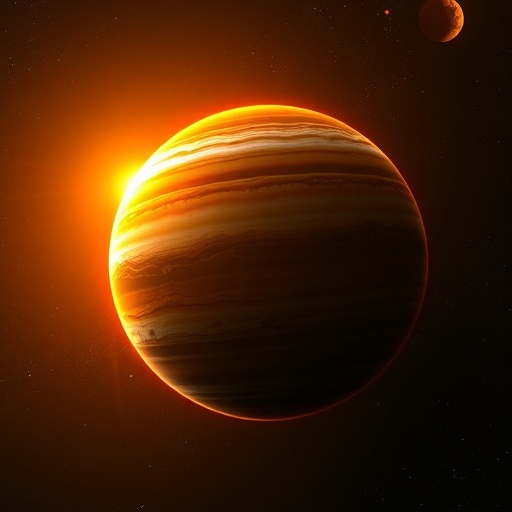
For nearly a decade, the hot Jupiter CoRoT-2 b has presented a profound mystery to astronomers: its atmospheric hot spot is inexplicably located opposite the position observed on all other exoplanets of its kind. This peculiar phenomenon challenges conventional wisdom about the nature of hot Jupiters and their atmospheric dynamics. Recent research led by Aurora Kesseli, a staff scientist at the NASA Exoplanet Science Institute (NExScI) housed within Caltech’s IPAC center, has shed new light on this enigma by leveraging advanced spectroscopic data obtained from the Very Large Telescope (VLT) at the European Southern Observatory. This breakthrough offers compelling evidence that CoRoT-2 b defies a fundamental assumption about hot Jupiters: it is not tidally locked to its host star.
Hot Jupiters are a fascinating class of exoplanets typified by their colossal size—often comparable to or exceeding that of Jupiter—and their blisteringly close orbits around host stars, sometimes completing a single revolution in mere days. Because of these properties, hot Jupiters serve as prime candidates for detailed atmospheric studies. Their proximity to the parent star means they receive intense irradiation, significantly influencing their atmospheric dynamics, radiative properties, and chemical compositions. This environment makes them critical laboratories for testing and refining planetary formation, evolution, and climate models.
The accepted paradigm for hot Jupiter atmospheres is predicated on tidal locking, whereby the planet’s rotation period synchronizes with its orbit, causing one hemisphere to perpetually face the star, exposed to relentless stellar radiation, while the opposite side remains cloaked in darkness. This lock is thought to occur rapidly due to strong gravitational interactions between the planet and its star. The perpetual dayside is expected to feature a dominant hot spot slightly offset towards the direction of planetary rotation and orbital motion, driven by atmospheric super-rotation. This consistent pattern is observed across many studied hot Jupiters, reinforcing tidal locking as a foundational concept within exoplanetary atmospheric science.
However, CoRoT-2 b stands out starkly against this backdrop. Discovered in 2007 and studied extensively since, this hot Jupiter’s hottest atmospheric region is displaced not ahead of but behind the substellar point—the point on the planet directly facing its star—opposite to the behavior seen in counterparts. Initial hypotheses proposed to explain this anomaly included obscuring cloud layers, magnetic field-driven atmospheric dynamics complicating wind patterns, or a rotation period differing from the orbital period. Previous work by Lisa Dang, a collaborator and professor at the University of Waterloo, outlined these potential explanations based on early observational data.
Aurora Kesseli and her team recently applied phase-resolved emission spectroscopy using the CRIRES+ instrument on the VLT, capturing the planet’s atmosphere in unprecedented detail across different orbital phases. This method enables tracing variations in emitted light corresponding to temperature and wind structures dynamically as the planet orbits. The data conclusively pointed toward the third hypothesis: CoRoT-2 b exhibits a rotation rate slower than its orbital period, meaning it is not synchronized tidally. Specifically, one full rotation of CoRoT-2 b lasts approximately three Earth days, while its orbital period is about 1.5 days. This differential implies that by the time the planet completes a single axial spin, it has circumnavigated its host star twice.
This non-synchronous rotation leads to a decoupling of the traditional tidally locked pattern of day-night heating contrasts, fundamentally altering how atmospheric circulation redistributes energy. Without tidal locking, the expected eastward-shifted hot spot is replaced by a distinct thermal signature resulting from slower planetary spin interacting with intense stellar irradiation. The discovery challenges standard assumptions embedded in many exoplanet climate models that universally prescribe tidal locking for hot Jupiters, suggesting a more nuanced picture with rotational diversity.
Understanding the rotational state of exoplanets like CoRoT-2 b carries broader implications, especially in the context of habitability studies. Many terrestrial exoplanets orbit M dwarfs, cool stars constituting roughly 70% of the stellar population in the Milky Way. These stars have habitable zones—regions where liquid water can persist on planetary surfaces—so close that tidal locking is highly probable within relatively short stellar lifetimes. Since rotation influences temperature gradients, weather systems, and atmospheric retention, a tidally locked terrestrial exoplanet’s climate could differ drastically from one with asynchronous rotation. Hence, unraveling CoRoT-2 b’s rotation contributes to refining the models employed for predicting environments on potentially habitable worlds in tight orbits.
While the revelation of CoRoT-2 b’s slow rotation solves a significant piece of the puzzle, it simultaneously opens further questions. The mechanisms driving this atypical rotational state in a planet where tidal forces should dominate remain elusive. Possible contributors might include magnetic torques, differential interior structures, or recent dynamical interactions within its planetary system that disturbed its spin. Future observations, especially with upcoming flagship observatories like the James Webb Space Telescope, the Habitable Worlds Observatory, and the ground-based Extremely Large Telescope, promise to provide deeper insight into these processes by offering higher precision data across broader wavelength ranges.
Hot Jupiters continue to act as vanguards in exoplanetary science. They are currently the best-understood and most accessible class of exoplanets for atmospheric characterization, enabling astronomers to test and recalibrate models of atmospheric physics, chemistry, and dynamics. The case of CoRoT-2 b exemplifies how nature’s variability often defies simplified expectations, compelling constant refinement of theories and models. These advances do not merely enhance comprehension of gas giants but ripple outward to shape understanding of all planetary atmospheres, including those bearing life.
Kesseli underscores the excitement of probing “weird” exceptions within the exoplanet census, emphasizing that such outliers drive scientific progress. As instrumentation improves and more extensive surveys unfold, the taxonomy of exoplanetary rotation states, atmospheric dynamics, and climate regimes will grow richer. This improved framework will essentialize our broader quest to understand planet formation, stellar influences, and potential biosignatures on distant worlds. CoRoT-2 b’s defiance of tidal locking invites the scientific community to remain alert to unexpected phenomena lurking in exoplanet atmospheres.
In summation, the unraveling of CoRoT-2 b’s anomalous atmospheric hot spot through rigorous spectroscopic measurements marks a milestone in exoplanet research. It dispels the notion of universal tidal locking among hot Jupiters and reveals a more intricate rotational behavior impacting atmospheric properties. The ongoing inquiry into the cause of this slowed rotation will propel future efforts to decipher planetary spins, magnetic interactions, and orbital dynamics across a diverse planetary population. These insights will deepen our grasp of planetary physics and help guide the search for habitable environments beyond our solar system.
Cite Scienmag News
Grant Pearson. (June 17, 2026). Unusual Exoplanet Redefines the Concept of a Hot Jupiter. Scienmag. https://scienmag.com/unusual-exoplanet-redefines-the-concept-of-a-hot-jupiter/
Grant Pearson. "Unusual Exoplanet Redefines the Concept of a Hot Jupiter." Scienmag, 17 June 2026, https://scienmag.com/unusual-exoplanet-redefines-the-concept-of-a-hot-jupiter/. Accessed 3 September 2026.
Grant Pearson. "Unusual Exoplanet Redefines the Concept of a Hot Jupiter." Scienmag. June 17, 2026. https://scienmag.com/unusual-exoplanet-redefines-the-concept-of-a-hot-jupiter/


