


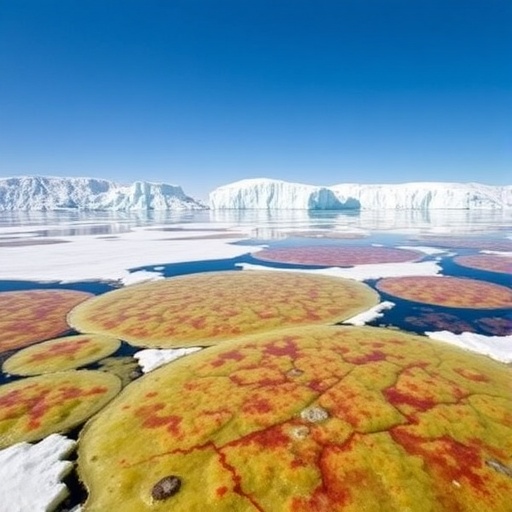
The Greenland Ice Sheet, one of the planet’s largest reservoirs of freshwater, has become the focal point of groundbreaking research revealing a hitherto underestimated phenomenon: pervasive and expanding glacier algal blooms. Recent advanced modeling conducted by scientists Williamson and Tedstone has shed new light on the spatial extent and environmental implications of these microscopic organisms thriving on the ice. This emerging evidence disrupts prior assumptions about glacier ecosystems and poses significant concerns regarding future ice sheet dynamics amid climate warming.
Glacier algae, photosynthetic microorganisms adapted to extreme cold, dark, and nutrient-poor environments, have traditionally been considered minor ecological players in polar regions. However, their capacity to proliferate in biofilms across the ice surface influences the ice’s physical properties profoundly. The team utilized sophisticated climate-ice modeling tools coupling biological growth parameters to simulate algal bloom dynamics across Greenland’s vast ice sheet. This holistic approach enabled quantification of bloom distribution and intensity under current and projected climatic scenarios, opening avenues to assess feedback mechanisms in cryosphere systems.
The researchers addressed key variables including temperature fluctuations, solar radiation, meltwater availability, and nutrient influx that regulate glacier algal growth. By integrating these parameters, their model replicated repeated satellite observations indicating that algal blooms have become ubiquitous rather than occasional phenomena on the ice sheet’s surface. Importantly, this newfound ubiquity corresponds with notable increases in the ice’s albedo reduction, a process by which the darkened ice absorbs significantly more solar energy, accelerating melting rates substantially.
One of the critical breakthroughs of the study is the identification of a positive feedback loop involving glacier algae expansion and ice melt intensification. As temperatures rise, the expanded meltwater ponds create optimal microhabitats, facilitating rapid algal growth. This dark biomass, in turn, reduces reflectance, trapping more heat and thus promoting further meltwater generation—a cascading effect that amplifies ice mass loss. The implications for sea-level rise are profound since even marginal increases in melt rates compound over the Greenland Ice Sheet’s immense area.
The modeling framework also underscores the spatial variability of algal bloom intensity. Coastal fringes and lower elevation zones experience the highest biomass accumulation due to warmer temperatures and longer melt seasons. Conversely, high-altitude sites see more sporadic blooms, limited by colder conditions and shorter windows of liquid water presence. However, the projection models suggest an altitudinal upward expansion of these biological communities as climate warming persists, potentially transforming previously cryotoxic zones into hospitable environments for microbial colonization.
Further analysis revealed complex interactions between algal species composition and their pigmentation, which influence their light-absorption properties. Some glacier algae produce dark pigments like purpurogallin, a bioactive compound that enhances solar radiation absorption, contributing disproportionately to albedo reduction relative to their biomass. This biochemical adaptation illustrates the tightly coupled biological-physical dynamics on ice surfaces and the potential for microbe-driven modulation of glacier energy balance.
The study also incorporates insights from remote sensing technologies, including multispectral satellite instruments capable of detecting subtle color changes on the Greenland Ice Sheet indicative of blooming events. These observational datasets, validated against in-situ measurements, provided empirical support for the model’s predictive accuracy. Such integration of fieldwork and computational modeling represents a cutting-edge methodology in cryoecology, enabling researchers to quantify glacier surface biological phenomena at unprecedented spatial and temporal resolutions.
Climate models incorporating these glacier algal dynamics expose an alarming acceleration in the Greenland Ice Sheet’s mass loss trajectory. Inclusion of biological factors leads to revised melt projections that surpass prior estimates relying solely on physical ice melt processes. This insight challenges the traditional paradigms of cryosphere modeling and calls for a multidisciplinary approach that fully integrates biogeochemical and microbial influences into climate impact assessments.
From an ecological perspective, expanding glacier algal blooms signify a broader shift in polar microbial ecosystems in response to anthropogenic climate change. These vibrant microbial mats not only modify the physical environment but also participate actively in the cycling of nutrients and carbon on the ice surface, potentially altering biogeochemical fluxes at regional and global scales. The expansion of such biota may herald a new era of glacier ecology, where microbial life increasingly shapes cryospheric processes.
The researchers caution that while current models provide a vital baseline, uncertainties remain regarding the precise sensitivity of glacier algae to evolving environmental parameters such as nutrient availability from atmospheric deposition and meltwater chemistry alterations. Future investigations will need to incorporate microbial genomic and metabolic studies to refine growth kinetics and adaptive resilience under multifactorial stress conditions driven by climate variability.
The potential ramifications of glacier algal blooms extend beyond Greenland. Similar processes may be occurring or will develop in ice masses worldwide, including mountain glaciers and Antarctic ice shelves. This raises critical questions about representativeness and transferability of observational and modeling findings across different cryoenvironments. Continued interdisciplinary research is essential to globally map biological-cryosphere interactions and predict their contributions to ice sheet stability and sea-level rise.
Ultimately, the work by Williamson and Tedstone adds a vital piece to the puzzle of how biological life interacts with Earth’s changing cryosphere. Their modeling of ubiquitous and expanding glacier algal blooms challenges us to reconsider ice sheets not merely as inert reservoirs of frozen water, but as dynamic ecosystems intricately entwined with climate processes. As climate warming intensifies, these microscopic organisms emerge as influential agents capable of reshaping the trajectories of some of the planet’s most critical and vulnerable landscapes.
Their findings call for immediate attention from climate scientists, ecologists, and policymakers alike, highlighting the need to integrate biological feedbacks into predictive models and mitigation strategies. Understanding and managing the consequences of expanding glacier algal blooms may prove crucial for preserving polar environments and moderating global sea-level rise in the coming decades.
In essence, Greenland’s ice sheet is not just melting — it is biologically darkening and transforming in ways that complicate our understanding of climate change impacts. The intersection of microbial ecology and glaciology unveiled by this study signals a paradigm shift that underscores the intricate complexity of Earth’s systems and the unforeseen drivers accelerating environmental change.
Cite Scienmag News
Violet Maxwell. (June 16, 2026). Widespread Glacier Algal Blooms Grow Across Greenland Ice. Scienmag. https://scienmag.com/widespread-glacier-algal-blooms-grow-across-greenland-ice/
Violet Maxwell. "Widespread Glacier Algal Blooms Grow Across Greenland Ice." Scienmag, 16 June 2026, https://scienmag.com/widespread-glacier-algal-blooms-grow-across-greenland-ice/. Accessed 4 September 2026.
Violet Maxwell. "Widespread Glacier Algal Blooms Grow Across Greenland Ice." Scienmag. June 16, 2026. https://scienmag.com/widespread-glacier-algal-blooms-grow-across-greenland-ice/


