


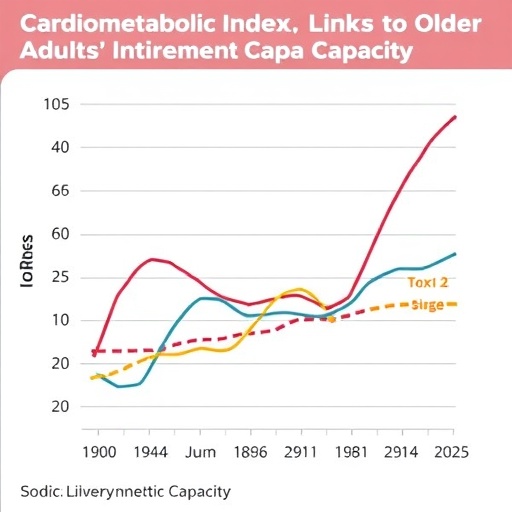
A groundbreaking new study leveraging the China Health and Retirement Longitudinal Study (CHARLS) data has illuminated the intricate relationship between the cardiometabolic index (CMI) and intrinsic capacity in older adults. As populations worldwide continue to age, understanding the multifaceted determinants of healthy aging becomes paramount. This fresh research, published in BMC Geriatrics in 2026, delivers critical insights that could revolutionize how geriatrics and preventive medicine approach elder care and chronic disease management.
Intrinsic capacity, a concept increasingly central to gerontology, represents the composite of all the physical and mental capacities an individual can draw upon. It encompasses diverse domains such as cognition, locomotion, sensory functions, psychological health, and vitality. Maintaining intrinsic capacity is essential for older adults to preserve functional independence and quality of life. The new investigation specifically examined how cardiometabolic health, a field that reflects the interplay of heart health, metabolism, and vascular function, correlates with intrinsic capacity trajectories among the elderly.
At the heart of this research is the cardiometabolic index, a quantitative marker amalgamating several metabolic risk factors—including waist circumference, triglyceride levels, and fasting glucose—as well as blood pressure and lipid profiles. Elevated CMI indicates heightened metabolic dysfunction and cardiovascular risk, which have long been implicated in age-related morbidity and functional decline. Yet, the extent to which CMI corresponds with the multidimensional intrinsic capacity domains has remained understudied until now.
Utilizing an expansive dataset from CHARLS, which tracks a nationally representative sample of Chinese adults aged 45 and older over time, the researchers conducted a rigorous analysis involving thousands of participants. This longitudinal framework provided an unprecedented opportunity to examine baseline cardiometabolic health factors and their dynamic associations with changes in intrinsic capacity across multiple years. Advanced statistical models adjusted for socioeconomic variables, lifestyle factors, comorbidities, and medication usage to isolate the independent effects of CMI.
The findings unveiled a robust inverse association between higher cardiometabolic index values and intrinsic capacity scores. Specifically, elevated CMI was linked to greater declines in locomotion, cognitive function, sensory abilities such as vision and hearing, and psychological well-being domains. This multidimensional impact underscores the pervasive influence of cardiometabolic health on overall physiological resilience and functional aging.
Importantly, the study demonstrated that these relationships persisted even after controlling for age, sex, physical activity levels, smoking status, and educational attainment. This suggests that cardiometabolic mechanisms independently contribute to the deterioration of intrinsic capacity beyond the typical aging process and lifestyle effects. The data imply that subclinical metabolic dysfunction silently erodes physiological reserve, accelerating frailty and disability onset.
Furthermore, disaggregated domain analyses revealed nuanced insights. For instance, cognitive decline exhibited particularly strong correlations with abnormal lipid and glucose regulation metrics, aligning with growing evidence implicating vascular and metabolic risk factors in neurodegeneration and dementia progression. Similarly, locomotor impairments appear linked to systemic inflammation and endothelial dysfunction promoted by metabolic dysregulation.
The practical implications of these results are profound. Cardiometabolic index assessment could serve as a cost-effective, integrative biomarker for early identification of older adults at heightened risk of functional decline, enabling timely interventions. Targeted strategies that optimize cardiometabolic profiles—such as dietary modulation, physical exercise, pharmacotherapy, and chronic disease management—may help preserve intrinsic capacity, prolong autonomy, and reduce healthcare burdens.
Moreover, the study advocates for a paradigm shift in geriatric evaluation frameworks. Rather than focusing solely on diagnosed diseases or disabilities, incorporating composite indices like CMI offers a proactive method to gauge physiological resilience holistically. This could facilitate personalized medicine approaches tailored to individual risk landscapes, enhancing prevention and rehabilitation outcomes.
From a public health standpoint, these findings spotlight the critical need to address cardiometabolic health across the lifespan to foster healthier aging trajectories. Policies promoting early screening, lifestyle education, and equitable access to metabolic disorder treatments will be essential to mitigate the growing socioeconomic impacts of aging populations globally.
Scientifically, this research opens new avenues for exploring the biological underpinnings linking cardiometabolic dysfunction and intrinsic capacity decline. Potential molecular pathways involve oxidative stress, chronic inflammation, mitochondrial impairment, and vascular remodeling. Subsequent investigations involving biomarkers, imaging, and intervention trials could unravel causal mechanisms and optimize therapeutic targets.
In sum, this seminal study elegantly integrates epidemiological data with gerontological constructs, highlighting the cardiometabolic index as a pivotal nexus impacting intrinsic capacity domains in older adults. By portraying metabolic health as a foundational determinant of multidimensional functional aging, it invites a recalibration of clinical priorities and enriches the conceptual fabric of healthy aging sciences.
As populations age globally, fostering intrinsic capacity preservation through cardiometabolic management offers a promising frontier to enhance longevity and life quality. This research embodies a critical step in unraveling the complex biology of aging and encourages cross-disciplinary endeavors that unify metabolic health and functional gerontology.
The collective insights underscore that aging is not an inexorable march towards decline but a modifiable process intricately linked to physiological homeostasis. Leveraging cardiometabolic indices as tools for early detection and targeted intervention can usher in a new epoch of preventive geriatrics, prolonging vitality and independence for millions worldwide.
The integration of cardiovascular and metabolic markers into geriatric assessments represents a monumental advancement with deep ramifications for clinical practice, research innovation, and public health strategy. Future studies can build upon this foundation to craft comprehensive models forecasting aging trajectories and responsively mitigating decline.
As this field evolves, multidisciplinary collaborations bridging endocrinology, neurology, cardiology, and gerontology will be indispensable. This fosters a holistic understanding indispensable for effectively addressing the challenges and opportunities inherent in extending healthspan alongside lifespan in an aging society.
Cite Scienmag News
Beatrice Stafford. (June 16, 2026). Cardiometabolic Index Links to Older Adults’ Intrinsic Capacity. Scienmag. https://scienmag.com/cardiometabolic-index-links-to-older-adults-intrinsic-capacity/
Beatrice Stafford. "Cardiometabolic Index Links to Older Adults’ Intrinsic Capacity." Scienmag, 16 June 2026, https://scienmag.com/cardiometabolic-index-links-to-older-adults-intrinsic-capacity/. Accessed 3 September 2026.
Beatrice Stafford. "Cardiometabolic Index Links to Older Adults’ Intrinsic Capacity." Scienmag. June 16, 2026. https://scienmag.com/cardiometabolic-index-links-to-older-adults-intrinsic-capacity/


