


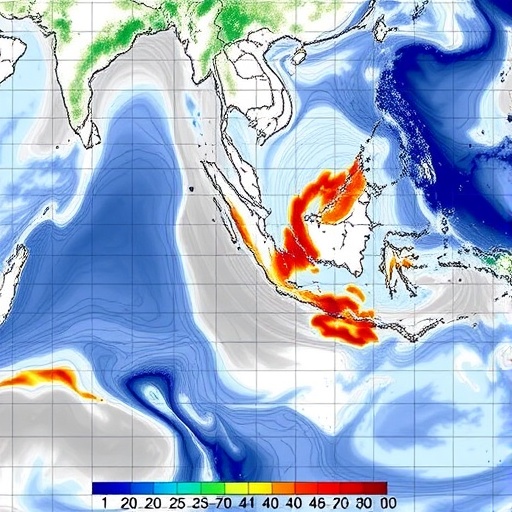
In a groundbreaking new study published in Nature Communications, researchers have uncovered how Rossby waves, colossal atmospheric phenomena, significantly modulate precipitation anomalies across the Asia-Pacific region. This discovery sheds light on the complex interplay between large-scale atmospheric dynamics and localized weather patterns, potentially revolutionizing predictive meteorology and water resource management in one of the world’s most climatically diverse and densely populated areas.
Rossby waves, named after the meteorologist Carl-Gustaf Rossby who first described them, are giant waves in the mid-latitude upper atmosphere that play a pivotal role in shaping weather systems. Their undulating patterns of high and low pressure migrate slowly around the globe, affecting storm tracks, jet streams, and ultimately precipitation. While the influence of Rossby waves on weather in the mid-latitudes has been broadly recognized, their specific modulation of precipitation in the Asia-Pacific region remained elusive until now.
Using an innovative integration of satellite data, climate models, and orbital mechanics, the research team led by Yu, Song, and Jian has revealed a direct correlation between the phase and amplitude of Rossby waves and precipitation anomalies linked with Earth’s orbital variations. The study illustrates how these oscillations are not simply random but dynamically intertwined with long-term orbital cycles, introducing a new paradigm in understanding regional climate variability.
One of the key advances presented is the ability to distinguish the orbital forcing signals within Rossby wave patterns. Orbital forcing refers to the slow but persistent changes in Earth’s orbit and axial tilt, which affect the distribution of solar radiation reaching the surface. Previously associated primarily with glacial cycles over millennia, these subtle orbital shifts appear to also modulate atmospheric waves on shorter, decadal timescales, influencing hydroclimatic extremes in the Asia-Pacific.
This interplay creates a complex atmospheric tapestry where Rossby waves serve as a conveyor belt, transmitting orbital signals from higher latitudes toward tropical and subtropical latitudes. The resulting precipitation anomalies manifest as prolonged droughts or intense monsoon episodes, with profound implications for agriculture, water security, and disaster preparedness throughout Asia and the surrounding Pacific islands.
The study capitalizes on a novel methodological framework that couples orbital parameters with observational reanalyses and high-resolution climate simulations. This hybrid approach allows researchers to pinpoint how variations in the Earth’s orbit tilt, precession, and eccentricity subtly alter atmospheric circulation patterns, triggering identifiable responses in Rossby wave behavior and from there, impacting rainfall distributions.
Particularly striking is the regional differentiation unveiled by the authors, where different segments of the Asia-Pacific basin respond with varying sensitivity. For instance, northern India and southeast China show amplified precipitation responses directly tied to specific Rossby wave phases modulated by orbital parameters. In contrast, island nations in the central Pacific exhibit more complex interactions influenced by both atmospheric wave patterns and ocean-atmosphere feedbacks.
The implications for predictive science are profound. By incorporating orbital signatures into seasonal and decadal forecast models, meteorologists can better anticipate extreme rainfall events—both drought and flood—and provide earlier warnings. This potential predictive edge is critical for managing water resources in rapidly developing economies that are vulnerable to climate variability.
The researchers also highlight the potential impact of anthropogenic climate change on the described interactions. As greenhouse gas concentrations alter atmospheric temperature gradients, the amplitude and phase of Rossby waves may shift, complicating the orbital modulation of precipitation. Understanding these future dynamics will be crucial for adapting infrastructure and agricultural practices in vulnerable regions.
Beyond the Asia-Pacific, this research prompts a reassessment of how planetary-scale atmospheric waves interact with long-term orbital cycles globally. If similar mechanisms operate in other mid-latitude regions, integrating orbital signals in climate models could enhance global hydrological forecasts and inform international climate resilience strategies.
The fusion of orbital mechanics with atmospheric sciences marks an interdisciplinary leap, providing a unified framework to decode complex climatic signals that have previously been treated in isolation. This approach bridges the gap between Earth system science components, urging a holistic view of climate variability drivers.
Moreover, the study’s reliance on cutting-edge supercomputing resources for climate simulations underscores the growing importance of computational power in unraveling multiscale interactions. It also sets new standards in climate science methodology by blending empirical data with theoretical advancements in geophysical fluid dynamics.
As the Asia-Pacific region grapples with heightened climate extremes and burgeoning populations, findings like these are especially timely. Not only do they advance scientific understanding, but they also hold tangible promise for policymakers, urban planners, and disaster management agencies seeking data-driven strategies to mitigate climate risks.
The study by Yu, Song, Jian, and colleagues represents a compelling convergence of theories stretching from orbital astrophysics to atmospheric science, yielding a transformative insight: the Earth’s long-term orbital wobbles resonate through planetary wave dynamics to shape the weather and climate of one of humanity’s most critical regions. This discovery invites a fresh scientific dialogue and opens avenues toward more reliable and nuanced climate forecasting.
In summary, the elucidation of Rossby wave modulation by orbital forcing extends our grasp of regional climate anomalies, providing a sophisticated lens through which the Asia-Pacific’s intricate precipitation variability can be better interpreted and predicted. This advancement promises not only academic acclaim but also practical benefits in managing the consequences of climate variability in an increasingly uncertain world.
Cite Scienmag News
Violet Maxwell. (June 16, 2026). Rossby Waves Drive Asia-Pacific Rainfall Anomalies. Scienmag. https://scienmag.com/rossby-waves-drive-asia-pacific-rainfall-anomalies/
Violet Maxwell. "Rossby Waves Drive Asia-Pacific Rainfall Anomalies." Scienmag, 16 June 2026, https://scienmag.com/rossby-waves-drive-asia-pacific-rainfall-anomalies/. Accessed 4 September 2026.
Violet Maxwell. "Rossby Waves Drive Asia-Pacific Rainfall Anomalies." Scienmag. June 16, 2026. https://scienmag.com/rossby-waves-drive-asia-pacific-rainfall-anomalies/


