


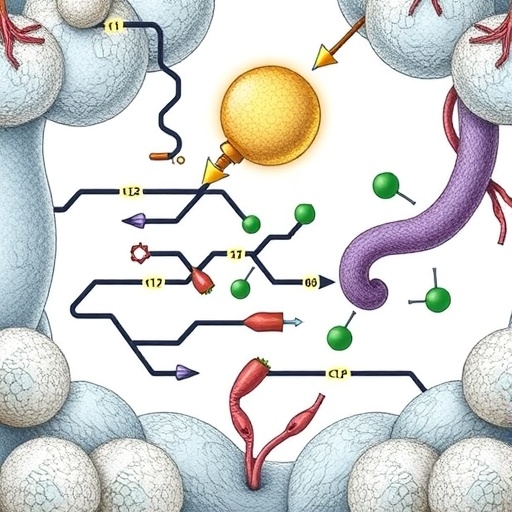
A groundbreaking study emerging from the frontiers of environmental microbiology challenges longstanding assumptions about nitrogen cycling and sulfur autotrophy. Gao, Zhao, Ismail, and colleagues have unveiled a previously overlooked mechanism of ammonium assimilation occurring simultaneously with sulfur-driven dissimilatory nitrate reduction to ammonium (DNRA), a process that significantly reshapes our understanding of both microbial metabolism and elemental biogeochemical cycles. Published ahead of print in Communications Earth & Environment, this novel insight carries profound implications for ecological modeling, nutrient management, and the mitigation of nitrogen pollution, serving as a clarion call for a revision of microbial nutrient dynamics in diverse ecosystems.
Dissimilatory nitrate reduction to ammonium, or DNRA, plays a pivotal yet often undervalued role in global nitrogen cycling. Classical views have characterized it mainly by the reduction of nitrate to ammonium, an important alternative to denitrification pathways that release nitrogen gases back into the atmosphere. DNRA, particularly when coupled with sulfur oxidation, facilitates the retention of bioavailable nitrogen in environments ranging from marine sediments to wastewater treatment systems. However, the finer nuances of ammonium fate—especially its assimilation back into microbial biomass—have largely escaped detailed scrutiny until this new research illuminated them.
The study meticulously disentangles the biochemical pathways underpinning sulfur autotrophic DNRA. Contrary to prior understanding, the authors reveal that ammonium produced during the process is not merely an end product released into the environment. Instead, ammonium undergoes active assimilation by sulfur-oxidizing autotrophic microorganisms themselves, integrating nitrogen back into microbial biomass and thereby modulating nitrogen availability in ways previously unaccounted for. This dual function broadens the ecological roles ascribed to sulfur-oxidizing microbes and necessitates a reconsideration of nitrogen retention strategies in diverse ecological niches.
Utilizing a combination of isotopic labeling experiments, metagenomic analyses, and stoichiometric modeling, the research team elucidated the intricate linkages between nitrogen and sulfur metabolisms. Isotopic tracers unambiguously showed assimilation of ammonium into key cellular components, while metagenomics pinpointed gene clusters responsible for ammonium uptake and assimilation encoded within sulfur-oxidizer genomes. Together, these methods converged to affirm that sulfur autotrophic microbes actively recycle ammonium, underscoring an overlooked feedback loop within nutrient cycles that stabilizes nitrogen pools against external fluxes.
Fundamental biochemical mechanisms explained in the study reveal how ammonium transport systems work in concert with sulfur oxidation enzymatic cascades. Transport proteins facilitate ammonium uptake concurrent with energy-yielding oxidation of reduced sulfur compounds, enabling cells to harness energy from sulfur while replenishing vital nitrogen for biosynthesis. This coupling reflects a sophisticated metabolic economy that optimizes resource utilization under anaerobic or microoxic conditions prevalent in sediments, wetlands, and engineered bioreactors.
This discovery reverberates through ecosystem science, revealing previously masked nitrogen retention that potentially mitigates nitrogen loss via denitrification. By recycling ammonium internally, sulfur-oxidizing microbes effectively slow the export of nitrogen from ecosystems, influencing nitrogen budgets in ways both subtle and profound. Such processes may underlie observed discrepancies in nitrogen fluxes in coastal and freshwater sediments, suggesting a critical reevaluation of reactive nitrogen cycling models and their impact on eutrophication and hypoxia.
Moreover, the insights gained hold considerable promise for enhancing wastewater management and bioremediation. Harnessing sulfur autotrophic DNRA coupled with ammonium assimilation could improve nitrogen recovery from waste streams, reducing reliance on synthetic fertilizers and downstream eutrophication risks. The study indicates potential engineering strategies that exploit microbial consortia capable of simultaneous sulfur oxidation and ammonium assimilation to optimize nutrient removal and resource recovery in sustainable treatment technologies.
Environmental implications extend to global climate regulation frameworks as well. Nitrogen transformations intersect with greenhouse gas emissions, particularly nitrous oxide, a potent climate forcing agent produced during incomplete denitrification. Accelerated ammonium assimilation within DNRA pathways may curtail nitrous oxide formation, offering pathways to mitigate climate impact associated with nitrogen cycling. This unrecognized microbial function could shape adaptive strategies in the face of climate change and anthropogenic nutrient perturbations.
The interdisciplinary approach of integrating microbiology, geochemistry, and systems biology in this study underscores the value of holistic investigations of biogeochemical cycles. By piercing the complexity of microbial metabolisms that govern elemental transformations, the research not only clarifies nitrogen and sulfur interplay but also exemplifies how multi-method research frameworks can uncover hidden environmental processes crucial for planetary health.
As nitrogen cycling remains a linchpin within global sustainability challenges — encompassing food security, water quality, and climate mitigation — this overlooked ammonium assimilation mechanism evokes a paradigm shift. Far from being a mere biochemical curiosity, it forms a keystone in the microbial management of nutrient fluxes, reinforcing the necessity for revised models that integrate such microbial feedbacks for accurate predictions and effective ecosystem stewardship.
The research also prompts questions about the evolutionary drivers and ecological distribution of sulfur autotrophic DNRA coupled with ammonium assimilation. Future studies may explore how environmental gradients, such as redox conditions and sulfur availability, shape microbial community composition and metabolic strategies. Knowledge gained could illuminate adaptive mechanisms enabling microbial survival and ecosystem resilience in the face of environmental stressors.
In conclusion, Gao and colleagues’ work pioneers a new frontier in our understanding of nitrogen biology. By revealing the complexity and nuance in ammonium fate during sulfur-driven nitrate reduction, the study enriches fundamental science and offers actionable insights for environmental management. It invites a reexamination of established paradigms, encouraging researchers and practitioners alike to appreciate the intricate microbial choreography underlying sustainable nutrient cycles.
This discovery stands as a testimony to the ongoing revolution in environmental microbiology, where hidden microbial processes are continuously brought to light, transforming theoretical constructs into actionable knowledge. It signals a future where more accurate and comprehensive nutrient cycle models enable better stewardship of Earth’s critical resources for generations to come, driven by the unseen architects—microbes—who quietly master the flow of nitrogen and sulfur beneath our feet.
Cite Scienmag News
Daisy Hatcher. (June 15, 2026). Hidden Role of Ammonium in Sulfur-Nitrate Metabolism. Scienmag. https://scienmag.com/hidden-role-of-ammonium-in-sulfur-nitrate-metabolism/
Daisy Hatcher. "Hidden Role of Ammonium in Sulfur-Nitrate Metabolism." Scienmag, 15 June 2026, https://scienmag.com/hidden-role-of-ammonium-in-sulfur-nitrate-metabolism/. Accessed 3 September 2026.
Daisy Hatcher. "Hidden Role of Ammonium in Sulfur-Nitrate Metabolism." Scienmag. June 15, 2026. https://scienmag.com/hidden-role-of-ammonium-in-sulfur-nitrate-metabolism/


