


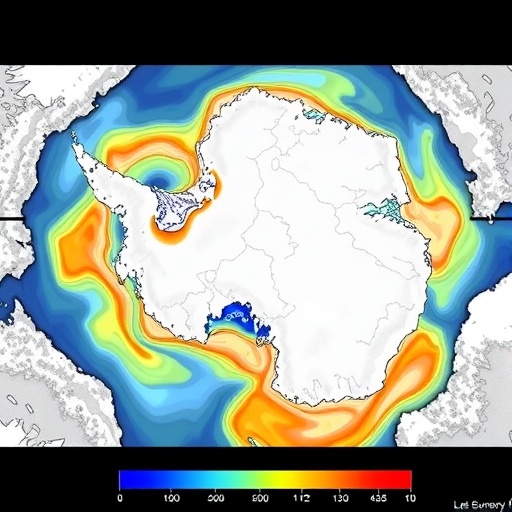
A recent breakthrough study led by Dr. Juan Dou and Professor Xiangzhou Song from Hohai University, in collaboration with Professor Renhe Zhang from Fudan University, has illuminated a significant transformation in the behavior of the Southern Annular Mode (SAM) during springtime. Their research, published in the National Science Review, reveals a fundamental structural shift in the spring SAM around the year 1998, which has crucial implications for the understanding of Antarctic summer sea-ice variability, particularly in the Weddell and Ross Seas. This shift has intensified the delayed influence of atmospheric circulation patterns on Antarctic sea ice, a phenomenon vital for predicting and comprehending the ongoing rapid changes in the polar environment.
Antarctica’s sea ice extent has experienced dramatic fluctuations, reaching historically low records in recent years. This alarming trend has intensified scientific scrutiny, with researchers striving to unravel the complex interplay of atmospheric, oceanic, and tropical climate variables influencing these changes. The SAM, as the dominant mode of atmospheric variability in the Southern Hemisphere, plays a pivotal role in structuring the climate and sea-ice dynamics around Antarctica. In particular, the SAM’s manifestation during the spring season (characterized by September, October, November—SON) carries pronounced effects that extend into the Antarctic summer months, modulating sea-ice conditions through mechanisms involving ocean heat storage, atmospheric circulation-driven sea-ice transport, and intricate ice-ocean feedback systems.
A key challenge in understanding these processes lies in recognizing that the SAM is not a uniform zonal pattern but possesses dynamic wave-like structures whose characteristics may evolve over time. Such temporal variability in the SAM’s spatial configuration can fundamentally change how it interacts with regional climate features and cryospheric elements. This observation sparked critical questions about the existence of any long-term structural shifts in the spring SAM and whether such shifts have altered the mode’s lagged impact on summer Antarctic sea-ice variability.
Employing advanced statistical techniques—including running empirical orthogonal function (EOF) analysis alongside k-means clustering—the research team detected a pronounced structural transformation of the spring SAM around 1998. Prior to this transition, the spring SAM exhibited only a tenuous and weak linkage with Antarctic summer sea-ice extent, offering little predictive capacity for sea-ice conditions. However, post-1998, the SAM pattern demonstrated amplified wave-like features and developed more robust associations with the Pacific–South American (PSA) teleconnection and the Amundsen Sea Low (ASL). This enhanced connectivity significantly strengthened the SAM’s lagged influence on summer sea-ice dynamics.
The study delineates two primary regional pathways through which spring SAM variations drive sea-ice changes in Antarctica. In the Weddell Sea sector, positive anomalies associated with the SAM cause persistent alterations in atmospheric circulation, which in turn modify air-sea heat exchanges, promoting sustained upper-ocean warming. This elevated ocean heat content sets the stage for increased melting and reduction of sea ice during the subsequent summer months. Meanwhile, in the Ross Sea, the intensification of the ASL during positive SAM phases enhances offshore ice transport during spring. This process exposes extensive areas of open water adjacent to coastal zones, which, upon receiving increased solar radiation as summer progresses, trigger a potent ice–albedo feedback. This feedback mechanism accelerates sea-ice reduction, compounding the ongoing loss.
Beyond the intrinsic atmospheric and oceanic processes, the research posits that interannual tropical climate variability, particularly the El Niño-Southern Oscillation (ENSO), modulates the post-1998 SAM structural transition. Since the late 1990s, the concurrence of positive SAM events with La Niña episodes has become more frequent. This coupling presumably strengthens the tropical Pacific teleconnection forcing, thereby amplifying the SAM’s influence on Antarctic sea-ice variability. Notably, the extreme low sea-ice extents observed in February 2022 and 2023 strongly corresponded to periods following pronounced positive SAM and persistent La Niña conditions, underscoring the relevance of SAM-ENSO interactions in driving Antarctic sea-ice extremes.
The emergent perspective from this work underlines the nonstationary nature of the relationship between Southern Hemisphere atmospheric circulation patterns and Antarctic sea-ice variability. It challenges the previously static assumptions about SAM’s structure and function, suggesting that shifts in its wave-like characteristics substantially modulate cryospheric responses. This recognition has broad implications for climate modeling and prediction, emphasizing the necessity of accurately capturing SAM’s spatial heterogeneity, the dynamic behavior of the Amundsen Sea Low, and the complex interplay between SAM and ENSO phenomena within global climate models.
In sum, this research advances our mechanistic understanding of how atmospheric circulation anomalies in the austral spring precondition Antarctic summer sea-ice states. The findings stress that the augmented role of wave-like SAM features, together with intensified ASL dynamics and tropical-telconnection modulation, jointly drive observed rapid sea-ice declines. As Antarctic sea ice profoundly influences global climate, ocean circulation, and polar ecosystems, this enhanced comprehension is vital for anticipating future climate changes with greater fidelity.
The study’s utilization of observational datasets and sophisticated analytical frameworks provides strong empirical evidence supporting the recent Antarctic sea-ice declines’ atmospheric and oceanic drivers. Given the observed structural shifts in the SAM and its teleconnections, there is a pressing need to refine climate models by incorporating these complex features to improve projections of Antarctic sea-ice behavior under ongoing global warming scenarios. This knowledge will not only deepen climate science but will also aid policymakers and stakeholders in addressing the global repercussions stemming from cryospheric changes.
Looking forward, continued monitoring and research focused on the evolving spatial structures of SAM, the fluctuating intensity of the Amundsen Sea Low, and the nuanced interactions with tropical climate variability will be essential. Such efforts will provide a more comprehensive understanding of Antarctic climate dynamics and improve the accuracy of forecasts, facilitating better preparation for the climatic and ecological transformations underway in the Southern Hemisphere.
Web References:
DOI: 10.1093/nsr/nwag314
Cite Scienmag News
Russell Cooper. (June 15, 2026). Spring Atmospheric Circulation Changes Drive Extreme Antarctic Summer Sea-Ice Variability. Scienmag. https://scienmag.com/spring-atmospheric-circulation-changes-drive-extreme-antarctic-summer-sea-ice-variability/
Russell Cooper. "Spring Atmospheric Circulation Changes Drive Extreme Antarctic Summer Sea-Ice Variability." Scienmag, 15 June 2026, https://scienmag.com/spring-atmospheric-circulation-changes-drive-extreme-antarctic-summer-sea-ice-variability/. Accessed 4 September 2026.
Russell Cooper. "Spring Atmospheric Circulation Changes Drive Extreme Antarctic Summer Sea-Ice Variability." Scienmag. June 15, 2026. https://scienmag.com/spring-atmospheric-circulation-changes-drive-extreme-antarctic-summer-sea-ice-variability/


