


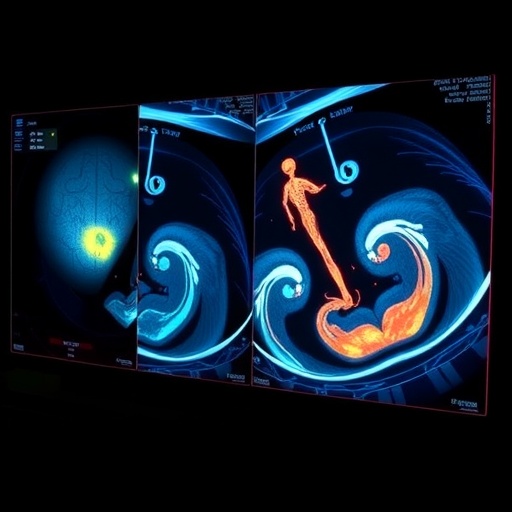
In a remarkable leap forward for medical training and surgical precision, researchers have unveiled a cutting-edge system that integrates real-time 3D ultrasound imaging with augmented reality (AR), fundamentally transforming how novice practitioners learn and how experts perform high-stakes procedures. This innovative approach, pioneered by a team led by Hou, Viswanath, and Dilibal, promises to dramatically accelerate proficiency in ultrasound-guided interventions, effectively bridging the gap between novice and expert performance.
Traditional ultrasound training has long been challenged by the difficulty novices face in interpreting two-dimensional images and translating them into spatially accurate clinical actions. These constraints often prolong the learning curve and potentially increase patient risk during early stages of skill acquisition. The newly developed AR platform tackles these issues head-on by superimposing volumetric, real-time 3D ultrasound data directly onto the patient’s anatomy, creating an immersive, interactive visual experience. This integration grants users enhanced spatial awareness and immediate feedback, heightening both accuracy and confidence in diagnostic and interventional maneuvers.
From a technical standpoint, the system utilizes advanced 3D ultrasound probes capable of capturing volumetric data streams at high frame rates. These data sets are processed through a robust computational pipeline that corrects for probe motion, filters noise, and converts ultrasound volumes into precise 3D renderings. Leveraging state-of-the-art AR displays—either head-mounted devices or screen-based projectors—the visualizations are dynamically registered to the patient’s physical form using simultaneous localization and mapping (SLAM) algorithms. This ensures that the virtual images remain stable, coherent, and aligned even as the patient or operator moves.
The training impact of this novel fusion of technologies was quantitatively significant. When applied in a controlled study, novices exposed to the real-time 3D ultrasound AR system rapidly closed performance gaps traditionally observed between beginner and expert users. Metrics such as needle placement accuracy, procedure time, and confidence ratings all showed marked improvement after only a brief period of interaction with the technology. This acceleration in skill acquisition not only promises better clinical outcomes but may also reduce the overall costs and risks associated with hands-on trainee learning.
Beyond training, the underlying methodologies bear transformative potential for complex interventions that require precise imaging guidance. For instance, in percutaneous biopsies or regional anesthesia, being able to visualize the needle and anatomical targets in 3D space through AR can mitigate errors arising from spatial misinterpretation. Experts, too, benefit significantly by way of enhanced visualization and intuitive spatial context, which can improve decision-making under pressure.
The system’s hardware integration was carefully optimized for practical clinical settings. Lightweight AR headsets equipped with high-resolution displays and built-in depth sensors ensure that the technology is comfortable for extended use and minimally disruptive. Importantly, the fusion of AR with real-time ultrasound imaging maintains the sterility and ergonomics essential for procedural environments. This design consideration reflects a thorough understanding of clinical workflows and practitioner needs.
In addition to hardware, the software ecosystem offers a flexible interface that allows customization for diverse procedural requirements. Users can adjust visualization modes, apply various color maps to highlight tissue densities, and save or replay sessions for in-depth review and debriefing. Such versatility opens avenues for both individualized learning and collaborative supervision, wherein trainers can observe and provide real-time guidance based on the shared AR visualization.
Safety and reliability were paramount in development and testing phases. The system underwent rigorous validation against standard ultrasound techniques to ensure that enhanced visualization did not compromise accuracy. Extensive trials confirmed that probe calibration, image fidelity, and AR registration precision met stringent clinical standards, fostering confidence in its deployment for real-world training and procedural assistance.
This transformative technology aligns with broader trends in medical education toward high-fidelity simulation and immersive learning environments. By combining volumetric imaging with spatial computing, it provides an unprecedented level of sensory integration that mimics the complexity of real clinical scenarios without subjecting patients to additional risk. Such advancements herald a future in which medical novices can achieve competence more swiftly, and experts can maintain peak performance across a variety of challenging cases.
Furthermore, the implications reach beyond ultrasound guidance alone. As AR platforms continue to evolve and computational power increases, similar frameworks can be adapted for multimodal imaging integration, encompassing MRI, CT, or even intraoperative optical imaging. The modular nature of this approach lays the groundwork for a new generation of image-guided interventions, where “see-through” visualization fuels greater precision and safer outcomes.
Critically, the study illuminated psychological aspects related to learning curves in medical procedural skills. Trainees reported increased engagement, reduced cognitive load, and decreased frustration thanks to the intuitive 3D interface. These human factors often remain underappreciated but are vital contributors to effective skill acquisition and retention. The AR-ultrasound combination is therefore not only a technical achievement but an ergonomic and pedagogical breakthrough.
Looking ahead, the research team envisions integration with artificial intelligence (AI) algorithms that could provide real-time decision support by automatically highlighting anatomical landmarks, suggesting optimal needle trajectories, or flagging potential complications. Such enhancements would further democratize access to expert-level guidance, especially in resource-limited settings where experienced instructors may not be available.
Industry partnerships are already underway to commercialize the platform, with prospects to integrate it seamlessly into existing hospital infrastructures. The potential for remote training and tele-mentoring is particularly exciting, as it could overcome geographical barriers and expand educational reach globally. This democratization aligns well with ongoing efforts to improve healthcare equity via technological innovation.
In sum, the advent of real-time 3D ultrasound displayed through augmented reality stands as a landmark advancement that redefines medical training paradigms and clinical practice. By shifting how spatial and temporal information is communicated to practitioners, it transcends the limitations of conventional ultrasound methods, creating a new standard for precision, efficiency, and safety in procedural care. This breakthrough is poised to ripple across medical specialties, shaping a future where technology fiercely empowers human expertise.
Cite Scienmag News
Denise Maddox. (June 15, 2026). Real-Time 3D Ultrasound Boosts AR Training Success. Scienmag. https://scienmag.com/real-time-3d-ultrasound-boosts-ar-training-success/
Denise Maddox. "Real-Time 3D Ultrasound Boosts AR Training Success." Scienmag, 15 June 2026, https://scienmag.com/real-time-3d-ultrasound-boosts-ar-training-success/. Accessed 4 September 2026.
Denise Maddox. "Real-Time 3D Ultrasound Boosts AR Training Success." Scienmag. June 15, 2026. https://scienmag.com/real-time-3d-ultrasound-boosts-ar-training-success/


