


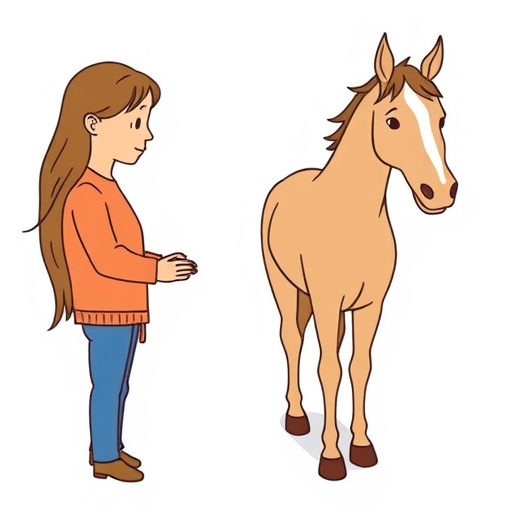
In a groundbreaking study that bridges the realms of human psychology and equestrian practice, researchers have revealed that the psychological profiles of horse owners—their attachment styles and personality traits—play a significant role in the ways they engage with their horses. This revelation not only deepens our understanding of the human-animal bond but also sheds new light on factors that influence equine welfare and training choices.
Attachment theory, initially formulated to explain dynamics in human interpersonal relationships, has found novel application in the context of human-animal interactions. This psychological framework categorizes individuals based on how they seek emotional connection and manage closeness. Individuals with an avoidant attachment style tend to emotionally distance themselves and prefer self-reliance, whereas those with an anxious attachment style seek proximity and are particularly sensitive to rejection or abandonment. The interdisciplinary team sought to investigate whether these attachment styles similarly manifest in human-horse relationships and, if so, how these affect everyday interactions and training regimes.
Led by Postdoctoral Researcher Océane Liehrmann, affiliated with both the Department of Biology at the University of Turku, Finland, and the Department of Biosystem and Technology at the Swedish University of Agricultural Sciences, the international group executed a comprehensive online survey. They gathered data from a global cohort of 2,239 horse owners, employing the Horse Attachment Questionnaire (HAQ), a tool developed and validated by the research collective themselves, alongside the Short Five Questionnaire to analyze personality dimensions.
Participants detailed their frequency of riding, engaging in groundwork training, and spending non-structured, quality time with their horses. In addition, they disclosed their headgear preferences, whether it be the traditional bit, bitless alternatives, or combinations thereof. These self-reports allowed for a nuanced analysis of how intrinsic psychological traits correlate with tangible equestrian practices.
The findings delineated a compelling pattern: horse owners demonstrating lower levels of emotional avoidance exhibited more frequent and closer interactions with their horses. Whether trotting under saddle or simply standing alongside their animals sharing quiet moments, these individuals reinforced a statistically significant bond marked by attentiveness and engagement. Conversely, owners with higher avoidant attachment scores tended to engage less in these activities, suggesting that emotional distancing dampens the frequency and quality of interactions critical to equine welfare.
This trend echoes prior research within the realm of companion animal care, where avoidant attachment correlates with diminished pet caregiving behaviors. The current study extends this paradigm to equines, a species whose care demands and human-animal interactions are often more complex and multidimensional. The study emphasizes that understanding these psychological underpinnings is crucial because reduced interaction may have long-term implications for horse behavior, performance, and well-being.
Intriguingly, the form and duration of owner-horse relationships were also influential. Owners who invested more time in informal, unstructured interactions—distinct from regimented training routines—showed stronger emotional closeness. This suggests that beyond formal riding or training, the simple act of being present and engaged without specific goals fosters a reciprocal attachment. Further, long-standing relationships exceeding a decade correlated with significantly lower avoidant attachment, suggesting that emotional closeness deepens over time as owners and horses cohabit and co-evolve.
Personality traits, as measured by the Short Five Questionnaire, also contributed subtle yet meaningful distinctions in equestrian engagement. More frequent riders scored marginally higher in conscientiousness, extraversion, and emotional stability—traits linked to discipline, sociability, and resilience. Meanwhile, those more involved in groundwork training tended to exhibit greater openness to new experiences, perhaps reflecting a curiosity-driven approach to non-traditional, horse-centred methods that challenge conventional riding paradigms.
These personality differences, though modest, underscore the pervasive influence of psychological factors in shaping behavior across life domains, including equestrian pursuits. Such insights pave the way for tailored approaches that consider personality when designing training regimens or horse care protocols, optimizing both human satisfaction and equine welfare.
The study uncovered correlations between equipment choices—specifically the use of bit versus bitless headgear—and owner attachment styles as well. Owners who preferred bitless equipment or alternated between bit and bitless options tended to display less emotional avoidance, hinting at a more empathetic or flexible psychology. Additionally, these owners scored higher in openness to experience, consistent with their willingness to experiment and deviate from tradition in favour of potentially more humane or comfortable options for their horses.
While these findings regarding equipment choice are moderate and recognize the multifactorial nature of such decisions—including discipline prerequisites, training history, and individual horse needs—the implications are profound. They suggest that the psychological makeup of owners subtly influences not only their engagement levels but also their willingness to innovate and adapt in their horse management practices.
Importantly, the research refrains from casting judgment on any particular method or style but instead encourages a deeper self-awareness among horse owners. By reflecting on one’s own psychological tendencies toward attachment and personality, equestrians can cultivate more conscious, horse-centred decision-making that harmonizes human inclinations with equine needs.
From a welfare perspective, the cumulative effect of consistent psychological influences over time can materially impact horses’ lives. Subtle tendencies in emotional closeness or distancing carry practical weight, shaping not only the daily routine but also the emotional environment in which horses thrive. Recognizing these patterns invites the development of educational tools and training programs tailored to various owner profiles, enhancing communication, reducing stress, and fostering better outcomes for both humans and horses.
Liehrmann and her colleagues envision creating frameworks that increase owners’ awareness of their psychological dispositions as a promising avenue to promote conscientious equestrianism. Such tools would empower owners to understand and possibly counterbalance tendencies that detract from optimal equine care and training, enriching the human-horse relationship and enhancing welfare on a broad scale.
This innovative integration of attachment theory and personality psychology into equestrian science marks a novel frontier in animal welfare research. By elucidating the subtle yet consequential ways in which owner psychology shapes equestrian behaviour, the study charts a path toward more empathetic and effective horse management that respects the complexity of these interspecies bonds.
As the discipline advances, subsequent research may explore interventions that support owners in fostering secure attachments and leveraging personality strengths, thereby translating psychological insight into practical, real-world equestrian benefits. This holistic approach promises not only to enhance horse welfare but also to deepen the enriching, mutually rewarding relationships that define the art and science of horsemanship.
News Publication Date: 11-Jun-2026
Web References: http://dx.doi.org/10.1080/08927936.2026.2676402
Cite Scienmag News
William Thompson. (June 12, 2026). How Horse Owners’ Personality and Attachment Styles Influence Their Interactions and Care for Horses. Scienmag. https://scienmag.com/how-horse-owners-personality-and-attachment-styles-influence-their-interactions-and-care-for-horses/
William Thompson. "How Horse Owners’ Personality and Attachment Styles Influence Their Interactions and Care for Horses." Scienmag, 12 June 2026, https://scienmag.com/how-horse-owners-personality-and-attachment-styles-influence-their-interactions-and-care-for-horses/. Accessed 3 September 2026.
William Thompson. "How Horse Owners’ Personality and Attachment Styles Influence Their Interactions and Care for Horses." Scienmag. June 12, 2026. https://scienmag.com/how-horse-owners-personality-and-attachment-styles-influence-their-interactions-and-care-for-horses/


