


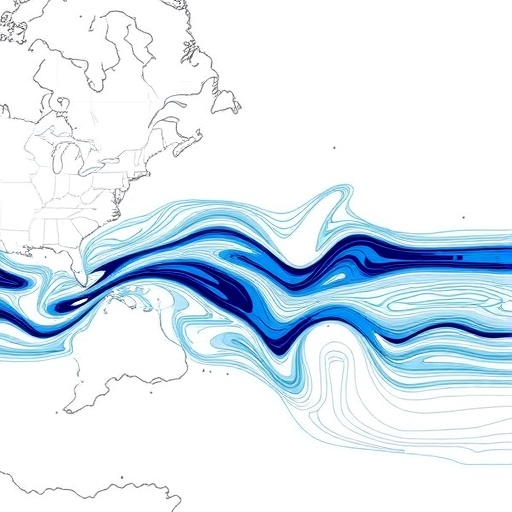
A groundbreaking study published in Nature Communications has shed new light on the complex interactions between deep-water formation processes and the Gulf Stream’s migratory behavior during abrupt climate changes. The research, led by Zhu, F., Carter-Champion, A., Wharton, J.H., and colleagues, represents a significant advancement in our understanding of how critical components of the Atlantic Meridional Overturning Circulation (AMOC) respond in tandem to rapid environmental shifts. This discovery has profound implications for predicting future climate scenarios, particularly as the world grapples with the accelerating pace of change in oceanic and atmospheric systems.
The Atlantic Meridional Overturning Circulation, a fundamental driver of global climate regulation, relies heavily on the process of deep-water formation in the North Atlantic. This mechanism involves the sinking of cold, dense water masses which effectively oxygenate the ocean depths and moderate heat distribution across the planet. The Gulf Stream, as a dominant component of the AMOC, transports warm water from the tropics towards the North Atlantic, influencing weather patterns and marine ecosystems. Yet, despite its importance, the dynamic relationship between the Gulf Stream’s position and the formation of deep water under conditions of abrupt climate events has remained elusive until now.
Utilizing a multi-proxy approach, the authors integrated high-resolution sediment core data with advanced ocean circulation models to reconstruct past variations in deep-water formation and Gulf Stream positions over millennia. These sediment records capture an archive of temperature, salinity, and biogeochemical changes that reflect oceanic and climatic conditions during key rapid climate events such as Heinrich Stadials and Dansgaard-Oeschger cycles. By combining paleoceanographic evidence with numerical simulations, the study provides an unprecedentedly detailed picture of how these two processes co-evolved during periods of climate instability.
Their results demonstrate a compelling coordination between the shifts in deep-water formation sites and the latitudinal migration of the Gulf Stream. During abrupt cooling episodes, the researchers observed a marked southward displacement of the Gulf Stream concurrent with a reduction or relocation in deep-water sinking regions. This dual phenomenon likely created feedback loops that intensified ocean circulation disruptions, leading to pronounced climate anomalies across the North Atlantic region and beyond. Importantly, the findings suggest that alterations in these critical oceanic functions were not isolated incidents but interlinked responses to prevailing climatic forcings.
The study also provides critical insights into the threshold dynamics that govern the stability of the AMOC. By pinpointing the timing and magnitude of these coordinated shifts, the authors reveal how relatively small changes in freshwater inputs or surface temperature gradients can tip the system into markedly different states. This nonlinear behavior underscores the intrinsic vulnerability of thermohaline circulation mechanisms and highlights the potential for abrupt transitions in response to anthropogenic climate warming and polar ice melt.
Further reinforcing the broader significance of their work, Zhu and colleagues delve into the implications for contemporary climate change scenarios. The modern-day Gulf Stream and deep-water formation patterns are already experiencing stress from increased Arctic freshwater fluxes and rising sea surface temperatures. By revisiting the paleoclimate record, the study offers an analog for understanding potential future pathways, warning that current trends could precipitate abrupt shifts resembling those documented in the past. Such shifts might trigger cascading effects on atmospheric circulation, sea-level patterns, and marine biodiversity.
To validate the robustness of their reconstructions, the team employed state-of-the-art climate models that incorporate coupled atmospheric-oceanic processes, ice sheet dynamics, and biogeochemical cycles. These models simulated transient climate events and their oceanic responses, producing results that closely align with empirical sediment core data. This modeling synergy not only strengthens confidence in the experimental findings but also provides a framework for projecting the future evolution of the AMOC under varying greenhouse gas emission trajectories.
The research highlights the importance of spatially resolved oceanographic observations in detecting early warning signs of AMOC destabilization. Monitoring shifts in deep-water formation zones and Gulf Stream paths could serve as critical indicators for approaching tipping points. Such observational strategies will be essential for informing climate policy and adaptation measures, as abrupt climate changes have far-reaching socio-economic consequences, including altered weather extremes, disrupted fisheries, and coastline vulnerability.
Moreover, the study advances the methodological frontier by emphasizing the utility of integrating geological archives with sophisticated numerical simulations. This interdisciplinary approach bridges gaps between paleoclimatology, oceanography, and climate science, fostering a holistic understanding of Earth system dynamics. The collaboration embodies a new era of climate research where data-rich reconstructions and predictive modeling inform each other to address pressing environmental challenges.
In conclusion, Zhu et al.’s pioneering work reveals how intricately linked deep-water formation and Gulf Stream migration patterns are during episodes of abrupt climate variability. Their findings underscore the fragility of the Atlantic circulation system and its capacity for rapid, coordinated transitions. As the climate crisis intensifies, unraveling these feedback mechanisms will be indispensable for anticipating and mitigating the impacts of ocean circulation disruptions on global climate stability.
This study not only enriches the scientific narrative surrounding AMOC but also serves as a clarion call for the international community to enhance ocean observation networks and invest in adaptive climate resilience strategies. By looking backward into Earth’s climatic past, scientists can better chart the course for a sustainable future under the mounting pressures of global warming.
In the broader context of climate science, the coordination between oceanic processes demonstrated here complements ongoing investigations into polar ice sheet dynamics, atmospheric teleconnections, and ecosystem responses. Understanding such interconnected systems is crucial to unraveling the complexities of climate change and formulating comprehensive response frameworks.
Ultimately, this research sets a new benchmark for the predictive power of climate models, especially in capturing the nonlinear and coupled nature of ocean circulation shifts. It underscores how multidisciplinary approaches combining geology, oceanography, and climate modeling are essential for accurately forecasting the trajectories of Earth’s critical climate regulators.
As humanity ventures deeper into an era of unprecedented climatic transformation, studies like these are vital to unveiling the hidden mechanisms that govern Earth’s climate system. The insights gained will inform not only academic discourses but also practical interventions aimed at safeguarding the planet’s environmental and societal well-being.
Cite Scienmag News
Violet Maxwell. (June 11, 2026). Linked Deep-Water Formation, Gulf Stream Shift During Climate Changes. Scienmag. https://scienmag.com/linked-deep-water-formation-gulf-stream-shift-during-climate-changes/
Violet Maxwell. "Linked Deep-Water Formation, Gulf Stream Shift During Climate Changes." Scienmag, 11 June 2026, https://scienmag.com/linked-deep-water-formation-gulf-stream-shift-during-climate-changes/. Accessed 4 September 2026.
Violet Maxwell. "Linked Deep-Water Formation, Gulf Stream Shift During Climate Changes." Scienmag. June 11, 2026. https://scienmag.com/linked-deep-water-formation-gulf-stream-shift-during-climate-changes/


