


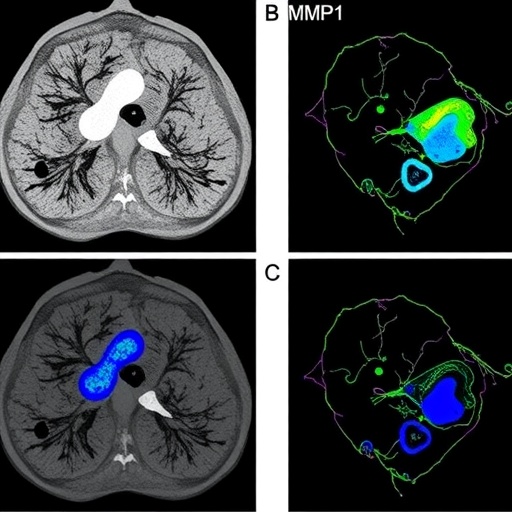
In a groundbreaking study released in 2026, researchers have unraveled a sophisticated molecular mechanism orchestrating lung cancer metastasis, delivering fresh insights that could redefine therapeutic strategies against this insidious disease. Central to this discovery is Interleukin 11 (IL11), a cytokine whose elevated expression has long been observed in various cancers but whose precise role remained enigmatic until now. The latest findings delineate how IL11 intricately modulates the expression of matrix metalloproteinase 12 (MMP12), a pivotal enzyme implicated in extracellular matrix degradation—a key step in cancer cell invasion and metastasis.
This study meticulously unpacks the signaling cascade activated by IL11, revealing a complex pathway involving the IL11 receptor alpha (IL11RA) and the IL6 signal transducer (IL6ST), also known as gp130. Upon IL11 binding to its receptor complex, a sequence of intracellular events is triggered, culminating in the activation of the phosphoinositide 3-kinase (PI3K)/Akt signaling axis. This pathway, renowned for its role in promoting cell survival and proliferation, further stimulates the nuclear factor kappa-light-chain-enhancer of activated B cells (NF-κB), a transcription factor that governs the expression of genes responsible for inflammation, cell proliferation, and survival.
Specifically, the research delineates how this IL11RA/IL6ST-PI3K/Akt-NF-κB signaling relay upregulates MMP12 expression at the transcriptional level. The overexpression of MMP12, identified as a crucial metalloproteinase, empowers cancer cells to degrade surrounding matrix components more effectively, thereby facilitating their invasive capabilities. This enzymatic activity remodels the tumor microenvironment, breaking down physical barriers and enabling malignant cells to disseminate from the primary tumor site to distant organs—a hallmark of cancer metastasis.
The study employed a comprehensive suite of molecular and cellular techniques to validate this pathway’s role in lung cancer metastasis. Through in vitro assays using lung cancer cell lines, the researchers demonstrated that IL11 stimulation leads to a marked increase in MMP12 expression and concomitant enhancement of migratory and invasive behaviors. These effects were abrogated upon silencing either IL11RA or IL6ST, or when pharmacological inhibitors targeting PI3K or NF-κB were applied, underscoring the specificity and integral nature of this signaling axis.
Further reinforcing these findings, in vivo models of lung cancer metastasis exhibited reduced tumor dissemination when IL11 signaling was inhibited. These results convincingly establish IL11 not merely as a passive inflammatory mediator but as an active driver of tumor progression through its modulation of MMP12, mediated by the IL11RA/IL6ST-PI3K/Akt/NF-κB pathway. This positions IL11 signaling as a potential therapeutic target in the fight against metastatic lung cancer, a disease notorious for its poor prognosis and limited treatment options.
The implications of this research extend beyond lung cancer alone. Given that IL11 and MMP12 are implicated in various pathological contexts, ranging from fibrosis to other malignancies, understanding their interplay opens new avenues for targeted interventions. The mechanistic insights presented illuminate how cytokine-driven signaling networks can reprogram tumor cells and their microenvironment, enabling metastatic competency. This understanding could catalyze the development of novel inhibitors designed to disrupt specific nodes within this pathway, thereby impairing the metastatic cascade.
Moreover, the identification of MMP12 as a downstream effector offers a dual opportunity for biomarker development and therapeutic targeting. Elevated MMP12 levels may serve as a predictive marker for aggressive disease and metastasis propensity, facilitating early intervention strategies. Therapeutically, MMP12 inhibitors or agents neutralizing IL11 or its receptor could synergistically curb lung cancer dissemination, potentially enhancing existing treatment regimens like chemotherapy, radiotherapy, or immunotherapy.
This study also locates the IL11RA/IL6ST complex as a crucial signaling hub, furthering the understanding of cytokine receptor crosstalk in cancer biology. The role of IL6ST, a shared signal transducer among the IL6 cytokine family, suggests that targeting this component might yield broad therapeutic benefits by intercepting multiple pro-tumorigenic signals. This possibility invites a reexamination of cytokine signaling networks and their redundancies within the tumor microenvironment.
Beyond the immediate molecular findings, this research underscores the importance of targeting the tumor microenvironment and its remodeling processes. It highlights how cancer cells hijack physiological signaling pathways to remodel tissue architecture, create niches conducive to survival, and evade immune surveillance. MMP12-mediated extracellular matrix degradation exemplifies such a strategy, emphasizing the need for therapies that not only kill tumor cells but also modify their surroundings to prevent metastasis.
Perhaps most strikingly, these findings open the door to precision medicine approaches in lung cancer management. Identifying patients with elevated IL11 and MMP12 expression could guide tailored therapeutic regimens, maximizing efficacy while minimizing systemic toxicity. This precision targeting aligns with the broader oncology trend of integrating molecular diagnostics with therapy selection, promising improved outcomes for patients with advanced lung cancer.
The study’s comprehensive approach, integrating molecular biology, cell signaling, and in vivo functional analyses, sets a new benchmark for investigating how cytokine networks fuel cancer progression. Its revelations about the IL11RA/IL6ST-PI3K/Akt/NF-κB axis intricately link inflammation, cell survival pathways, and matrix remodeling into a cohesive framework explaining lung cancer metastasis. Such a framework has the potential to inform the design of drugs with enhanced specificity and potency.
In conclusion, the discovery of IL11’s role in modulating MMP12 expression via the IL11RA/IL6ST-PI3K/Akt/NF-κB axis represents a paradigm shift in understanding lung cancer metastasis. This signaling nexus offers multiple therapeutic intervention points, ranging from cytokine-receptor interactions to intracellular signal transducers and transcription factors. Harnessing this knowledge promises to fuel the next generation of cancer therapies aimed at halting metastatic spread, thereby improving survival rates and quality of life for lung cancer patients worldwide.
As the scientific community builds upon these findings, future research may explore combinatorial treatments targeting various nodes of this pathway, as well as the extent of IL11’s involvement in other cancer types. The unraveling of such complex signaling webs marks a significant stride toward conquering metastatic disease, a formidable challenge in oncology.
Cite Scienmag News
Nathaniel Bowman. (June 11, 2026). IL11 Drives Lung Cancer Metastasis Through MMP12 Pathway. Scienmag. https://scienmag.com/il11-drives-lung-cancer-metastasis-through-mmp12-pathway/
Nathaniel Bowman. "IL11 Drives Lung Cancer Metastasis Through MMP12 Pathway." Scienmag, 11 June 2026, https://scienmag.com/il11-drives-lung-cancer-metastasis-through-mmp12-pathway/. Accessed 4 September 2026.
Nathaniel Bowman. "IL11 Drives Lung Cancer Metastasis Through MMP12 Pathway." Scienmag. June 11, 2026. https://scienmag.com/il11-drives-lung-cancer-metastasis-through-mmp12-pathway/


