


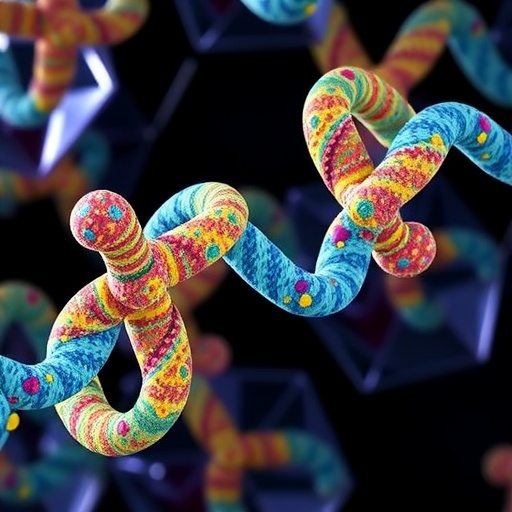
In a groundbreaking study published recently in Nature Chemistry, researchers have unveiled a novel perspective on protein dynamics by investigating the flips of aromatic rings within proteins. This work fundamentally challenges existing conceptions of how proteins move and interact in both crystalline environments and biologically relevant complexes. As proteins are the molecular workhorses of the cell, understanding their dynamic behaviors at an atomic level is crucial for advancements across biochemistry, drug design, and molecular biology.
The research, led by Becker, Fu, Tatman, and colleagues, utilizes aromatic ring flips as a molecular probe—a subtle yet telling motion within proteins capable of revealing deep insights about the protein’s internal flexibility and conformational landscape. Aromatic side chains, such as those of phenylalanine, tyrosine, and tryptophan, possess planar ring structures that can rotate or flip under certain conditions. These flips occur relatively infrequently and are difficult to detect with conventional techniques, often overlooked or considered background noise. However, the team harnessed state-of-the-art nuclear magnetic resonance (NMR) spectroscopy methods tailored to capture these rare dynamic events.
Traditionally, protein dynamics have been examined grossly over broad conformational changes or by high-resolution crystallographic snapshots that often freeze proteins into single states. More recently, molecular dynamics simulations have suggested an astonishing level of flexibility and a myriad of transient conformational substates. Placing these dynamics into context, especially within the physical confines of crystal lattices or in complexed forms, has sparked controversy. The new study elegantly interrogates this issue by focusing on aromatic ring flips, a scale of motion that acts as a sensitive barometer for the protein’s local dynamic environment.
Using a combination of isotopic labeling, advanced relaxation dispersion NMR, and complementary computational modeling, the researchers quantified flip rates and energetic barriers within multiple protein systems, both in their crystalline state and when bound to interacting partners. Intriguingly, they found that the rates and populations of aromatic ring flips were markedly different between crystalline proteins and those engaged in protein-protein complexes. This observation points to a reshaping of the dynamic energy landscape, influenced by the neighboring molecular environment, crystal packing forces, and complex formation.
One of the most striking outcomes of the study is the revelation that protein crystals are not static, perfectly ordered solids but exhibit a dynamic plasticity that was previously underappreciated. Aromatic ring flips within crystals occur with notable frequency and are modulated by lattice contacts. These dynamic processes help reconcile discrepancies in crystallographic data where electron density maps sometimes hint at multiple conformations or subtle disorder. The findings thus paint crystalline proteins as dynamic ensembles, albeit with constraints imposed by the crystal lattice that differ markedly from those seen in solution or complexed states.
Delving into protein complexes, the team discovered that binding events could either dampen or amplify aromatic ring flips depending on how the interaction alters the local environment. Sites directly involved in the interface tend to exhibit restricted motion, with flip rates dropping significantly, reflecting the importance of rigidification for functional interactions. Conversely, allosteric sites away from the interface can show enhanced flipping dynamics, suggesting that complex formation induces long-range changes in the protein’s dynamic network.
The implications of this work extend beyond fundamental biophysical knowledge. In drug discovery, for example, understanding these subtle conformational fluctuations opens avenues for targeting dynamic pockets that are invisible in static crystal structures. The dynamic reshaping of proteins in complexes implies that successful inhibitors or modulators need to account for not just the static structures but also the transient conformations and dynamic states that proteins adopt during their functional cycles.
From a methodological standpoint, the study highlights the power of combining experimental NMR techniques with computational simulations to capture and interpret dynamic processes on timescales and spatial resolutions that were inaccessible before. The exquisite sensitivity to aromatic ring flips provides a new, minimally invasive molecular sensor of local environments within proteins, expanding the repertoire of tools available for studying protein motions.
Furthermore, the researchers suggest that aromatic ring flips could serve as a universal molecular probe to study how external factors—such as temperature, pressure, pH, or ligand binding—influence protein flexibility. This could transform the study of protein dynamics in varied biological contexts, from enzyme catalysis to signaling pathways, where flexibility plays a key regulatory role.
Their work also provides a fresh lens to revisit longstanding questions in structural biology, particularly how proteins reconcile the apparent contradiction of needing both stability and flexibility. Aromatic ring flips exemplify the delicate balance proteins strike—showing how small-scale motions are integrated into the overall dynamic architecture, allowing for both functional adaptability and structural integrity.
In summary, this pioneering research redefines our understanding of protein dynamics by elegantly employing aromatic ring flips as a sensitive reporter of molecular motion. It bridges the gap between static structural snapshots and the often overlooked but vital dynamic dimension of proteins, revealing a world where molecular rotations at the atomic level reflect extensive reshaping triggered by crystal packing and protein interactions.
This paradigm shift underscores the importance of dynamics in molecular recognition, enzyme activity, and potentially in pathological states associated with aberrant protein motion. Future work building on these insights may unlock novel strategies for drug design, protein engineering, and the development of dynamic biomarkers for disease.
The implications for structural biology echo loudly: crystals are not mere inert fixtures but dynamic matrices wherein proteins explore multiple conformations, and complexes are not rigid unions but fluid associations shaped by subtle atomic motions. Aromatic ring flips thus open a window into this hidden kinetic dimension, promising to unleash a deeper comprehension of biological function at the molecular level.
Cite Scienmag News
Bethany Barker. (June 11, 2026). Aromatic Ring Flips Reshape Protein Dynamics in Crystals. Scienmag. https://scienmag.com/aromatic-ring-flips-reshape-protein-dynamics-in-crystals/
Bethany Barker. "Aromatic Ring Flips Reshape Protein Dynamics in Crystals." Scienmag, 11 June 2026, https://scienmag.com/aromatic-ring-flips-reshape-protein-dynamics-in-crystals/. Accessed 4 September 2026.
Bethany Barker. "Aromatic Ring Flips Reshape Protein Dynamics in Crystals." Scienmag. June 11, 2026. https://scienmag.com/aromatic-ring-flips-reshape-protein-dynamics-in-crystals/


