


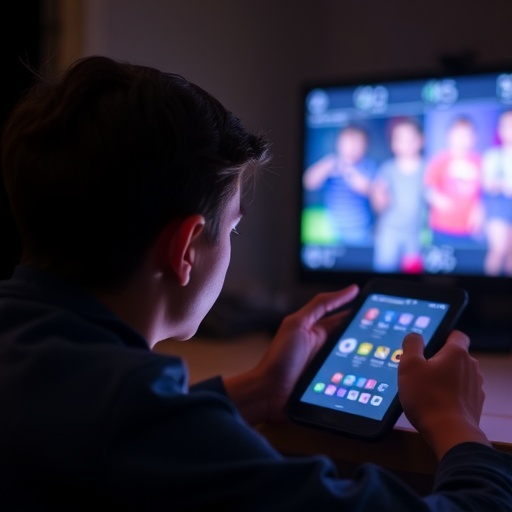
Researchers at Nationwide Children’s Hospital have published a groundbreaking study that challenges longstanding concussion recovery guidelines, revealing that moderate screen time in the early days following a concussion may actually facilitate faster symptom resolution in youth aged 11 to 17. The research, appearing in the British Journal of Sports Medicine, employs objective data derived from wearable technology to measure real screen exposure, providing a more accurate picture than previous self-reported methods. This novel approach has significant implications for clinical recommendations and reshapes current paradigms surrounding post-concussion behavioral interventions.
Historically, concussion management protocols have advocated for strict avoidance of screen time, presuming that sensory stimulation exacerbates brain symptoms and delays healing. However, the new evidence suggests a nuanced relationship between screen usage and recovery timelines. The study identifies an optimal median screen time duration of approximately 141 minutes per day during the critical first three days after injury, correlating with a 35% faster recovery rate compared to higher screen time exposure of roughly 260 minutes daily. This finding indicates a U-shaped curve, where both excessive and minimal screen time are associated with protracted symptom persistence.
The investigative team used state-of-the-art wearable devices to objectively quantify out-of-school screen time, encompassing smartphone use, television watching, computer/tablet engagement, and gaming activities over the initial post-injury week. This method overcame the limitations of retrospective self-reporting, which is susceptible to recall bias and inaccuracies, enhancing the validity of the data. By analyzing screen type alongside duration, researchers established that not all screen time is equivalent in effect; specifically, moderate smartphone and television use demonstrated positive associations with shortened recovery periods, while computer/tablet and gaming screen time did not show significant impacts.
Physiologically, the permissive moderate screen time possibly offers controlled cognitive engagement that aids neural network reactivation and promotes neuroplastic healing mechanisms without overwhelming neurological systems. Complete sensorineural deprivation, as imposed by stringent screen abstinence, could inadvertently delay cognitive recalibration processes essential for recovery. Conversely, prolonged screen exposure exceeding four hours daily may induce overstimulation, potentially aggravating symptoms such as headaches, dizziness, and cognitive fog. Thus, the emerging clinical message underscores balance rather than outright restriction.
Lead author Dr. Jingzhen Ginger Yang explained that this research represents a paradigm shift, indicating a middle ground approach that leverages screen time as a rehabilitation tool. Co-author Dr. Thomas Pommering emphasized the promise of wearable technology not only for monitoring symptomatology but also for personalizing recovery regimens based on individual patterns of screen exposure and responses. This adaptive strategy marks a departure from traditional, one-size-fits-all recommendations.
The study also bears practical clinical implications for pediatricians and concussion specialists. A tailored recommendation framework could be developed advising moderate engagement with smartphones and television during the earliest recovery phase while cautiously limiting computer and gaming activities pending further research. Such guidance would empower caregivers with clearer, evidence-based instructions, mitigating the anxiety and confusion often associated with post-concussion care.
Importantly, this observational study paves the way for controlled clinical trials to validate optimal screen time thresholds and disentangle the effects of different digital activities on neurocognitive recovery pathways. Future investigations could also explore neuroimaging correlates to better understand the underlying neural substrates affected by varying screen exposures. The integration of technology-facilitated monitoring tools will be crucial in advancing personalized brain injury rehabilitation.
Furthermore, families are advised to collaborate closely with healthcare providers to craft individualized recovery plans calibrated to the youth’s injury severity, symptom trajectory, and milestones. Dynamic adjustments to screen time recommendations in response to real-time symptom feedback could optimize outcomes. This multidisciplinary approach aligns with precision medicine principles, leveraging objective digital health data for improved care delivery.
The Nationwide Children’s Hospital’s Center for Injury Research and Policy (CIRP) spearheads such innovative injury prevention and treatment research globally, translating scientific insights into clinical practice and public health policy. CIRP’s work in developing evidence-based concussion management protocols exemplifies its commitment to reducing pediatric morbidity associated with traumatic brain injuries.
As concussion incidence continues to rise, especially in organized youth sports, evolving recovery guidelines backed by robust data are paramount. This study’s findings question dogmatic screen avoidance and advocate for a more balanced, data-driven methodology to facilitate brain healing. Ultimately, this research could significantly influence standard-of-care concussion treatment, improve quality of life for affected youth, and reduce long-term disability risk.
By harnessing advanced wearable sensors to objectively assess real-world behaviors, the study highlights the potential for technology-assisted management in pediatric concussion care. These innovations could soon transform how clinicians and families approach brain injury rehabilitation, marking a notable scientific advancement towards optimized, personalized pediatric healthcare.
News Publication Date: 9-Jun-2026
Web References:
- Nationwide Children’s Hospital Center for Injury Research and Policy
- British Journal of Sports Medicine DOI Link
References:
Yang, J.G., Pommering, T.L., et al. (2026). Post-concussion screen time duration and type and its association with symptom resolution in youth aged 11–17 years. British Journal of Sports Medicine. DOI:10.1136/bjsports-2025-110310
Cite Scienmag News
Ophelia Keating. (June 10, 2026). Moderate Screen Time Linked to Faster Recovery in Youth Concussion, Study Finds. Scienmag. https://scienmag.com/moderate-screen-time-linked-to-faster-recovery-in-youth-concussion-study-finds/
Ophelia Keating. "Moderate Screen Time Linked to Faster Recovery in Youth Concussion, Study Finds." Scienmag, 10 June 2026, https://scienmag.com/moderate-screen-time-linked-to-faster-recovery-in-youth-concussion-study-finds/. Accessed 3 September 2026.
Ophelia Keating. "Moderate Screen Time Linked to Faster Recovery in Youth Concussion, Study Finds." Scienmag. June 10, 2026. https://scienmag.com/moderate-screen-time-linked-to-faster-recovery-in-youth-concussion-study-finds/


