


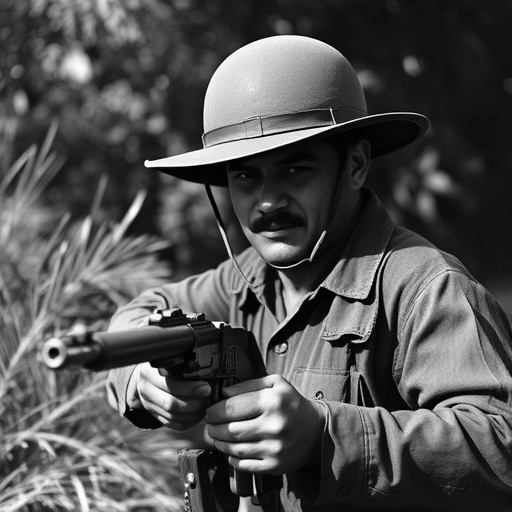
The intricate entanglement of the drug trade and the Mexican state’s modern identity is grounded not only in the commerce of narcotics itself but also in the governmental responses it has provoked over decades. A recent article published in The Social History of Alcohol and Drugs sheds new light on this enduring nexus by examining how counterinsurgency tactics initially forged in the suppression of leftist guerrilla movements in the 1960s and 1970s southern Mexico would eventually evolve into the country’s contemporary war on drugs. Author Alexander Aviña argues that the warp and weft of these intertwined conflicts reveal a nuanced, yet profoundly troubling, social war—one that primarily targeted impoverished rural populations under the guise of combating widespread criminality and drug trafficking.
Aviña’s study takes a deep dive into the historical realities of Guerrero, a southern Mexican state that became a crucible for the collision between armed guerrilla groups, so-called “bandits,” and state security forces. The analysis relies on a wealth of declassified military, police, and intelligence documents, allowing for an unprecedented reconstruction of these fraught encounters. These confrontations highlight a crucial irony: while banditry—encompassing heinous acts such as abduction, sexual violence, and livestock theft—was undeniably destructive to rural communities, its emergence was in many ways an offshoot of systemic socioeconomic neglect and disenfranchisement. These very conditions were central to the grievances that drove local socialist insurgents, such as the Party of the Poor led by communist schoolteacher Lucio Cabañas, into armed revolt.
The post-World War II era brought rapid industrialization to Mexico, but this process disenfranchised many campesinos (small-scale farmers), pushing them toward illicit economies like drug cultivation as survival mechanisms. Meanwhile, the Mexican government viewed these dual phenomena—economic insurgency and criminal banditry—through a homogenizing lens, lumping both as threats to national stability defined as “banditry.” This framing effectively justified a counterinsurgency campaign that blurred the lines between social rebellion and criminal activity, serving state interests in the suppression of political dissidence as much as drug trafficking.
The Mexican military initially blended a combination of coercion and strategic community engagement in Guerrero, attempting to win over rural populations with social aid programs intended to isolate and undermine rebel sympathies. However, as the Cold War’s anticommunist fervor intensified, counterinsurgency efforts shifted in scale, scope, and brutality. The late 1960s and 1970s saw the militarization of counternarcotic campaigns, intensified by the advanced training Mexican officers received abroad, particularly in counterinsurgency doctrine developed in Europe and the United States. This evolution marked a transition to a more systematic and repressive model of state violence.
Significantly, the United States government began providing increased financial support, training, and military equipment to Mexico during this period, embedding the nation’s drug war within the broader geopolitical context of Cold War anti-communism. Operations such as the U.S.-backed Operation Condor not only intensified the governmental crackdown on drug networks but also sanctioned the operation of clandestine death squads like Group Blood. These entities terrorized the populace ostensibly to dismantle drug trafficking, but paradoxically their activities often led to greater destabilization and did not halt the narcotics supply chain feeding northern markets.
Central to Aviña’s thesis is the paradoxical symbiosis between the Mexican security apparatus and the illicit drug economy. Counterintuitively, many official initiatives aimed at curbing drug trafficking resulted in the state exercising control over drug production and distribution routes rather than outright eliminating them. This regulatory approach reveals that the “war on drugs” was more an exercise in economic management and political control than a bona fide crackdown. Unlike socialist guerrillas, who were met with wholesale military annihilation, the drug trade’s persistence was tacitly tolerated or even manipulated as a resource for state power.
This nuanced understanding challenges dominant narratives that depict the Mexican state’s involvement in the drug war as a straightforward battle between law enforcement and criminal syndicates. Instead, Aviña proposes that the deeper conflict at play was a campaign to “depistolize” rural rebellion—to pacify and permanently police a countryside deemed potentially subversive. Within this framework, the drug war can be read as a continuation and adaptation of earlier counterinsurgency strategies that prioritized political stability and class control over justice or public health.
The implications of this research extend beyond historical revisionism; they compel a reexamination of contemporary drug policies and militarized interventions. By tracing the molecular evolution of counterinsurgency into counter-narcotics, Aviña reveals how state violence and economic marginalization continue to shape the dynamics of Mexico’s drug conflict. The persistence of drug routes and trafficking amid intensive militarization questions the efficacy and motives behind such campaigns, suggesting that exploitation and regulation of illicit economies may have been, and remain, state strategies of governance rather than anomalies.
Moreover, Aviña’s findings highlight the complex social fabric of violence in Guerrero and similar regions. The state’s treatment of campesinos—both as potential insurgents and criminals—exemplifies how deeply ingrained class biases and political paranoia can inform policies with devastating human consequences. The legacy of conflating political rebellion with criminality under regimes of counterinsurgency casts long shadows on Mexican society, contributing to cycles of violence, mistrust, and social fragmentation that endure today.
In sum, the article “From Bandit Hunting to a War Against ‘Social Poisoners’: Counterinsurgency as Drug War and Drug War as Counterinsurgency in 1960s–1970s Southern Mexico” challenges simplified portrayals of Mexico’s drug wars. It places the violent repression of rural guerrilla movements and the orchestration of militarized counternarcotics campaigns within a shared continuum of state-led control over marginalized populations. The intricate entanglement between war on drugs and war on insurgency elucidates a broader social war—one where poverty, political resistance, and criminalization intersect in the crucible of state power.
This historical intervention adds a vital dimension to understanding the ongoing crisis of violence and governance in Mexico. It calls into question the premises behind decades of counter-narcotic militarization, revealing how such efforts may be less about the eradication of drugs and more about the maintenance of a socio-political order hostile to rural dissent and poverty. Aviña’s research urges policymakers, scholars, and the public to reconsider the costs and consequences of conflating social opposition with criminal deviance—costs borne disproportionately by México’s most vulnerable communities.
Web References: https://www.journals.uchicago.edu/doi/10.1086/739586
Cite Scienmag News
Courtney Benton. (June 9, 2026). Counterinsurgency or Crime Control? Uncovering How Bandit Hunting Masked Mexico’s 1960s-70s Campaign. Scienmag. https://scienmag.com/counterinsurgency-or-crime-control-uncovering-how-bandit-hunting-masked-mexicos-1960s-70s-campaign/
Courtney Benton. "Counterinsurgency or Crime Control? Uncovering How Bandit Hunting Masked Mexico’s 1960s-70s Campaign." Scienmag, 9 June 2026, https://scienmag.com/counterinsurgency-or-crime-control-uncovering-how-bandit-hunting-masked-mexicos-1960s-70s-campaign/. Accessed 3 September 2026.
Courtney Benton. "Counterinsurgency or Crime Control? Uncovering How Bandit Hunting Masked Mexico’s 1960s-70s Campaign." Scienmag. June 9, 2026. https://scienmag.com/counterinsurgency-or-crime-control-uncovering-how-bandit-hunting-masked-mexicos-1960s-70s-campaign/


