


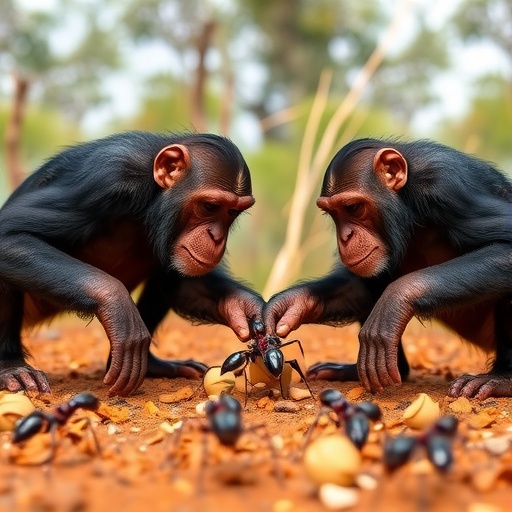
In the expansive mosaic of African savannas, chimpanzees exhibit a remarkable adaptability that sets them apart from most other great apes. Unlike their forest-dwelling counterparts, these savanna chimpanzees face an environment marked by intense heat, seasonal droughts, and scarce food availability. Recent groundbreaking research spearheaded by the University of Barcelona in collaboration with the Jane Goodall Institute Spain reveals intricate, previously undocumented strategies these primates employ to exploit one of their most challenging but nutritious food sources: aggressive army ants, known locally as marabunta. This pioneering study, published in the journal Scientific Reports, sheds critical light on how these savanna inhabitants harness tool use and selective foraging to capture and consume army ants, thereby unlocking new insights into primate behavioral ecology and evolutionary biology.
The prevailing knowledge of chimpanzee foraging largely stems from extensive studies in dense tropical forests, where army ants are more accessible and environments relatively stable. However, the savanna presents a starkly different set of ecological pressures, notably the scarcity of water, shelter, and food, as well as the harsher thermal landscape. The research team embarked on a rigorous observational study spanning four years, from 2018 to 2022, in Dindefelo, Senegal—a savanna habitat where these chimpanzees uniquely thrive. Through detailed behavioral monitoring and analysis of 156 recorded ant-eating episodes, the scientists uncovered that, contrary to expectations, savanna chimpanzees’ ant-capturing techniques do not diverge significantly from those documented in forest regions. This revelation challenges preconceived notions about habitat-specific adaptations in tool-assisted foraging.
Integral to the hunting strategy is the sophisticated use of stick tools, carefully crafted from the branches and lianas of at least eight different plant species prevalent in the savanna biome. The chimpanzees meticulously strip bark and fray the ends of these tools, enhancing their efficacy in extracting army ants from subterranean nests. Notably, the primates manipulate the tools by holding them in their mouths and trimming the tips with their teeth, actions suggesting a high level of manual dexterity and an intimate knowledge of tool maintenance. The researchers identified that one of the selected plants contains chemical compounds with sedative properties, prompting intriguing hypotheses that chimpanzees may deliberately select this species to mitigate the pain inflicted by the ants’ venomous bites, illustrating a refined use of botanical resources for medicinal purposes.
The army ants themselves represent a formidable prey. Known for their aggressive swarming behavior and painful bites, they form some of the largest insect colonies on the planet and are rich in proteins and minerals essential to chimpanzee diets. Despite the hazards, army ants remain a critical nutritional resource, especially in the food-scarce periods characterizing the savanna’s dry season. The study’s observations reveal that the chimpanzees exhibit a remarkable capacity for behavioral plasticity, adapting their foraging depending on the specific army ant species’ aggression encountered, an intricate dance of predator and prey influenced by ecological variables.
This dynamic reflects a broader evolutionary narrative. The chimpanzees’ ability to use tools and strategize their foraging in harsh savanna environments draws compelling parallels to the evolutionary trajectory of early hominins. The first human ancestors are believed to have evolved in similar savanna habitats, where fluctuating resource availability demanded sophisticated problem-solving skills and adaptive foraging behaviors. Adriana Hernández-Aguilar, co-leader of the study, emphasizes the profound implications of understanding these chimpanzee behaviors as windows into human evolutionary history, illuminating how early tool use and dietary strategies could have shaped the emergence of our lineage.
Beyond evolutionary significance, the findings carry urgent conservation messages. West African chimpanzee populations are critically endangered, with habitat loss, poaching, and climate change intensifying threats to their survival. The detailed understanding of their dietary habits and survival tactics under savanna conditions underscores the necessity of preserving these ecosystems and the chimpanzees’ natural habitats. The research community advocates that conservation strategies must integrate behavioral knowledge to ensure effective protection tailored to the chimpanzees’ ecological realities.
Furthermore, the methodology of this study exemplifies cutting-edge interdisciplinary collaboration, blending psychology, anthropology, archaeology, and biology. Researchers from the University of Barcelona, Jane Goodall Institute Spain, Max Planck Institute for Evolutionary Anthropology, and the University of Copenhagen pooled expertise and technical resources, including long-term behavioral fieldwork and advanced analytical techniques. This multifaceted approach allowed them to parse nuanced behavioral patterns and tool-use complexities that might otherwise remain obscure, demonstrating the power of collaborative science in uncovering nature’s secrets.
Notably, the research complements a recent project revealing that these chimpanzees repeatedly revisit specific army ant nests across multiple years, indicating spatial memory and potential cultural transmission of foraging knowledge within groups. This facet highlights that army ant consumption is not a mere instinctual behavior but a learned practice requiring prolonged observation, experimentation, and social learning. Such cognitive complexity parallels elements traditionally considered uniquely human, further bridging the understanding between primate and human behaviors.
The study also raises provocative questions about the role of botanical chemistry in primate survival strategies. The deliberate selection of plant materials with calming compounds suggests early forms of zoopharmacognosy, where animals use plants not only for food but also for self-medication. This insight invites deeper investigations into the interplay between primates and their botanical environment, potentially revealing evolutionary origins of medicinal plant use.
Moreover, the observed consistency in ant-consuming methods across different habitats reveals a surprising lack of habitat-specific divergence in tool-assisted foraging strategies, suggesting a strong evolutionary conservation of these behaviors. This uniformity could be attributed to the similar ecological function of army ants as a food source across landscapes, reinforcing that fundamental survival tactics can transcend environmental variability when sculpted by shared evolutionary pressures.
The implications of this research reverberate beyond academic circles, touching public awareness regarding the cognitive and cultural richness of chimpanzees. Recognizing that these apes exhibit complex tool use, plant selection, and adaptive foraging strategies challenges stereotypes and fosters empathy, essential components in galvanizing support for primate conservation. It also underscores the importance of maintaining biodiversity and natural habitats, not only to protect these species but to preserve the bridges they provide to understanding our own evolutionary past.
In sum, this investigation into savanna chimpanzees’ army ant consumption strategies represents a significant stride in primatology, evolutionary biology, and conservation science. By illuminating how these great apes negotiate the hazards and opportunities of a demanding environment through learned, sophisticated behaviors, the study enhances our grasp of primate adaptability and cognition. It showcases nature’s intricate balance between predator and prey, the innovative use of environmental resources, and the enduring link between great apes and the human story. As environmental challenges intensify, such knowledge becomes crucial not only for scientific progress but for safeguarding the shared heritage of life on Earth.
Cite Scienmag News
Gavin Prescott. (June 9, 2026). Scientists Uncover How Savanna Chimpanzees Hunt and Feed on Army Ants. Scienmag. https://scienmag.com/scientists-uncover-how-savanna-chimpanzees-hunt-and-feed-on-army-ants/
Gavin Prescott. "Scientists Uncover How Savanna Chimpanzees Hunt and Feed on Army Ants." Scienmag, 9 June 2026, https://scienmag.com/scientists-uncover-how-savanna-chimpanzees-hunt-and-feed-on-army-ants/. Accessed 3 September 2026.
Gavin Prescott. "Scientists Uncover How Savanna Chimpanzees Hunt and Feed on Army Ants." Scienmag. June 9, 2026. https://scienmag.com/scientists-uncover-how-savanna-chimpanzees-hunt-and-feed-on-army-ants/


