


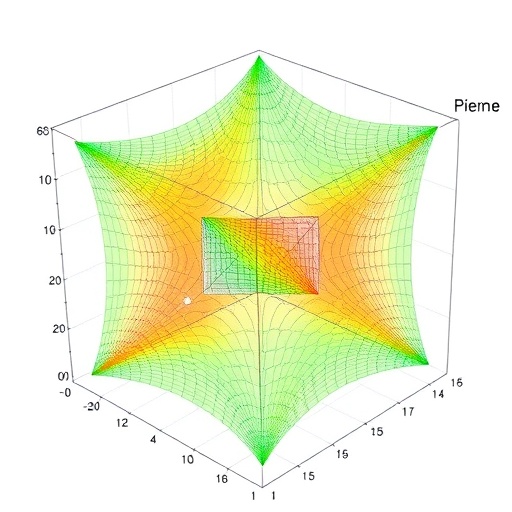
In a groundbreaking advancement at the intersection of computational mathematics and medical imaging, researchers Jena, Chaudhari, and Gee have unveiled a novel approach termed Adaptive Riemannian Optimization for Multi-Scale Diffeomorphic Matching. Published in Nature Communications, this work introduces a sophisticated framework that revolutionizes how complex shapes and images, particularly those derived from anatomical data, are aligned and analyzed. The implications of this methodology extend across diverse fields, ranging from brain imaging to advanced computer vision applications, where understanding precise anatomical correspondences is paramount.
The core challenge addressed by the new research centers on diffeomorphic matching—a process by which one spatial map is smoothly deformed into another while preserving topological integrity. Traditional algorithms often struggle with reconciling the multi-scale nature of anatomical features, where structures vary drastically in size, shape, and detail. By harnessing adaptive techniques embedded in Riemannian optimization schemes, the authors have circumvented these limitations, enabling more accurate, stable, and computationally efficient registrations.
At the heart of the study lies a mathematical framework that elegantly integrates Riemannian geometry principles with adaptive optimization algorithms. Riemannian manifolds provide a natural setting for modeling complex deformations by encoding the geometry of the problem in a curved space rather than Euclidean flatness. This geometric perspective allows the algorithm to navigate the high-dimensional, nonlinear space of diffeomorphisms effectively, adapting dynamically to feature scales present in the datasets being matched.
Traditional diffeomorphic registration techniques often rely on fixed metrics that inadequately capture the intrinsic variability at different spatial resolutions. The innovation here is the adaptive tuning of the Riemannian metric based on local scale information, which allows the optimization routine to focus computational resources on features of varying granularity without sacrificing global structural integrity. This multiscale capability is essential for handling real-world anatomical structures, such as the brain, where sulci and gyri exhibit highly complex patterns that require multi-resolution analysis.
Importantly, the algorithmic advancements in this work enable a significant reduction in computational costs compared to conventional non-adaptive methods. Sophisticated mathematical tools are employed to reduce the search space adaptively, focusing on geodesics—the shortest paths in curved space—that represent efficient deformation pathways. By doing so, the method avoids costly iterative evaluations over irrelevant or overly detailed regions, resulting in faster convergence and improved robustness to noise and initial misalignments.
The practical outcomes demonstrated by Jena, Chaudhari, and Gee showcase the method’s versatility and precision. In neuroimaging applications, for example, the adaptive approach yields superior alignment of cortical surfaces, enhancing the ability to compare fine-scale morphological differences across individuals and populations. This precision at multiple scales unlocks future possibilities for detailed studies in brain development, aging, and neurological disorders, providing clinicians and researchers with a powerful quantitative tool.
Furthermore, the method’s framework is generalizable beyond neuroimaging. It holds promise for a broad range of biomedical applications, including cardiac imaging, where the dynamic and complex shapes of the heart chambers require multi-scale registration. Similarly, it can impact non-biological realms such as computer graphics, where realistic and deformable shape matching underpins animation and shape synthesis.
A fascinating aspect of the adaptive Riemannian optimization technique is its ability to seamlessly integrate with existing diffeomorphic frameworks. Rather than replacing fundamental models, this approach enhances them, introducing scalability and adaptability previously unattainable. This compatibility ensures that the scientific community can readily adopt and extend these tools, facilitating rapid dissemination and iterative innovation.
In the context of mathematical optimization, this research pushes the envelope by marrying classical differential geometry with modern computational techniques. The adaptive nature of the Riemannian metric means that the optimization landscape itself evolves during iterations, a concept that requires advanced theoretical underpinnings and careful numerical implementation. These innovations demand a deep understanding of manifold-valued data and geodesic calculus, reflecting an impressive melding of theory and practice.
While the paper is dense with technical detail, its practical implications are tangible and exciting. The enhanced accuracy and speed in diffeomorphic matching could improve diagnostic workflows, enabling more personalized medicine through better visualization and quantification of patient-specific anatomical variation. This technology is poised to become a vital component in AI-driven healthcare solutions where image registration underpins tasks such as treatment planning, surgical navigation, and disease progression tracking.
Moreover, the adaptive optimization framework’s flexibility extends to multimodal imaging. Combining information from different imaging modalities—like MRI, CT, and PET scans—often necessitates precise registration under varying resolutions and intensity contrasts. This work offers a robust pathway for aligning such heterogeneous datasets, potentially leading to more integrative and insightful biomedical analyses.
Looking ahead, the integration of this method with machine learning pipelines promises synergistic gains. Deep learning models often require large amounts of accurately aligned training data, and adaptive multi-scale matching could provide improved registration for dataset curation, enhancing model generalizability and predictive performance. There is also scope for embedding learned priors into the adaptive metric, allowing even more intelligent and data-driven registration processes.
The challenge remains to translate these sophisticated mathematical frameworks into accessible, user-friendly software tools. Given the inherent complexity of the approach, significant effort is needed in algorithmic optimization, parallelization, and user interface design to facilitate widespread adoption by clinicians and researchers unfamiliar with differential geometry.
Nonetheless, the work of Jena, Chaudhari, and Gee represents a leap forward in the science of shape and image analysis, combining deep theoretical insights with practical innovation. The approach stands as a testament to the power of mathematical elegance combined with computational ingenuity to tackle some of the most intricate problems in modern biomedical imaging.
In light of their significant contributions, this breakthrough in adaptive Riemannian optimization marks a pivotal moment for the fields of computational shape analysis and medical image processing. The potential for enhanced precision, efficiency, and flexibility in diffeomorphic matching paradigms will undoubtedly influence research directions and technological developments for years to come.
The publication itself, appearing in Nature Communications, ensures broad visibility and impact within the scientific community. It invites further exploration, validation, and application of the techniques across diverse domains, setting the stage for a new era of adaptive and geometrically-informed computational methods.
In sum, this research offers a robust, mathematically grounded, and computationally efficient framework for the complex problem of multi-scale diffeomorphic matching. It leverages adaptive Riemannian optimization to address fundamental challenges in shape registration, opening avenues for enhanced biomedical imaging and beyond.
Cite Scienmag News
Ophelia Keating. (June 9, 2026). Adaptive Riemannian Optimization Powers Multi-Scale Diffeomorphic Matching. Scienmag. https://scienmag.com/adaptive-riemannian-optimization-powers-multi-scale-diffeomorphic-matching/
Ophelia Keating. "Adaptive Riemannian Optimization Powers Multi-Scale Diffeomorphic Matching." Scienmag, 9 June 2026, https://scienmag.com/adaptive-riemannian-optimization-powers-multi-scale-diffeomorphic-matching/. Accessed 3 September 2026.
Ophelia Keating. "Adaptive Riemannian Optimization Powers Multi-Scale Diffeomorphic Matching." Scienmag. June 9, 2026. https://scienmag.com/adaptive-riemannian-optimization-powers-multi-scale-diffeomorphic-matching/


