


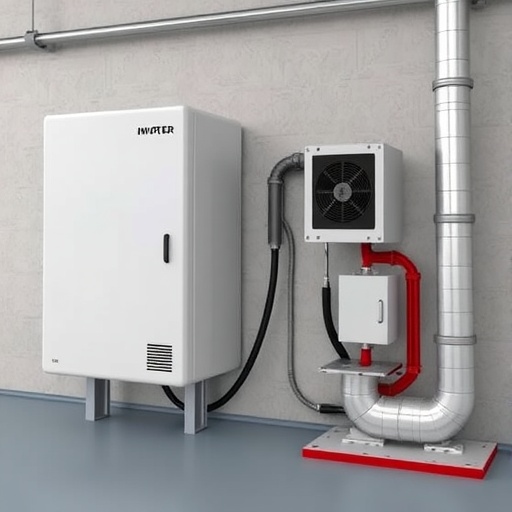
In the rapidly evolving landscape of renewable energy integration, the stability of grid-connected inverters remains a critical challenge, particularly when these systems operate within weak grid conditions. A recent groundbreaking study led by Zhu, L., Liu, Y., Wang, P., and colleagues presents an innovative synchronous stability analysis alongside a novel enhancement method aimed at fortifying the reliability of inverter-based generation units in unstable and weak electrical grids. This research, published in Scientific Reports in 2026, addresses a pivotal bottleneck in renewable energy deployment, promising to accelerate the transition to sustainable energy infrastructures globally.
Grid-connected inverters serve as essential components that convert direct current (DC) generated by renewable sources such as solar panels and wind turbines into alternating current (AC) compatible with existing electrical grids. However, the increasing penetration of these inverters exposes significant vulnerabilities, especially when the grids they connect to are weak—characterized by low short-circuit power levels, high impedance, and low voltage stiffness. Under such conditions, synchronous stability of these inverters becomes jeopardized, leading to undesirable operational anomalies including voltage instability, oscillations, and even system-wide blackouts.
The cornerstone of Zhu and colleagues’ study is their comprehensive synchronous stability analysis framework that goes beyond traditional methods, incorporating advanced mathematical modeling and dynamic system analysis. Their approach meticulously captures the interactive dynamics between multiple inverters and the weak grid environment by considering parameters such as phase angle differences, voltage fluctuations, and frequency deviations. This multi-layered approach provides an unprecedented depth of insight into the transient behaviors and nonlinear interactions that often precipitate system instabilities.
More technically, the study integrates rigorous time-domain simulations with eigenvalue analysis to characterize the stability margins of interconnected inverter systems. This bifocal methodology enables the identification of critical nodes and parameters susceptible to oscillations and instability. By mapping the stability boundaries relative to grid strength and inverter control settings, the researchers have formulated predictive models that can anticipate stability loss before it manifests in real-world operations, enhancing the proactive management of power systems.
One of the most remarkable contributions of this research is the proposed enhancement method tailored to augment synchronous stability in weak grids. This method leverages adaptive control strategies embedded within inverter firmware, dynamically adjusting operational parameters such as output current regulation, voltage control loops, and phase-locked loop (PLL) tuning based on real-time grid conditions. These intelligent adjustments enable the inverter to maintain synchronization with the grid voltage despite fluctuations and disturbances, thereby minimizing the risk of destabilizing oscillations.
Integrating these control strategies necessitates a synergistic blend of power electronics, control theory, and grid engineering. Zhu et al. have rigorously validated their method through both simulations and hardware-in-the-loop experimentation, confirming the ability of their enhanced inverters to maintain smooth and stable operation under a variety of weak grid scenarios—including sudden load changes, fault occurrences, and varying penetration levels of renewable sources. This empirical evidence not only substantiates the theoretical framework but also demonstrates practical feasibility for industrial application.
In the broader context, the significance of ensuring inverter stability in weak grids cannot be overstated. As electrical grids worldwide evolve towards more decentralized, renewable-based paradigms, many rural and remote areas inherently constitute weak grids due to lower infrastructure robustness. The implications of failing to maintain inverter synchrony encompass not only local outages but cascading failures that can propagate through interconnected networks, impairing energy security and economic stability.
Moreover, the enhancement method elucidated by Zhu and collaborators aligns seamlessly with ongoing smart grid initiatives. It supports the transition towards grids capable of real-time self-diagnosis and adaptive response, key features that underpin modern grid resilience frameworks. By enabling inverters to autonomously adapt their behavior, this innovation markedly reduces the need for manual intervention and extensive infrastructure upgrades, thereby lowering operational costs and expediting renewable integration.
Importantly, this work addresses a gap often overlooked in previous research—the dynamic interplay between multiple grid-connected inverters operating in concert rather than in isolation. Many stability analyses have focused on single-inverter scenarios, neglecting the complex interactions and feedback loops that emerge in practical, multi-inverter systems. The researchers’ holistic approach captures this complexity, offering insights into system-wide synchronization dynamics and potential mitigation strategies for collective instability phenomena.
Technologically, the study also pioneers the incorporation of advanced phase-locked loop (PLL) design enhancements. PLLs are critical for maintaining the phase and frequency synchronization of inverters relative to the grid voltage. In weak grid conditions, standard PLLs are prone to errors and oscillations. Zhu et al. introduce adaptive PLL algorithms with enhanced noise immunity and faster convergence rates, substantially improving inverter tracking performance and stability robustness amid grid disturbances.
From an engineering standpoint, implementing these findings involves upgrading inverter control firmware and coordinating settings among multiple devices to conform with the proposed adaptive strategy. This raises important considerations regarding interoperability standards, cybersecurity, and real-time data communication across geographically dispersed inverter arrays. The authors acknowledge these challenges and advocate for future work emphasizing integrated communication protocols and secure grid-interface technologies.
The environmental and economic impact of stabilized inverter operation in weak grids is profound. Reliable inverter performance facilitates higher penetration of renewable energy sources by mitigating grid constraints and reducing curtailment. This, in turn, accelerates decarbonization efforts, supports energy access in underdeveloped regions, and promotes grid modernization initiatives aligned with global climate goals.
The study’s implications further extend into policy and regulatory domains. As grid operators and policymakers seek technical standards to incorporate large-scale inverter-based resources, the insights and methodologies from Zhu et al. provide a scientifically grounded basis for defining stability criteria, certification protocols, and operational guidelines to ensure grid reliability and safety.
In summation, the innovative synchronous stability analysis and enhancement method developed by Zhu, Liu, Wang, and their team charts a pivotal path forward for the integration of renewable energy in weak grid environments. By blending in-depth theoretical modeling with practical control enhancements, their work not only solves a pressing technical challenge but also lays the groundwork for smarter, more resilient power systems essential for a sustainable energy future. As grids worldwide face the twin pressures of decarbonization and decentralization, such advancements herald a new era of stable, secure, and adaptable energy networks driven by sophisticated inverter technologies.
Zhu, L., Liu, Y., Wang, P. et al. Synchronous stability analysis and enhancement method for grid connected inverters in weak grids. Sci Rep (2026). https://doi.org/10.1038/s41598-026-56759-0
Cite Scienmag News
Denise Maddox. (June 5, 2026). Boosting Grid-Tied Inverter Stability in Weak Grids. Scienmag. https://scienmag.com/boosting-grid-tied-inverter-stability-in-weak-grids/
Denise Maddox. "Boosting Grid-Tied Inverter Stability in Weak Grids." Scienmag, 5 June 2026, https://scienmag.com/boosting-grid-tied-inverter-stability-in-weak-grids/. Accessed 4 September 2026.
Denise Maddox. "Boosting Grid-Tied Inverter Stability in Weak Grids." Scienmag. June 5, 2026. https://scienmag.com/boosting-grid-tied-inverter-stability-in-weak-grids/


