


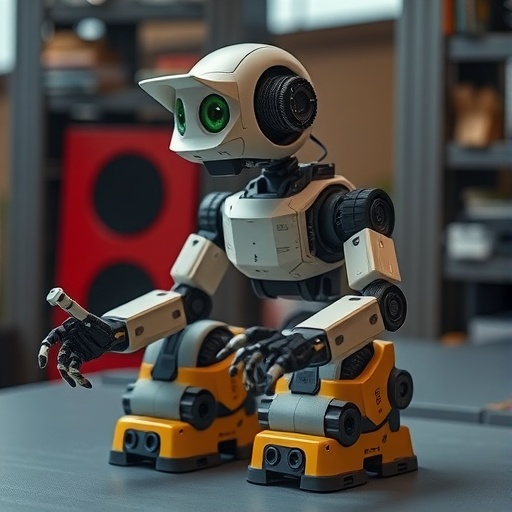
Teaching robots to achieve humanlike dexterity—particularly in manipulating objects through nuanced finger movements and shifting grips—has long stood as one of the most formidable challenges in robotics. Tasks that require constant adjustments of contact points, such as rotating objects within a robotic hand or coordinating two arms to maneuver bulky or awkwardly shaped items, present complex behavior patterns that are notoriously difficult to program explicitly. Traditional methods, relying heavily on human demonstrations through teleoperation, have struggled due to the technical demands of translating intricate, multi-fingered motions from a human operator to robotic hardware.
A transformative study led by researchers at the NYU Tandon School of Engineering and the Robotics and AI Institute proposes a paradigm shift: instead of using human demonstrations as the primary data source for training robots, could robots learn from synthetic data generated by classical motion-planning algorithms? Their groundbreaking paper, published in the prestigious IEEE Robotics and Automation Letters and recently honored with the IEEE RA-L Best Paper Award, dives deep into this question, illuminating the surprisingly critical role that the quality of synthetic training datasets plays in robot learning.
In conventional robot-learning workflows, imitation learning reigns supreme. Robots observe demonstrations where humans teleoperate robotic arms or hands remotely, then attempt to replicate these behaviors precisely. However, teleoperation systems falter when faced with contact-rich, dexterous manipulation tasks involving simultaneous multisite contacts and fine finger motions; the complexity overwhelms typical interfaces and control channels. To bypass this bottleneck, the NYU research team innovatively leveraged motion-planning algorithms to autonomously generate demonstration trajectories within physics-based simulation environments. This approach enabled them to “teach” robots using virtual experience, circumventing the need for extensive human input.
Yet, this novel approach revealed a critical insight about the data produced by widely-used sampling-based planners such as rapidly exploring random trees (RRTs). While RRTs excel at quickly finding feasible paths in high-dimensional spaces, their inherent randomness results in demonstrations exhibiting high variability. Each solution path designed to accomplish the same physical task often differed significantly from others in terms of motion patterns and strategies. This inconsistency—what the researchers term “high-entropy” data—hinders imitation learning frameworks because the robot struggles to discern what core behaviors to replicate amid wildly varying examples.
Lead author Huaijiang Zhu explains, “Although these planners can generate countless valid paths, their solutions’ intrinsic diversity makes it difficult for learning algorithms to converge on a robust policy. The robot sees many different ways to perform a task but cannot confidently infer which aspects are essential versus incidental.” This challenge marks a critical crossroads for the field: simply generating more demonstrations is insufficient; the demonstrations must exhibit structural consistency to be pedagogically effective.
To resolve this obstacle, the research team devised innovative alternative planning strategies aimed at producing lower-entropy, more consistent synthetic training data. One method prioritized steady progress toward the specified manipulation goals rather than exhaustive random exploration, thus narrowing the solution space. Another approach involved reusing a pre-curated library of canonical motion primitives — a set of predefined motion sequences — to guide planners toward more repeatable behaviors. These refinements reduced the variability in demonstrations, focusing the robot’s learning on core manipulation strategies that lead reliably to task success.
The research team rigorously evaluated their approach on two notoriously challenging manipulation tasks involving contact-rich dynamics. The first scenario required a pair of robot arms to rotate a large cylinder by 180 degrees, a task necessitating frequent grip changes and complex coordination between the arms. The second scenario centered on a dexterous robotic hand tasked with performing intricate in-hand rotations of a cube to match target orientations. In these experiments, the robots trained with consistent, low-entropy datasets vastly outperformed their counterparts trained on standard RRT-generated demonstrations. Remarkably, in the challenging dual-arm rotation task, near-perfect success rates were attained with as few as 100 demonstrations—a testament to the data quality’s impact.
Perhaps most impressively, the learned policies transferred remarkably well from simulation to real-world robotic hardware without any additional retraining—a milestone known in robotics as sim-to-real transfer. The dual-arm robot completed 90 percent of physical trials successfully, while the dexterous hand attained a respectable 62 percent success rate in real-world tasks. This seamless transfer underscores the robustness of the data-driven policies and the effectiveness of their synthetic training approach.
This research signals an important evolution in robotic dexterity development, illustrating how classical motion planning and modern machine learning are not adversaries but rather complementary tools. Instead of positioning planning as an alternative to learning, this work harnesses planning algorithms as “teachers” of neural network policies, marrying the strengths of algorithmic search with statistical pattern recognition. It’s an elegant and powerful synthesis that could accelerate progress in teaching robots complex physical skills.
The findings reverberate beyond robotics, echoing a broader lesson emerging across artificial intelligence: the sheer volume of training data is not the only determinant of success. Instead, the structure, consistency, and clarity of training examples critically shape how effectively machines learn. An abundance of noisy, inconsistent, or high-entropy data can sow confusion, whereas carefully curated, consistent demonstrations can dramatically enhance learning efficiency.
Of course, challenges remain. Tasks involving deformable objects, interaction with soft robotic fingers, or other complex materials are harder to simulate with high fidelity—limiting the immediate applicability of this synthetic teaching approach. Nonetheless, this research paves a promising path forward. It suggests a future where virtual environments are engineered not merely to produce task solutions but to generate solutions that robots can understand and learn from with precision.
By enabling robots to learn sophisticated manipulation policies from thoughtfully structured synthetic experiences, this work brings us closer to machines capable of truly dexterous, humanlike object handling. Such capabilities could revolutionize fields ranging from manufacturing and logistics to healthcare and home assistance. As robotics continues to blend the rigor of classical algorithms with the adaptability of machine learning, breakthroughs like these hint at a new era of robotic intelligence born not only from data but from data designed for deeper comprehension.
News Publication Date: 28-Apr-2026
Web References:
Keywords
Robotics, Robot Learning, Motion Planning, Imitation Learning, Synthetic Data, Rapidly Exploring Random Trees (RRT), Dexterous Manipulation, Sim-to-Real Transfer, Neural Networks, Contact-Rich Tasks, Sampling-Based Planners, Algorithmic Teaching
Cite Scienmag News
Denise Maddox. (June 4, 2026). New Study Reveals Consistency Over Complexity as the Key to Teaching Robots Dexterity. Scienmag. https://scienmag.com/new-study-reveals-consistency-over-complexity-as-the-key-to-teaching-robots-dexterity/
Denise Maddox. "New Study Reveals Consistency Over Complexity as the Key to Teaching Robots Dexterity." Scienmag, 4 June 2026, https://scienmag.com/new-study-reveals-consistency-over-complexity-as-the-key-to-teaching-robots-dexterity/. Accessed 3 September 2026.
Denise Maddox. "New Study Reveals Consistency Over Complexity as the Key to Teaching Robots Dexterity." Scienmag. June 4, 2026. https://scienmag.com/new-study-reveals-consistency-over-complexity-as-the-key-to-teaching-robots-dexterity/


