


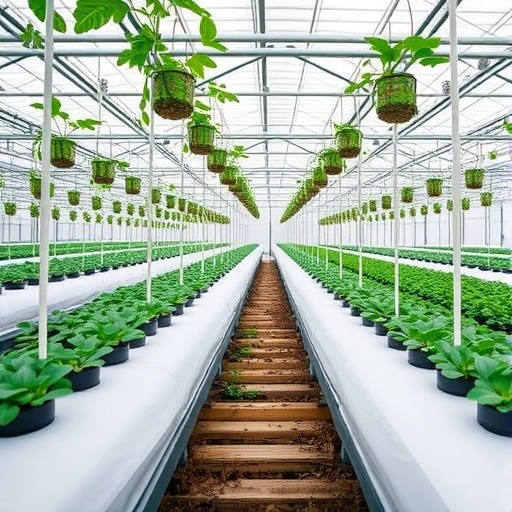
In a world grappling with escalating demands for food amid shrinking arable land, the innovative integration of diverse greenhouse farming systems emerges as a beacon of hope, particularly in China. A pioneering study led by Dong, J., Tong, X., Xu, J., and colleagues, recently published in Communications Earth & Environment, delves deep into how varied greenhouse agriculture not only boosts land-use efficiency but also reinforces food security in one of the world’s most populous nations. This research signals a paradigm shift in agricultural science and sustainable food production, possibly setting a blueprint for global adaptation.
China’s agricultural landscape has long been challenged by rapid urbanization, environmental degradation, and climate unpredictability. With arable land per capita dwindling, the urgency to optimize space for food production has never been higher. Within this context, greenhouse farming — the practice of growing crops in controlled, enclosed environments — offers a promising solution. However, the true breakthrough lies in the diversity of these systems and their tailored applications depending on crop types, climatic conditions, and local topography.
The comprehensive analysis conducted by Dong and colleagues highlights how diverse greenhouse farming modalities create a mosaic of micro-environments that collectively maximize output per unit area. Instead of relying on a monolithic greenhouse model, the study emphasizes diversified structures and cultivation techniques, including multi-span greenhouses, vertical planting systems, and hydroponics tailored to specific crops such as vegetables, fruits, and flowers. This heterogeneity addresses site-specific challenges and leverages local resources efficiently.
One of the paper’s remarkable findings is that such system diversity contributes to an impressive land-use efficiency far beyond traditional open-field farming standards. The enclosed, climate-controllable system inherently offers extended growing seasons and protection against adverse weather, but the diversity of greenhouse designs further enhances crop yield stability and resource optimization. This variability allows for staggered production cycles and multi-cropping strategies, thereby ensuring a more continuous and reliable food supply chain.
Moreover, implementing such diversified systems facilitates the incorporation of advanced agricultural technologies including precision irrigation, climate monitoring sensors, and automated nutrient delivery systems. These can be customized to each greenhouse type and crop’s specific needs, resulting in significant reductions in water and agrochemical use without compromising productivity. The study illustrates how these technological integrations contribute to sustainable intensification, marrying high yields with ecological responsibility.
The ecological ramifications of diverse greenhouse farming are particularly intriguing. By mitigating soil erosion, reducing pesticide runoff, and curbing greenhouse gas emissions linked to open-field cultivation, these systems represent a forward-thinking response to environmental pressures. The researchers suggest that designing greenhouse farms to suit microclimates not only preserves biodiversity but also enhances resilience against climate shocks such as droughts and floods.
Food security, a central theme of this research, transcends mere production metrics. The diversity in greenhouse farming systems enhances nutritional diversity by enabling year-round availability of various vegetables and fruits, addressing micronutrient deficiencies common in many populations. Furthermore, the localized production significantly decreases food transport emissions and the risks of supply chain disruptions, critical factors in volatile global markets.
China’s policy framework has been instrumental in fostering the growth of greenhouse agriculture. The study discusses how government incentives, infrastructure development, and farmer training programs have underpinned this momentum. These policy measures encourage innovation and adoption at scale, transforming smaller, disparate greenhouses into integrated networks capable of supporting regional food supplies effectively.
Another pivotal aspect explored is the socioeconomic impact. Diverse greenhouse farming systems empower farmers by increasing their income stability and providing opportunities for entrepreneurship through crop specialization and niche market targeting. The creation of high-value crops within these greenhouses enhances rural livelihoods and contributes to poverty alleviation in agricultural communities.
Interestingly, the study employs advanced spatial analysis and modeling to quantify the aggregated benefits of these varied farming systems at provincial and national levels. Using high-resolution satellite data coupled with ground-truth measurements, the researchers map out the relationship between greenhouse distribution patterns and productivity outcomes, providing compelling evidence of the scalability and replicability of this approach.
The integration of renewable energy systems, such as solar panels and geothermal heating, within these greenhouses is another emerging trend the study highlights. These energy systems reduce the carbon footprint and operational costs, making greenhouse farming both economically viable and environmentally sustainable. This synergy between energy and food production systems presents an innovative avenue towards achieving climate-smart agriculture.
Challenges remain, however. The research acknowledges constraints such as initial capital investment, technological complexity, and the need for skilled labor to manage sophisticated greenhouse systems. Ensuring equitable access to these technologies across diverse socioeconomic groups is emphasized as a priority to avoid exacerbating rural inequalities.
Looking forward, the authors call for expanded interdisciplinary research encompassing agronomy, ecology, economics, and social sciences to optimize greenhouse farming further. They advocate for dynamic policy frameworks that adapt to evolving challenges such as climate change, market fluctuations, and technological innovations, ensuring the resilience and inclusivity of the food system.
In conclusion, this exhaustive study by Dong, J., Tong, X., Xu, J. and team paints a compelling narrative on the transformative potential of diverse greenhouse farming systems in China. Their work underscores a vital principle: diversity within agricultural technology and practice is not just beneficial but essential for sustainable intensification, environmental stewardship, and food security in the 21st century. As global pressures mount, the lessons drawn from China’s experience could light the path toward a more secure, efficient, and resilient agricultural future worldwide.
Cite Scienmag News
Alan Morgan. (June 4, 2026). Diverse Greenhouse Farming Boosts China’s Food Security. Scienmag. https://scienmag.com/diverse-greenhouse-farming-boosts-chinas-food-security/
Alan Morgan. "Diverse Greenhouse Farming Boosts China’s Food Security." Scienmag, 4 June 2026, https://scienmag.com/diverse-greenhouse-farming-boosts-chinas-food-security/. Accessed 4 September 2026.
Alan Morgan. "Diverse Greenhouse Farming Boosts China’s Food Security." Scienmag. June 4, 2026. https://scienmag.com/diverse-greenhouse-farming-boosts-chinas-food-security/


