


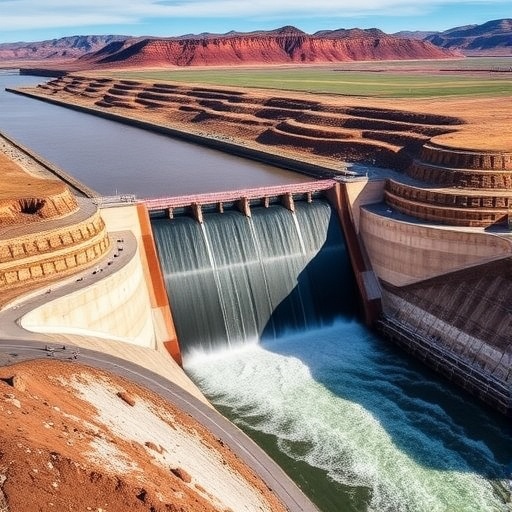
In a significant advancement for renewable energy infrastructure, researchers have unveiled an innovative integrated numerical-physical modeling approach aimed at optimizing riverbed dredging for Mixed Pumped-Storage Power Stations (MPSPS). This breakthrough, anchored in a detailed case study of the Lianghekou project, illustrates how combining computational fluid dynamics with scaled physical models can revolutionize sediment management and operational efficiency of hydroelectric facilities. As the global energy sector intensifies its search for sustainable solutions, this pioneering methodology offers a scalable framework adaptable to diverse hydrological environments, potentially transforming how riverbed modifications are planned and executed.
The complexity of sediment dynamics in hydropower station environments has long challenged engineers and environmental scientists. Sediment accumulation can significantly degrade operational capacity, posing persistent risks to turbine integrity and flood control effectiveness. Traditional dredging strategies, often reliant on empirical data and isolated physical experiments, exhibit limitations in predictive accuracy and cost efficiency. Addressing these gaps, the Lianghekou project research team developed a hybrid modeling system that synergizes numerical simulations with physical model tests, enabling comprehensive analysis of sediment transport, riverbed morphology, and hydraulic impacts within the MPSPS operational context.
Central to this integrated approach is the sophisticated use of computational fluid dynamics (CFD) to simulate multiphase flow conditions and sediment movement under varying operational regimes. CFD models, calibrated through extensive field measurements, offered granular insights into turbulent flow patterns, sediment entrainment thresholds, and deposition zones. By coupling these simulations with physical scale models replicating riverbed topography and flow conditions, the researchers achieved a rigorous validation mechanism. This iterative process not only enhanced model fidelity but also provided actionable intelligence on the optimal locations, depths, and timing for dredging interventions.
The Lianghekou project, located in a complex riverine environment with high sediment loads, served as an exemplary proving ground for this methodology. The site’s unique geological and hydrological characteristics, including variable seasonal flow and sediment grain size distributions, necessitated a highly tailored modeling approach. Through iterative model adjustments and scenario analyses, the research team identified critical sedimentation hotspots and predicted how dredging these zones would influence both hydraulic performance and long-term morphological stability. The ability to forecast these changes with precision marks a notable stride forward in infrastructure resilience planning.
Furthermore, the research revealed that optimized dredging schedules, informed by the integrated modeling framework, dramatically reduce operational downtime and maintenance costs. By pinpointing sediment accumulation episodes before they reach critical thresholds, facility operators can implement targeted dredging campaigns, mitigating risks of turbine damage and unexpected shutdowns. This predictive capability aligns with industry trends favoring data-driven decision making and demonstrates the potential of modeling techniques to enhance asset management strategies in hydropower systems.
A key innovation of this study lies in the comprehensive treatment of sediment characteristics within the model architecture. Unlike conventional approaches that often simplify sediment properties, the integrated scheme accounts for heterogeneous particle size distributions, cohesiveness, and transport mechanics. This nuanced representation enabled simulations to capture complex processes such as sediment layering, resuspension, and burial under dynamic flow conditions. These insights facilitated more accurate forecasts of riverbed evolution, crucial for planning sustainable dredging regimes that minimize environmental disturbance.
The implementation of this integrated modeling approach also underscores the importance of interdisciplinary collaboration. Hydrologists, mechanical engineers, environmental scientists, and computational modeling experts worked in concert to address the multifaceted challenges presented by the Lianghekou site. This collaborative framework fostered innovation through the cross-pollination of ideas and methodologies, highlighting the necessity of holistic perspectives when tackling complex infrastructure problems.
Environmental considerations were paramount throughout the research process. The modeling framework enabled evaluation of dredging impacts on aquatic ecosystems, sediment quality, and water quality parameters. This environmental sensitivity assessment ensured that dredging operations comply with regulatory standards while safeguarding ecosystem health. By integrating ecological risk evaluation directly into the optimization process, the study exemplifies a sustainable approach to resource utilization that balances operational efficiency with conservation imperatives.
Another notable dimension explored in the study is the scalability of the integrated modeling approach. Although developed in the context of the Lianghekou project, the methodology’s modular design permits adaptation to other mixed pumped-storage power stations facing varied sedimentation challenges. This transferability extends to projects in diverse climatic and geological settings, amplifying the potential global impact of the research. The availability of high-performance computing resources further facilitates application across different spatial and temporal scales, supporting continuous monitoring and adaptive management.
The researchers also emphasized the role of advanced data acquisition techniques in enhancing model input quality. High-resolution bathymetric surveys, sediment sampling, and flow measurement technologies provided the critical datasets necessary for accurate model parameterization. The integration of real-time monitoring equipment into the operational framework creates opportunities for dynamic model updating, enabling responsive dredging strategies that adapt to evolving riverbed and flow conditions.
From a technical perspective, the study details sophisticated coupling algorithms that harmonize physical and numerical components, overcoming challenges related to scale disparity and complexity of sediment-fluid interactions. These computational innovations reduce simulation time while preserving accuracy, a balance vital for practical engineering applications. The validation procedures employed, including laboratory testing and field verification, reinforce the reliability and robustness of the integrated model, paving the way for its adoption in commercial and regulatory domains.
The implications of this research reach beyond immediate operational improvements. By enhancing the predictability and controllability of sediment management, the integrated modeling framework contributes to the long-term sustainability of hydropower infrastructure. Maintaining optimal riverbed conditions not only maximizes power generation efficiency but also reduces environmental footprint and extends asset longevity. This comprehensive approach supports climate action goals by facilitating the reliable generation of clean energy and reducing the need for costly retrofitting or replacement works.
Looking forward, the study sets a foundation for incorporating artificial intelligence and machine learning techniques into the integrated modeling domain. Predictive analytics and automated optimization algorithms could further elevate dredging strategy formulation, enabling real-time, closed-loop management systems. This fusion of advanced computational methods aligns with broader trends in digital transformation of energy infrastructure and positions the field at the cutting edge of smart environmental engineering.
In summary, the Lianghekou project represents a milestone in the application of integrated numerical-physical modeling to the optimization of riverbed dredging in Mixed Pumped-Storage Power Stations. The methodology’s demonstrated potential for improving operational efficiency, minimizing environmental impact, and fostering sustainable energy production marks a vital contribution to the hydropower sector. As energy systems worldwide pivot towards decarbonization, tools that enhance infrastructure resilience and performance are indispensable. This research stands as a testament to the power of interdisciplinary innovation in overcoming complex engineering challenges.
The publication of these findings in Scientific Reports invites industry stakeholders, policymakers, and the broader scientific community to engage with and extend this work. Collaborative efforts aimed at refining models, expanding datasets, and piloting implementations across diverse sites will be critical for unlocking the full benefits of this approach. The integration of physical experimentation with numerical simulations heralds a new era in environmental modeling, where precision and pragmatism converge to advance sustainability goals.
By bridging theoretical insights and practical engineering needs, the Lianghekou case study illuminates a path forward for hydropower sediment management that is both scientifically rigorous and operationally viable. Its success story underscores the broader potential of integrated modeling frameworks across environmental and civil engineering disciplines, setting a precedent for innovation in resource management amidst increasing ecological constraints. The fusion of technology and ecological stewardship embodied in this research exemplifies the transformative impact of modern science on global energy challenges.
Bai, R., Li, J., Song, Y. et al. Integrated numerical–physical modeling for optimizing riverbed dredging in Mixed Pumped-Storage Power Stations: a case study of Lianghekou project.
Sci Rep (2026). https://doi.org/10.1038/s41598-026-56537-y
Cite Scienmag News
Audrey Campbell. (June 3, 2026). Optimizing Riverbed Dredging in Pumped-Storage Power. Scienmag. https://scienmag.com/optimizing-riverbed-dredging-in-pumped-storage-power/
Audrey Campbell. "Optimizing Riverbed Dredging in Pumped-Storage Power." Scienmag, 3 June 2026, https://scienmag.com/optimizing-riverbed-dredging-in-pumped-storage-power/. Accessed 4 September 2026.
Audrey Campbell. "Optimizing Riverbed Dredging in Pumped-Storage Power." Scienmag. June 3, 2026. https://scienmag.com/optimizing-riverbed-dredging-in-pumped-storage-power/


