


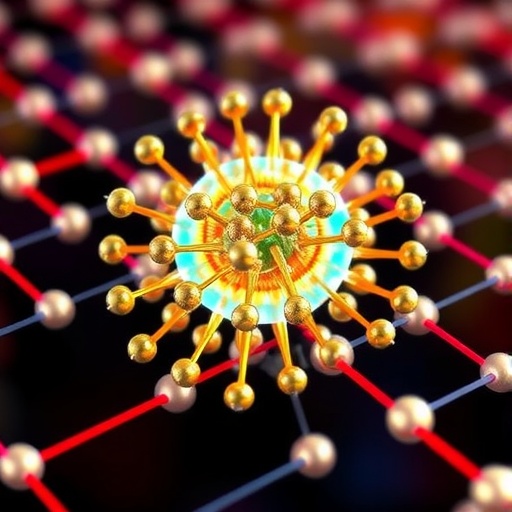
Quantum computing has long tantalized scientists and engineers alike with its promise of revolutionizing the landscape of computational power. Once relegated to the realm of theoretical physics and complex quantum mechanics, it is now emerging as a tangible technology poised to accelerate calculations and reduce energy consumption well beyond the capabilities of classical computers. Recent breakthroughs from Virginia Commonwealth University’s College of Engineering hint at a practical way forward, addressing critical hurdles in scaling quantum hardware. This advancement holds promise not just for faster computing but for fundamentally transforming industries reliant on complex data processes.
At the heart of this innovation lie nanoscale magnets—astonishingly tiny magnetic structures nearly half the size of the wavelength of visible light. These miniature magnets enable unprecedented control over the quantum bits, or qubits, required for quantum computation. By integrating these nanomagnets with diamond-based qubits, the researchers have pioneered a technique that compresses the physical footprint of quantum computing components, potentially enabling the fabrication of much denser quantum chips. Such scaling is vital for realizing the full potential of quantum devices, which require thousands to millions of interacting qubits.
The foundational technology for today’s classical computing relies on transistors, components that function as binary switches to represent data as ones and zeros. In quantum computing, however, the binary system is replaced by qubits, which harness the principles of quantum mechanics. Unlike classical bits, qubits can exist in superpositions, exponentially expanding the types of calculations computers can undertake. Within Atulasimha’s laboratory, each qubit begins with a diamond—a robust lattice of carbon atoms that houses unique quantum properties when manipulated at the nanoscale.
Specifically, these lab-grown diamonds are engineered with deliberate atomic vacancies: two adjacent carbon atoms are replaced such that one site is occupied by a nitrogen atom while the neighboring site remains vacant. This nitrogen vacancy complex generates free electrons whose quantum spin—akin to tiny magnetic dipoles—can be coherently controlled. The spin states of these electrons, which can be oriented up or down, serve as the primary carriers of quantum information. By deftly manipulating the spins, quantum computers can encode vast amounts of data and perform complex operations unattainable by conventional silicon-based systems.
Traditional approaches to controlling electron spins within diamond qubits have relied heavily on electromagnetic signals transmitted through wire antennas. While effective at small scales, these wide-area electromagnetic fields lack the precision necessary for densely packed qubit arrays. The resultant crosstalk makes it nearly impossible to individually address multiple qubits in close proximity, thereby limiting scalability. As the quantum computing community pushes towards integrated multi-qubit chips, overcoming this obstacle becomes paramount.
Enter the nanoscale magnets developed by the VCU team. These magnets, stunningly measuring merely 200 nanometers across—roughly 500 times thinner than an ordinary sheet of paper—offer a localized magnetic field source that can selectively interact with individual qubits. By coupling a nanomagnet with the qubit’s diamond substrate, the researchers demonstrated control over the spin states via acoustic wave stimulation of the magnet. This novel magneto-acoustic technique facilitates the coherent manipulation of electron spins with a spatial precision unachievable through classical antenna methods.
One of the remarkable advantages of this approach is its potential for scalability and energy efficiency. The localized magnetic fields generated by nanomagnets reduce the power requirements compared to widespread electromagnetic stimulation, thus lowering the overall energy footprint of quantum operations. Additionally, the elongated coherence times of these spin-based qubits, coupled with their operability at relatively higher temperatures, position them favorably for practical quantum computing implementations that are not restricted to ultra-cold environments.
Beyond sheer computational prowess, these nanomagnets harbor potential applications in fields such as medical science and chemical research. By exploiting the exquisite sensitivity of spin qubits, researchers could develop ultra-precise sensors capable of detecting minute magnetic fluctuations at the molecular level. Such sensors might revolutionize drug delivery systems, enable real-time monitoring of biochemical interactions, and deepen our understanding of fundamental molecular mechanisms, effectively ushering in a new era of quantum-enhanced sensing technology.
Despite these advances, colossal challenges remain before fully functional quantum computers become ubiquitous. Current laboratory demonstrations typically involve only single or a few qubits, while practical quantum computing will necessitate thousands or millions of interacting qubits operating reliably in concert. Integrating vast arrays of nanomagnet-controlled qubits into coherent quantum circuits represents a formidable technical and engineering challenge, one that researchers like Atulasimha and Chowdhury are working relentlessly to solve.
This pioneering research epitomizes the high-risk, high-reward nature of quantum technology development. Each incremental breakthrough not only enriches our scientific understanding but also propels us closer to the transformative payoff quantum computing promises. Scientists at VCU and around the globe are fueled by the excitement of uncharted discovery and the potential to solve previously intractable problems in cryptography, complex systems modeling, and beyond.
The integration of nanoscale magnets to steer the spins of electrons in diamond qubits offers a compelling new avenue towards scalable, efficient quantum computers. As these techniques mature, they will likely catalyze progress across diverse scientific and industrial sectors. The work conducted by the Atulasimha lab demonstrates a nimble fusion of materials science, quantum physics, and nanotechnology, marking a pivotal step towards quantum devices capable of delivering unprecedented computational power while consuming minimal energy.
Ultimately, quantum computing’s promise lies in its ability to tackle problems classical computers simply cannot solve in practical time frames—be it modeling molecular interactions with unmatched fidelity or breaking encryption methods thought to be unassailable. The ongoing research into qubit control through nanomagnets represents not only a leap forward in hardware development but also a beacon of hope for breakthroughs across science and technology. As these quantum journeys continue, their impact may well redefine the technological horizon for generations to come.
Cite Scienmag News
Katie Riggs. (June 3, 2026). VCU Researchers Propel Quantum Computing Forward with Virus-Sized Nanomagnets. Scienmag. https://scienmag.com/vcu-researchers-propel-quantum-computing-forward-with-virus-sized-nanomagnets/
Katie Riggs. "VCU Researchers Propel Quantum Computing Forward with Virus-Sized Nanomagnets." Scienmag, 3 June 2026, https://scienmag.com/vcu-researchers-propel-quantum-computing-forward-with-virus-sized-nanomagnets/. Accessed 5 September 2026.
Katie Riggs. "VCU Researchers Propel Quantum Computing Forward with Virus-Sized Nanomagnets." Scienmag. June 3, 2026. https://scienmag.com/vcu-researchers-propel-quantum-computing-forward-with-virus-sized-nanomagnets/


